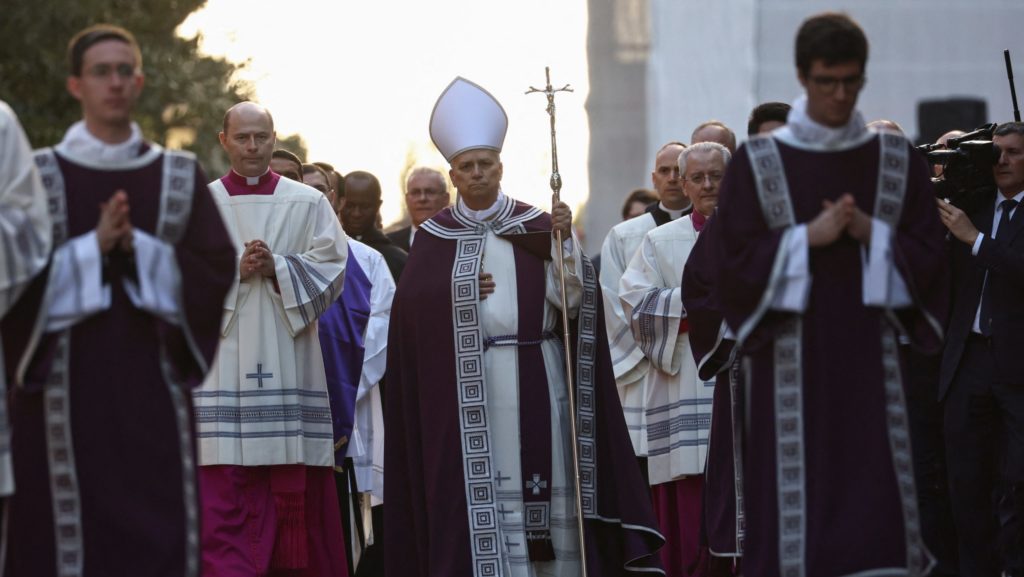
Beneath the Roman pines of the Aventine Hill, Pope Leo XIV led a solemn penitential procession Feb. 18 to Rome's oldest extant basilica, marking the first Ash Wednesday of his pontificate with a call for "countercultural" repentance for sins from individuals, institutions and the Church itself.
Priests, bishops and cardinals chanted the Litany of the Saints as the procession wound from the Benedictine Basilica of Sant'Anselmo to the ancient Dominican Basilica of Santa Sabina, where the pope offered Ash Wednesday Mass.
"How rare it is to find adults who repent -- individuals, businesses and institutions that admit they have done wrong," Pope Leo said in his homily in the Basilica of Santa Sabina.
"Indeed, during Lent, a people is formed that recognizes its sins. These sins are evils that have not come from supposed enemies, but afflicts our hearts, and exist within us. We need to respond by courageously accepting responsibility for them," he added.
Pope Leo acknowledged that "this attitude is countercultural," but it "constitutes an authentic, honest and attractive option, especially in our times, when it is so easy to feel powerless in the face of a world that is in flames."
In his homily, the pope pointed to young people as an unexpected sign of openness today.
"Even in secularized contexts, many young people, more than in the past, are open to the invitation of Ash Wednesday," Pope Leo observed. "Young people especially understand clearly that it is possible to live a just lifestyle, and that there should be accountability for wrongdoings in the Church and in the world."
He called on the faithful to "embrace the missionary significance of Lent," not as a distraction from personal conversion, but "in a way that introduces this season to the many restless people of good will who are seeking authentic ways to renew their lives, within the context of the Kingdom of God and his justice."
Pope Leo received ashes sprinkled atop his head in the Italian custom before imposing them on the cardinals and some of the faithful present.
"We perceive in the ashes imposed on us the weight of a world that is ablaze, of entire cities destroyed by war," he said.
"This is also reflected in the ashes of international law and justice among peoples, the ashes of entire ecosystems and harmony among peoples, the ashes of critical thinking and ancient local wisdom, the ashes of that sense of the sacred that dwells in every creature," Pope Leo added.
The pope recalled that 60 years ago, on the Ash Wednesday following the close of the Second Vatican Council, St. Paul VI had warned of the modern world's "fundamental pessimism" and its tendency to proclaim "'the inevitable vanity of everything, the immense sadness of life, the metaphysics of the absurd and of nothingness.'"
"Today, we can recognize that his words were prophetic," Pope Leo added.
The pope also reflected on the significance of the Lenten Station Church tradition, in which pilgrims pray at the tombs of Rome's early Christian martyrs. The Basilica of Santa Sabina, where Pope Leo offered Mass, is the first church in the Roman Station Church pilgrimage. The basilica dates back to A.D. 422.
""The ancient and contemporary martyrs shine as pioneers on our journey towards Easter," he said. "The ancient Roman tradition of the Lenten stationes -- which begins today with the first station -- is instructive: it refers both to moving, as pilgrims, and to stopping, statio, at the 'memories' of the Martyrs, on which stand the basilicas of Rome."
"Is this not perhaps an invitation to follow in the footsteps of the admirable witnesses to the faith, who can now be found throughout the world?" he added.
Ash Wednesday marks the start of the 40-day Lenten season, during which Christians are called to prayer, fasting, and works of charity. Lent concludes with the Easter Triduum.
"We recognize our sins so that we can be converted; this is itself a sign and testimony of Resurrection. Indeed, it means that we will not remain among the ashes, but will rise up and rebuild," Pope Leo said.
"Then the Easter Triduum, which we will celebrate as the summit of the Lenten journey, will unleash all its beauty and meaning. This will take place if we participate, through penance, in the passage from death to life, from powerlessness to the possibilities of God."