
In late 2025, a news headline of disturbing proportions went largely unnoticed amid the holiday news cycle.
Reclusive 48-year-old Chinese billionaire Xu Bo, the Wall Street Journal reported, had quietly fathered as many as 100 children through in vitro fertilization (IVF) and U.S. surrogate mothers in his quest to build a “mega-family” made up of children whom he hoped would reproduce with Elon Musk’s children.
The scheme was brought to light in part by a Los Angeles Superior Court judge who denied Bo’s request for parental rights to at least four unborn children being carried by surrogate mothers.
The story of Bo, together with cases like that of a convicted sex offender in Pennsylvania who obtained a baby by IVF and surrogacy, may seem like far-fetched examples of shady people taking advantage of technological advances.

After all, fertility has become a major global concern. Rising numbers of couples are struggling to conceive a child. The global “birth dearth” has led to a demographic crisis in first-world countries like the U.S., Japan, and Italy, poised to cause major economic and social upheaval. Meanwhile, voices from the political left and right insist that making IVF, egg freezing, and other reproductive technologies free (or at least generously supported by governments and private employers) is the answer. Is it?
An Aug. 21 essay by The New York Times contributor Anna Louie Sussman titled “When the Choice to be Childless is Not Your Own” seems to inadvertently reveal the dark premise underlying the demand for free IVF.
Sussman writes that the “desire for a child” is so powerful that it drives families to go into crushing debt for the chance to conceive a child via IVF. Sussman herself made repeated trips to Europe for egg freezing and IVF because it was more affordable than in the United States.
Perhaps because of this experience, she argues that access to IVF should be considered a human right, since the right to have a child belongs to all human beings, regardless of their individual circumstances. Sussman insists that the government or private employers should pay for egg freezing and IVF, because anything less is “fertility discrimination.”
The language of human rights and discrimination sends a message. Whether young or old, single or married, in a traditional (opposite-sex, monogamous) marriage, a same-sex relationship, or a polycule (three or more people), all adults are entitled to “have a child” if that is what they desire.
And not just any child, but rather the exact kind of child they desire (healthy, preferred sex), on the individual’s preferred timetable.
But make no mistake — Sussman is not arguing from a pro-life or pro-child perspective.
She rejects any equation of “embryos with living people” or concerns about discarded embryos as attempts to “limit access to abortion.” All of these, by her retelling, are part of the conspiracy of “religious conservatives” seeking to impose their prejudiced religious vision of the family.
While Sussman insists on adults’ right to have a child, she is equally emphatic about preserving the right to not have a child by preserving access to abortion.
Sussman’s article focuses entirely on the adult’s desire to have a child. But it never acknowledges the embryo as a human being with human dignity and human rights that are not contingent on someone else’s desires.

Yet Sussman is correct about one thing: that acknowledging that the embryo has human rights would disrupt not only the IVF industry, but the abortion industry as well. Her insistence on both the right to a child and the right to not have a child reveals the common denominator for these industries: the raw assertion of power over an unborn child so that adults may use their preferences to sort out which children they will allow to live, and which children must die.
Advocates of IVF like Sussman avoid the status of the embryo by using the language of property, as slaveowners once did. They admit that embryos are precious, miraculous, even magical cells. Nevertheless, an embryo is still a means to an end that can be discarded if it doesn’t further adult goals.
Thus far, states are split on how to treat embryos. Are they property, as “chattel,” the “ownership” of which must be litigated like disputes over a car or jewelry? Are they human beings, the custody of which must be litigated? Or property with special status?
No one knows exactly how many human embryos live frozen and suspended in cryo-storage. Estimates range from 1 million to 10 million in the United States alone, with some having been frozen for decades. Created in labs, they are typically screened for genetic defects and graded for “quality” (as if they were meat or eggs prepared for market). The chosen embryos are flash-frozen, numbered, and stored, their fate uncertain. Some will be implanted, others discarded, or donated to another person, or subjected to medical experiments. Even if chosen later for implantation, many embryos do not survive the thawing process.
The injustice to these tiny human beings often extends into the indefinite future. Because the harm is ongoing, it is hard to grasp the magnitude of the problem of frozen embryos.
The treatment of embryos by the reproductive technology industry is one reason why the Catholic Church has long warned couples about the moral issues arising from reproductive technology, whether in “Donum Vitae” (“The Gift of Life,”1987), “Dignitas Personae” (“The Dignity of a Person,” 2008), and “Dignitas Infinita” (“Infinite Dignity,” 2024).
A common misconception is that the Church’s prohibition of IVF means that the Church somehow rejects IVF children. Nothing could be further from the truth: the Church views every child as a gift who possesses intrinsic dignity, and the circumstance of a child’s conception does not alter the dignity of the child.
The Church’s use of the word “gift” is crucial. Human life is not a possession, a commodity, or an object that you can take or dominate. As a gift, it should be gratefully received and cherished. Embryos are not magical cells — they are human persons. Like all human persons, they should never be used as means to an end or to further someone else’s desires.
Rather, the Church bases its conclusion that IVF is unethical on what is owed to the child. Every child deserves to be conceived through the loving embrace of his or her parents, not created in a lab. Every human being must be treated with dignity and respect from conception to natural death. In the words of Pope Francis, the child is “always a gift and never the basis of a commercial contract.”
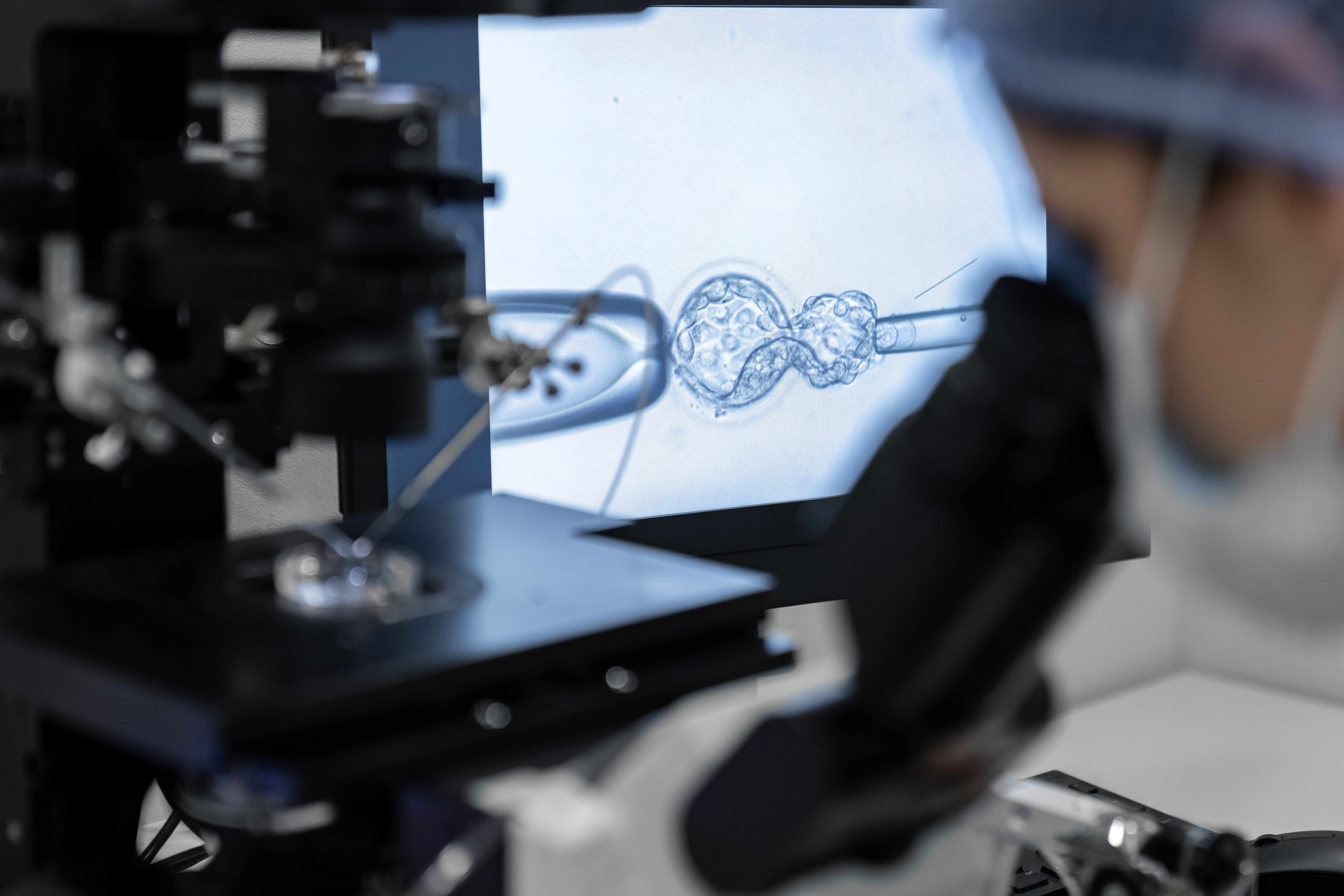
So far, the Church’s warnings have been disregarded by many Catholics who have used IVF. Other Catholics have friends and family who have used IVF and are reluctant to seem mean or judgmental. They worry that objecting to how a child is conceived will be interpreted as not loving that child.
But when it comes to IVF, silence, no matter how well-meaning, does everyone a disservice. They need to know that some interventions to address infertility are licit, while others, including IVF, are not. They need to know that the IVF industry’s assurance of their right to have a child comes at a terrible price — that lab technicians will rate and grade their children, and that at some point they will be asked to decide if their embryos should live or die.
Couples who have used IVF to have children also deserve to know the truth. They need to know that the Church welcomes and loves their children, and that the Church understands that they meant well when they sought IVF. They deserve to know why the Church objects to IVF, that the sacraments can be a tremendous source of healing, and that guidance from their diocese or pastor can help navigate the ethical issues caused by using IVF.
Finally, they deserve to be reminded that God is a merciful God who loves them and all their children, born and unborn. As Francis reminded us, “God never tires of forgiving us.”