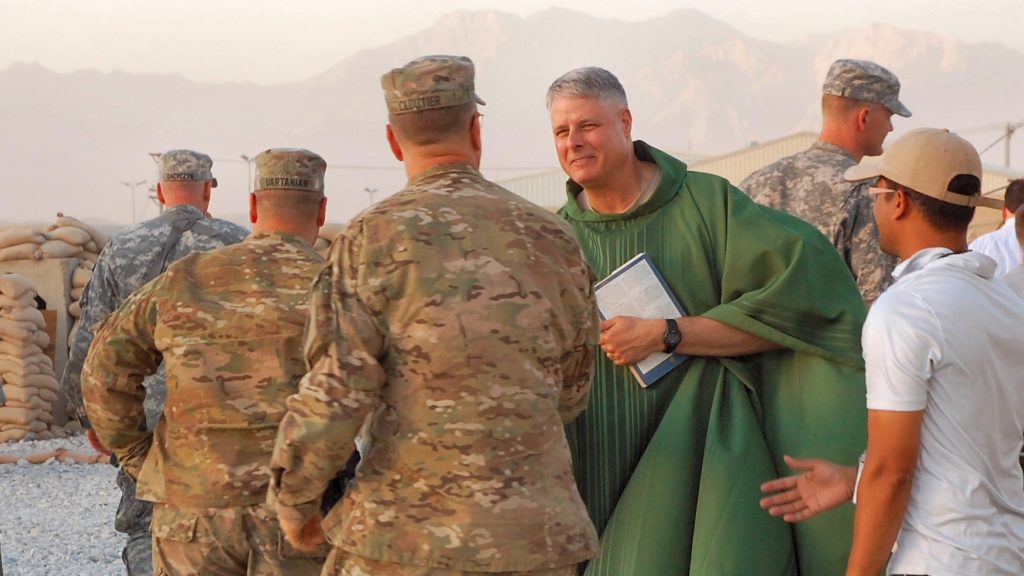
Key religious liberty challenges facing Americans serving in the armed forces include ensuring the availability of chaplains and even certain grooming requirements, witnesses at a Dec. 10 meeting of the Department of Justice's Religious Liberty Commission said.
President Donald Trump in May signed an executive order creating the commission, which includes Cardinal Timothy M. Dolan of New York and Bishop Robert E. Barron of Winona-Rochester, Minnesota, among its members.
The commissioners gathered in Dallas to examine what recommendations they should make to the president about promoting and protecting religious freedom in a report next spring. Bishop Barron was in attendance, but not Cardinal Dolan.
The commission's fourth hearing -- and its first outside the nation's capital -- examined what witnesses called religious liberty issues in the military.
Archbishop Timothy P. Broglio, head of the U.S. Archdiocese for the Military Services, recently raised alarm about religious support contracts for Army chapels. Msgr. Anthony Frontiero, vicar general and moderator of the curia for that archdiocese, told the commissioners, "It is impossible for priests to fulfill the work of the operational unit and the equally demanding roles of pastoring the installation chapel community without proper support."
"We've recently had a challenge with this. With the army, they're canceling contracts all over the place," Msgr. Frontiero said. "Now, as a result of the intervention of Archbishop Broglio, we've seen some positive movement toward rectifying the situation, and that should be noted."
Msgr. Frontiero said that generally, sometimes in the armed services, "misunderstanding arises when Catholic sacramental needs are viewed as mere preferences rather than doctrinal obligations."
"A military that preserves the sacramental life of its Catholic members is one that respects their dignity, supports their resilience and reinforces the moral fabric essential to honorable service," he said.
His recommendations for safeguarding the availability of Catholic sacraments to service members included efforts to "educate commanders and staff on the non-substitutable role of Catholic sacraments to foster informed accommodation at every level," as well as further efforts to ensure service members on remote assignments have access to a Catholic chaplain where necessary.
Sukhbir Singh Toor, a retired Captain in the U.S. Marine Corps, said new uniform guidelines issued by Secretary of Defense Pete Hegseth — who uses the moniker “secretary of war” since Trump signed an executive order on Sept. 5 adding the “Department of War” as a secondary, ceremonial title for the Department of Defense -- present himself and his fellow Sikhs serving in the armed forces facing significant religious liberty challenges.
"Sikhs maintain distinct articles of faith, including a turban, unshorn hair and a beard, essential expressions of our religious identity," Singh Toor said.
In a September speech to generals, Hegseth said he would purge from service those he called the military's "beardos."
"If you don't meet the male-level physical standards for combat positions, cannot pass a (physical training) test or don't want to shave and look professional, it's time for a new position," Hegseth said at the time.
A subsequent memo from Hegseth said the department will use "pre-2010 standards" for religious accommodations and generally will not authorize waivers permitting facial hair.
Critics of the policy said it presented Sikhs -- as well as other faith traditions that require men to keep their facial hair -- with a choice between serving their country or maintaining the tenets of their faith.
"No young American from a religious minority should have to choose between their faith and their service to their country, especially when they're willing and able to wear the uniform of the United States Marine Corps," Singh Toor said. "That promise of equal opportunity is not only constitutional, it is quintessentially American."
Singh Toor said the policy "requires recruits to meet grooming standards before requesting an accommodation, forcing religious minorities to violate their faith in order to request permission not to violate their faith."
Reverting to pre-2010 standards, he added, rolls back accommodations he and others have won in the years since.
"For these reasons, I respect and urge the commission to defend the rights of Sikhs and all service members of faith and elevate this respectful request to the highest levels of our government," he said. "It is vital that any new policy that the Department of War and the service secretaries preserve fair, constitutional and functional religious combination processes."
Other witnesses said they were forced out of roles in the armed services when they refused to undergo vaccination for COVID-19.
During the height of the COVID-19 pandemic in 2020 and 2021, shortly before vaccines first became available to the general American public, the Holy See’s Congregation (now Dicastery) for the Doctrine of the Faith, Catholic bishops and theologians all released statements that the COVID-19 vaccines were morally permissible for Catholics to receive. The 2020 statement from the Congregation (now Dicastery) for the Doctrine of the Faith said that while Catholics can morally undergo vaccination for COVID-19, that decision should be voluntary, not compulsory.
The commission was tasked by Trump with producing “a comprehensive report on the foundations of religious liberty in America, strategies to increase awareness of and celebrate America’s peaceful religious pluralism, current threats to religious liberty, and strategies to preserve and enhance protections for future generations,” the White House said when the commission was established. The commission was placed under the purview of the Department of Justice.
Americans United for Separation of Church and State, a group among the commission's critics, argued in a Dec. 9 post on its website the commission "is not a genuine and impartial inquiry into the state of religious freedom in this country. Instead, it’s another example of the Trump administration misusing taxpayer funds to reward donors and to promote a Christian Nationalist vision of this country."
In a joint interview with OSV News at the U.S. bishops’ fall plenary assembly in Baltimore in November, Cardinal Dolan and Bishop Barron said the commissioners seek to protect religious freedom for Americans of all faiths, with Dolan saying its commissioners and witnesses showed "the diversity of religious freedom."