White House will proceed with mining project that will destroy site sacred to Native Americans
Native American advocates have been fighting the threatened obliteration of Oak Flat for several years.
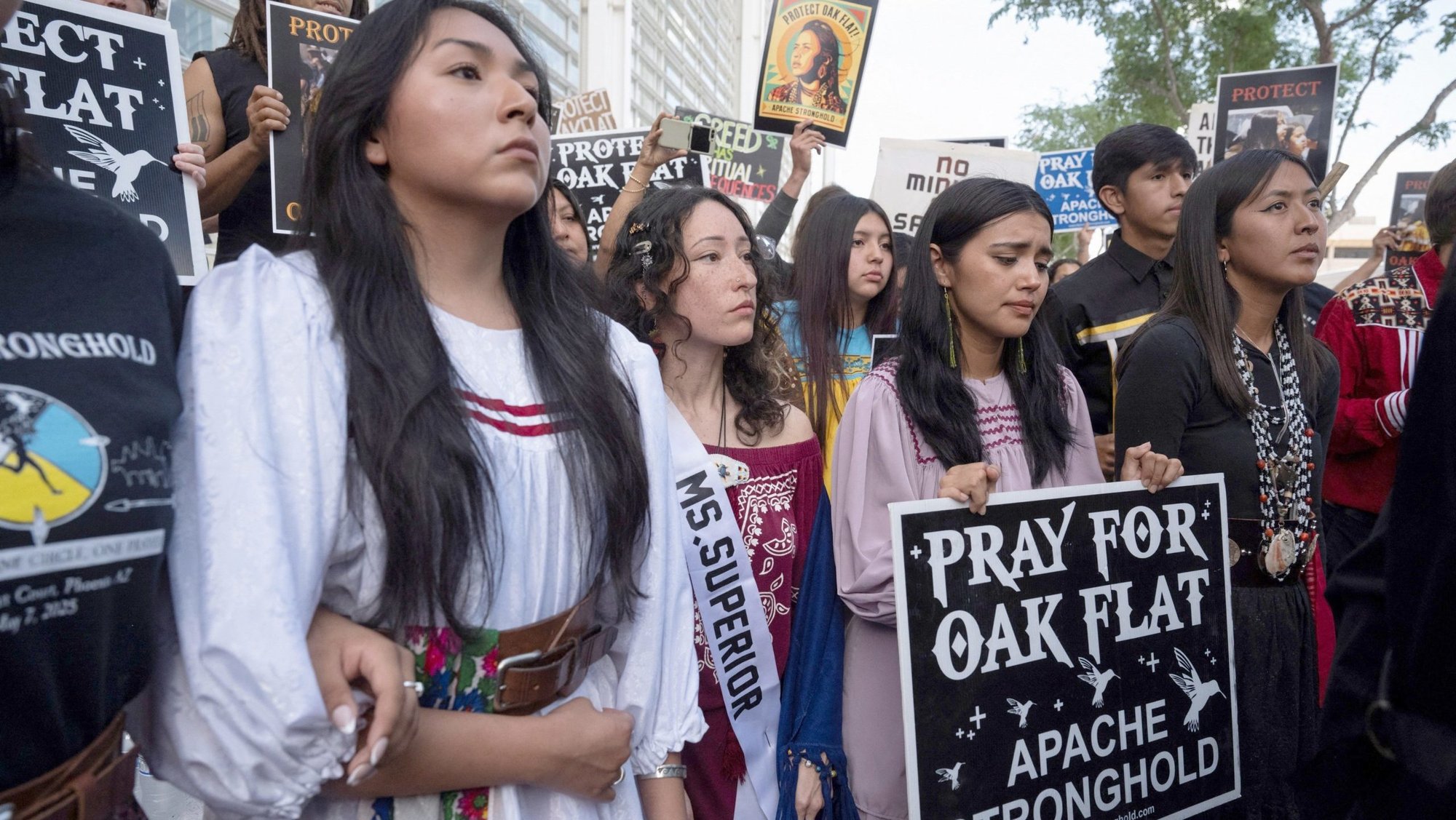
The federal government will proceed with plans to develop a copper mine at a Native American religious site, claiming the effort is “crucial” to meeting the “growing demand for critical minerals” in the U.S.
Indigenous advocates of the Oak Flat site, meanwhile, are vowing to continue fighting against the effort to obliterate what they say is a “holy place” and the “spiritual lifeblood” of Apaches.
Since 2021, the coalition group Apache Stronghold has been fighting the sale of the Arizona site to Resolution Copper, a British-Australian mining company.
The group has argued that the planned land transfer to the multinational company violates U.S. religious freedom law and threatens Native American traditions dating back centuries.
The battle against the sale — which advocates argue violates the federal Religious Freedom Restoration Act — made it all the way to the U.S. Supreme Court, which in May 2025 ultimately refused to halt the transfer. Advocates lost another bid at the Supreme Court in October 2025.
On March 23 the U.S. Department of Justice said its Environment and Natural Resources Division had secured a “major win” in the push to develop the site.
The 9th Circuit Court of Appeals upheld a district court’s order to allow the sale to proceed, allowing the government to “proceed with a congressionally mandated land exchange crucial to advancing development of one of the largest known copper deposits in the world.”
The mining project “will play an important role in developing a stable, domestic copper supply,” the government said.
Wendsler Nosie Sr. of Apache Stronghold told EWTN News in a statement on March 25 that the group “will never stop fighting to protect Oak Flat.”
“It is our spiritual lifeblood — the place where generations of Apache have gathered to worship, pray, and connect with our Creator,” the activist said. “The federal government and Resolution Copper want to wipe Oak Flat off the map and sever our connection with this holy place forever. But we will never give up.”
“We will keep defending what is holy. We will continue pressing forward in the lower courts and urging America’s leaders to protect Oak Flat before it is too late,” Nosie said.
The Native American coalition garnered support from Catholic leaders in its effort to halt the sale of the site. In 2024, the U.S. Conference of Catholic Bishops joined an amicus brief, arguing that lower court decisions allowing the sale of Oak Flat represented “a grave misunderstanding” of religious freedom law.
The Knights of Columbus similarly filed a brief in support of the Apaches, arguing that the decision to allow the property to be mined applies an “atextual constraint” to federal religious freedom law with “no grounding in the statute itself.”
The Religious Freedom Restoration Act states that the government “shall not substantially burden” an individual’s religion unless it can demonstrate that the burden is “in furtherance of a compelling governmental interest” and is “the least restrictive means of furthering that compelling governmental interest.”
The measure became law with bipartisan support in 1993. It was passed partly in reaction to the 1990 U.S. Supreme Court decision Employment Division of Oregon v. Smith, which upheld “neutral laws of general applicability” even if they burden the exercise of religion.
The specific case in Oregon v. Smith involved two Native American residents of Oregon who had been denied unemployment benefits stemming from their use of peyote, a cactus with psychoactive properties that has been used in Indigenous ceremonies for thousands of years.

Daniel Payne is a senior editor at EWTN News. He previously worked at the College Fix and Just the News. He lives in Virginia with his family.