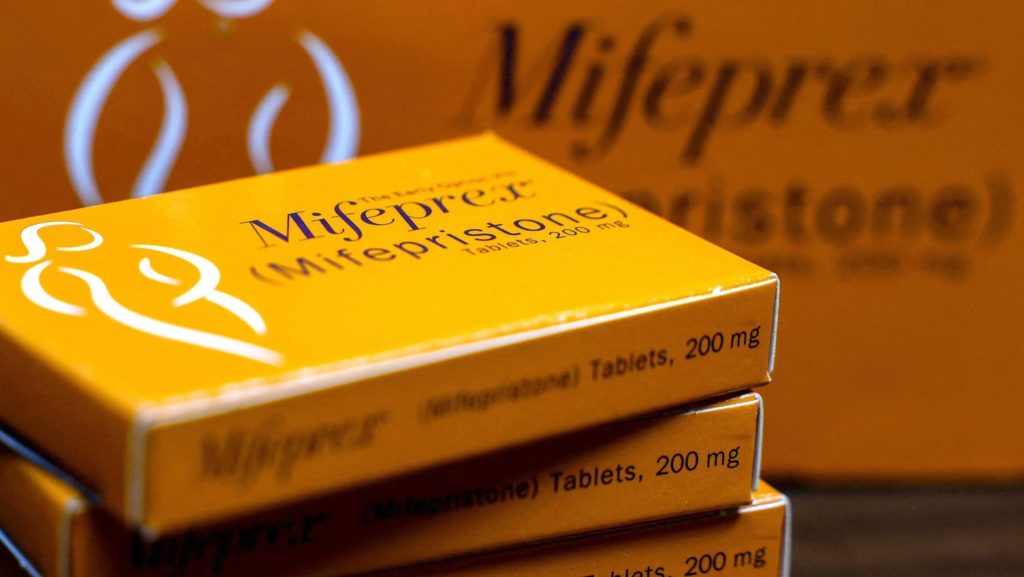
The U.S. Supreme Court on May 4 temporarily blocked an appeals court ruling that sought to pause a federal policy permitting mifepristone, sometimes called the abortion pill, to be dispensed through the mail.
An administrative stay issued by Justice Samuel Alito blocked a May 1 temporary injunction issued by the 5th U.S. Circuit Court of Appeals until at least 5 p.m. on May 11 EDT.
Alito directed the state of Louisiana to respond by May 7.
The stay in effect restores permission for the drug's distribution by mail.
Previously, the 5th Circuit had granted May 1 Louisiana's request to temporarily pause the Food and Drug Administration’s policy permitting mifepristone -- a drug commonly, but not exclusively, used for abortion up to ten weeks' gestation -- to be mailed into the state despite its own laws restricting abortion.
Danco Laboratories, one of the pharmaceutical companies that manufactures the drug, promptly appealed to the U.S. Supreme Court, asking it to block that injunction.
Louisiana Attorney General Liz Murrill, alongside Rosalie Markezich, who said she was coerced into taking abortifacient drugs by her then-boyfriend, sued the FDA over a Biden administration policy permitting mifepristone to be distributed by mail. The suit contends the policy enabled Markezich’s former partner to acquire the drug from a California doctor, whom Markezich says never spoke with her, and then coerced her into taking it.
However, the Trump administration has thus far left that regulation in place despite opposition from pro-life groups, and has sought to block state challenges to mifepristone, such as Louisiana's.
Prior to the appellate ruling, a federal judge on April 7 had granted the Trump administration's request to pause Louisiana’s lawsuit challenging the FDA’s approval of mifepristone pending the FDA's promised safety review, indicating the state could continue its challenge after that review. However, the status and timeline of the FDA’s review are still unclear.
Proponents of mifepristone -- the first of two drugs used in a chemical or medication-based abortion -- argue it is statistically safe for a woman to take, and attempts to restrict it are an attempt to ban abortion outright. Opponents of the drug’s use for abortion argue there are significant risks to those who take it, particularly outside of medical settings, in addition to ending the life of an unborn child early in its development.
The Catholic Church teaches that all human life is sacred from conception to natural death, and as such, opposes direct abortion.
However, the same drug combination has sometimes been used in recent years for miscarriage care, where an unborn child has already passed, a situation that Catholic teaching would hold as morally licit use.