When Bishop Mark Seitz of El Paso, Texas, took his turn to speak at this year’s OneLife LA event, he chose to bring up a painful subject: his father.
Seitz said his father walked away from him and his nine other siblings in 1976 and stayed away for 40 years, resurfacing when he needed care in the last years of his life.
Caring for an elderly parent can be frustrating, exhausting, and awkward. For Seitz, the estrangement made it even more difficult. But in describing how he and his siblings put that aside to care for their dad until his death at age 93, Seitz sought to make a deeper point about the mission to protect human dignity.
“It was beautiful, it was challenging, it was hard, it was scary, it was all of those things,” Seitz said.
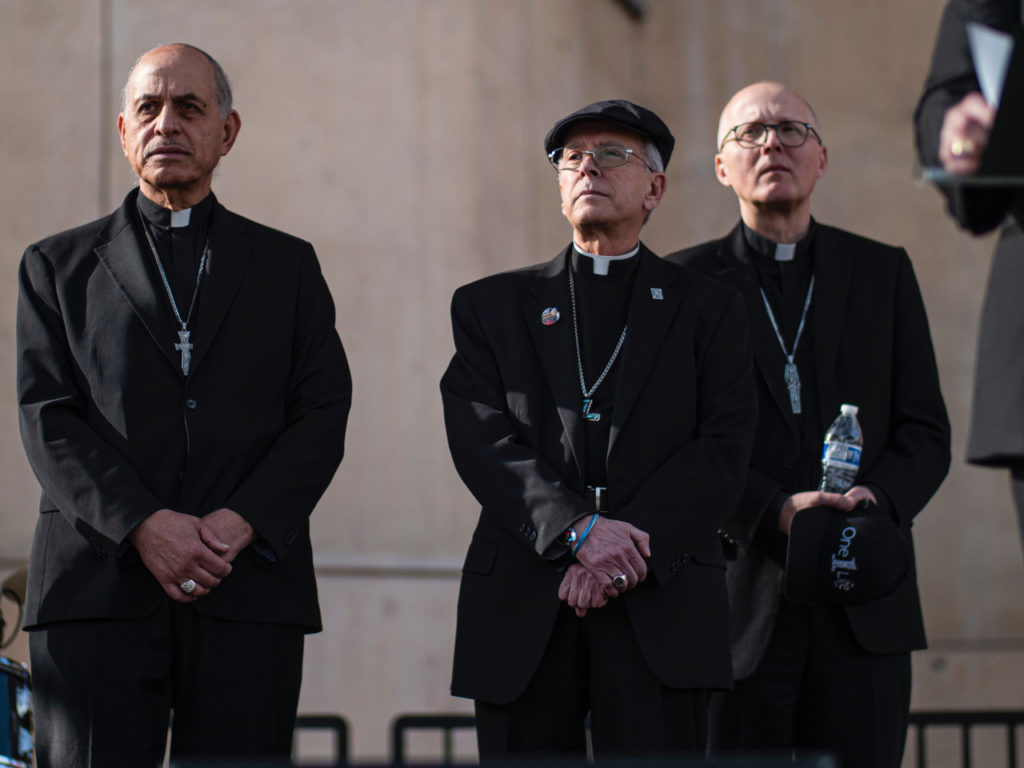
Personal testimonies like Seitz’s at the OneLife event highlighted the challenges, responsibilities — and blessings — in being pro-life in today’s environment. Apart from abortion, the Jan. 24 event at the Cathedral of Our Lady of the Angels also highlighted other life issues, among them immigration, drug abuse, and assisted suicide.
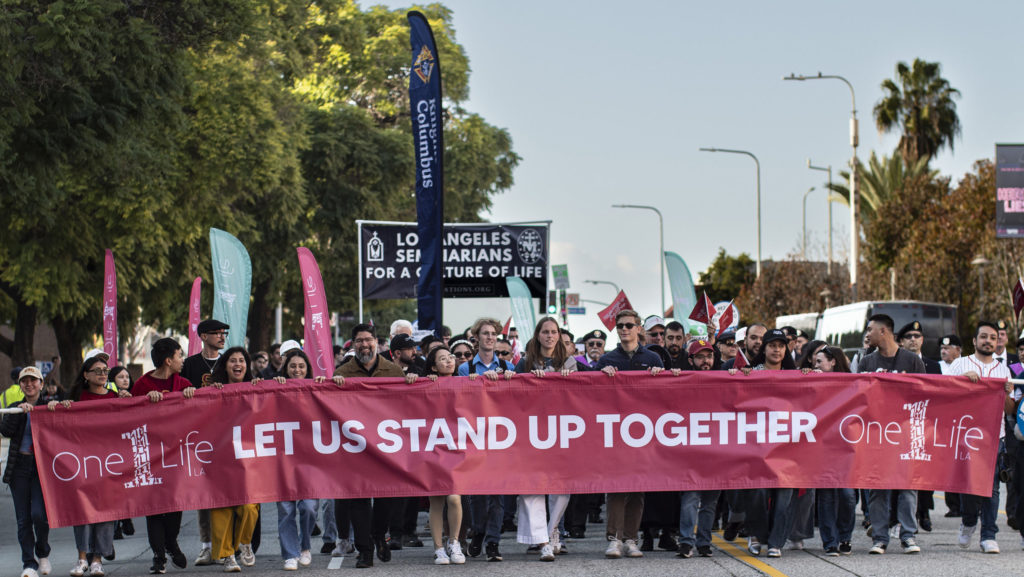
The event — emceed by Father Matt Wheeler, the pastor at Our Savior Church and USC Caruso Catholic Center, and Daniela Verástegui — drew some 5,000 people and included speakers, musical performances, a “Walk for Life” procession through the streets around the cathedral, and a Requiem Mass for lives lost to abortion.
Known for his longtime advocacy for migrants at both his border diocese and among the U.S. bishops, Seitz acknowledged that many Americans — Catholics included — find it uncomfortable to look at those who are weak and suffering.
“We kind of recoil before human vulnerability, don’t we?” Seitz said. “We ignore it, we hide it away. We don’t like to acknowledge it. And the sick, the frail, and the elderly all suffer because of it. There are tons of isolations in our society today.
“When we look at our country today, we’ve lost the idea that every human life is a blessing, or that we have obligations to one another. We divide up the pie. Some lives are not worthy of our concern.”
Archbishop José H. Gomez sounded a similar tone in remarks to kick off the event, saying that as America celebrates its 250th anniversary this year, if the right to life is not protected, no other human right can be guaranteed.
“OneLife LA has never been about politics,” Archbishop Gomez said. “We are a religious movement, a stirring of the heart and conscience. A movement of the Spirit. OneLife is the dream of a city of love where every human life is sacred, where every person is cherished, welcomed, and cared for.
“And we mean every human life. At every stage and in any condition. No matter what their skin color, or where they came from, or the language they speak, or what documents they have.”
The day’s other speakers helped address an array of pro-life issues.
Nora Yesenia, a former host of “Buenos Días LA” on Los Angeles Catholic radio, spoke of her experience losing her baby and losing part of her reproductive system after emergency surgery. After being told that it would be nearly impossible to have a child, Yesenia introduced her husband, carrying in his arms their 5-month-old daughter. She also announced that she was pregnant again, to loud applause.
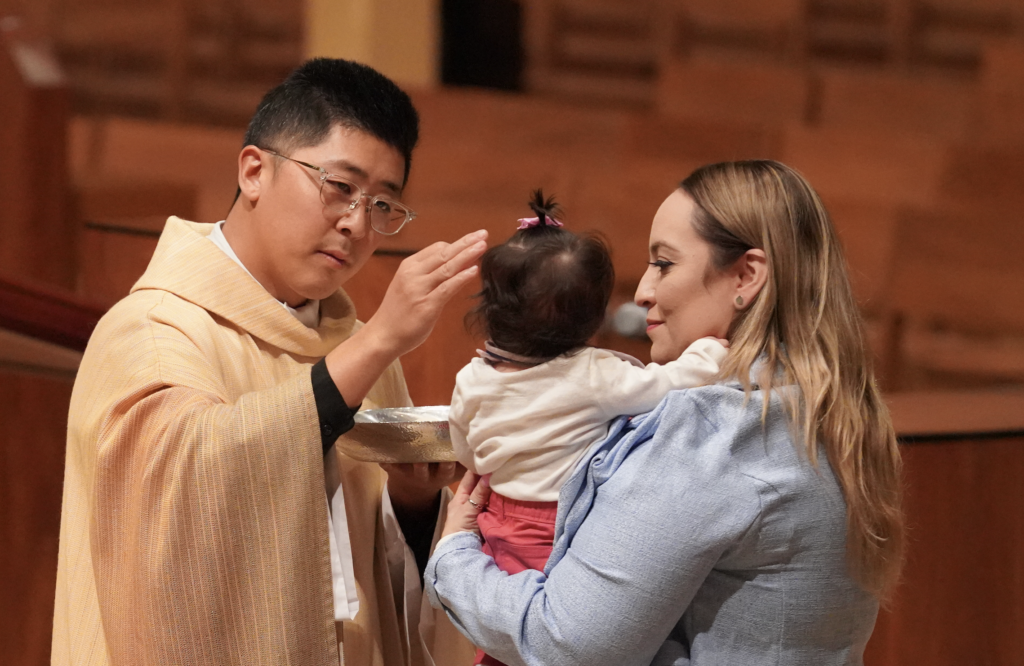
“If there’s something I want you to remember: God decides,” Yesenia said.
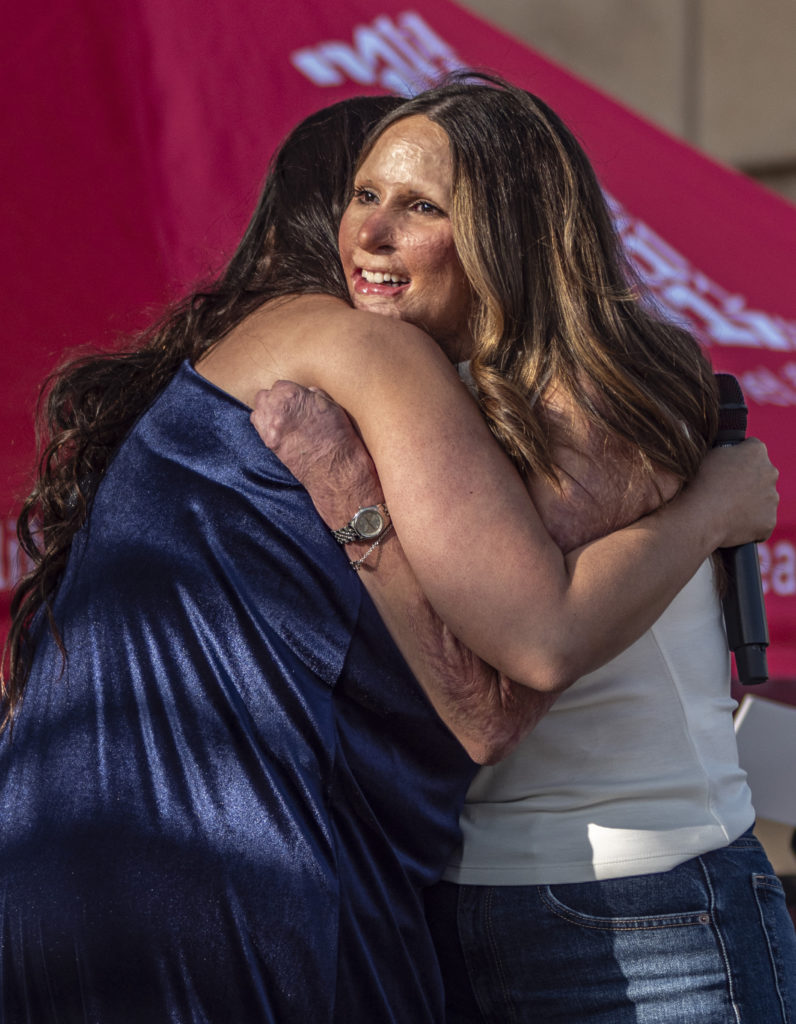
After a performance by Mexican singer Miriam Solis, she introduced her niece, Sofia Alatorre Gonzalez, who shared her story of surviving a fire at 8 years old that claimed her grandmother’s life and led to years of medical care and trauma. Wearing short sleeves that showed the burn scars across her arms, Gonzalez said her faith has helped her stay strong in times of challenges.
“A big part of my entire story is the faith I have in God — how he was there during the most difficult moments of my life, and how he has also been there in the good times,” Gonzalez said. “How, through him, even when I didn’t understand why all of this had to happen to me, or why I had to be the one who suffered that day, today I can see that the things that happen are meant to teach us.”
During her second performance, Solis dedicated a song to Gonzalez and spent much of it with her arm clasped around her.
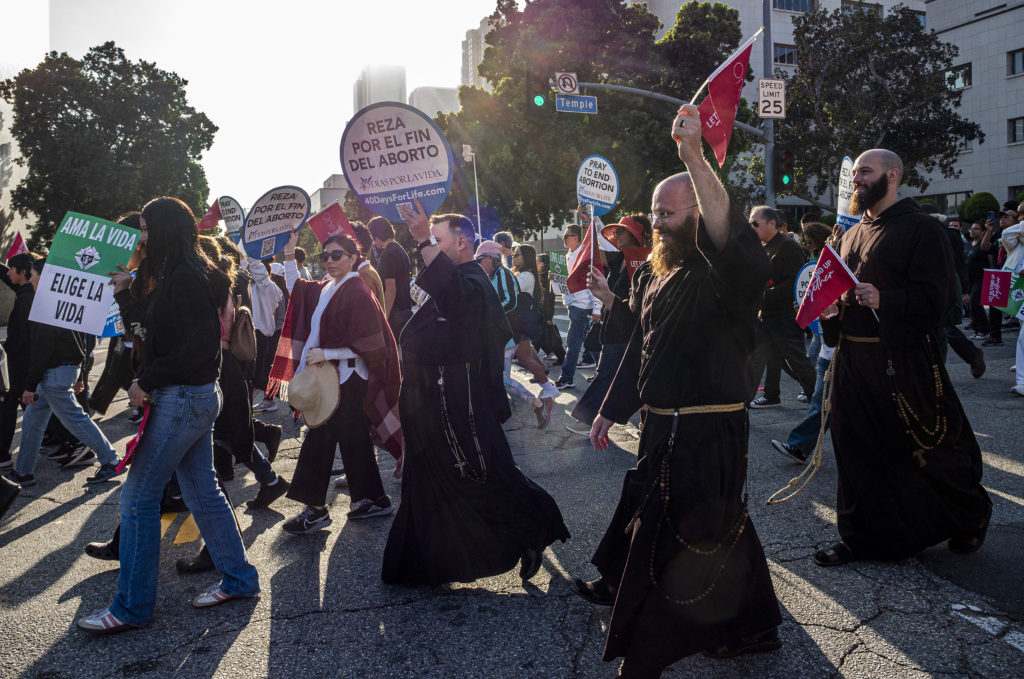
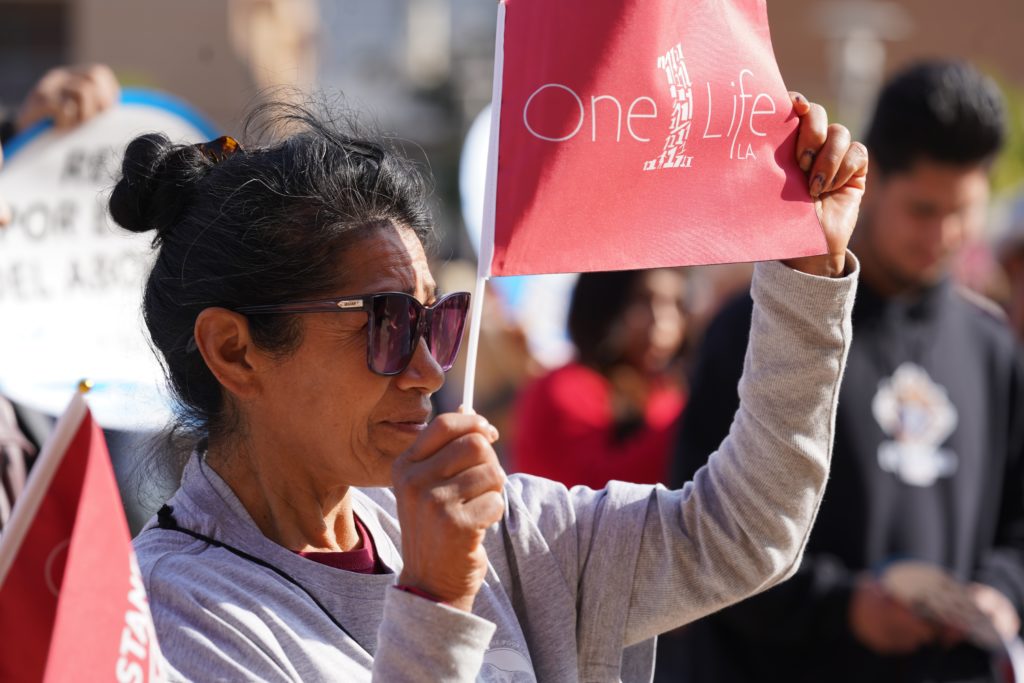
From there, the thousands took to the pavement in a “Walk for Life” demonstration through downtown Los Angeles, some singing, some praying the rosary, some carrying signs or banners, and others pushing their children or the elderly in wheelchairs and strollers.
Ann Vaeth walked with her husband, Joe, and their three kids. Parishioners at St. Kateri Tekakwitha Church in Santa Clarita, they’ve been attending OneLife LA for about 10 years. Ann Vaeth said it was important to show society — and her children — that you can’t just talk the talk about being pro-life, you have to walk the walk too.
“It’s not just something we preach from the pulpit or behind our closed doors,” she said. “This is something we’ll go out there and we’ll help you if you need help. And it starts with you have to be present and available if anybody’s going to be able to see you for help.”
Oscar Diaz walked with his wife, Idali, and his two sons. Parishioners at Holy Name of Jesus Church in Redlands, Diaz said he was “Catholic-ish” and was pro-choice. That is, until he saw his first child’s ultrasound.
“Hearing that heartbeat really impacts you, and you really think about that life,” he said. “That’s what life is.
“And ever since that, a complete 180.”
Bringing up the rear of the procession was Francisco Avina, pushing one child in a stroller and his wife, Jennifer, carrying two more: One on her shoulder and one in her womb. They came from St. John Chrysostom Church in Inglewood.
“There are truths that we all abide by, and I think we hold that the right to live, regardless of your age, it shouldn’t be taken away,” Francisco Avina said. “I think in these times, it’s far too political. I think there has to be someone with a strong central ground, a strong moral value to stick up, and we’re called to do that. That’s why we’re here.”
From the streets, the crowd returned to the cathedral, packing inside for the Requiem Mass for the Unborn.
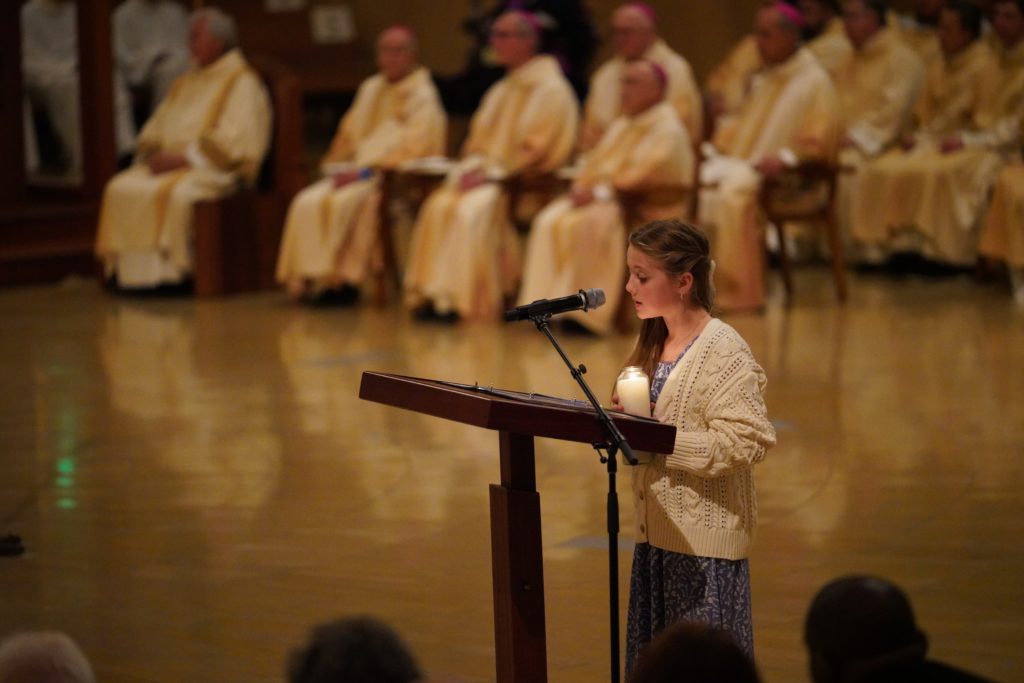
In his homily, Archbishop Gomez said that Catholics “cannot rest until every human life is cherished” and thanked those who serve “quietly, under the radar, praying and making sacrifices, walking with mothers in need, giving your time as foster parents and adoptive parents.”
The Mass also included the annual tradition where the cathedral lights were dimmed and Mass participants carried hundreds of white candles, one by one, and placed them on the altar, representing the lives that were lost to abortion that day in the greater Los Angeles area.
As the OneLife LA day ended, Seitz was hopeful that people would take the words they heard and run with them, not just for a day, but going forward.
“I hope people will be able to take what they hear and apply it, not only to immigrants, not only to the unborn, but to all of those people around us who are vulnerable and in need, and recognize that we as Catholics have a particular call to love those who are poor, to love those who are weak, to love those who are sick,” Seitz said. “I hope that message comes through.”