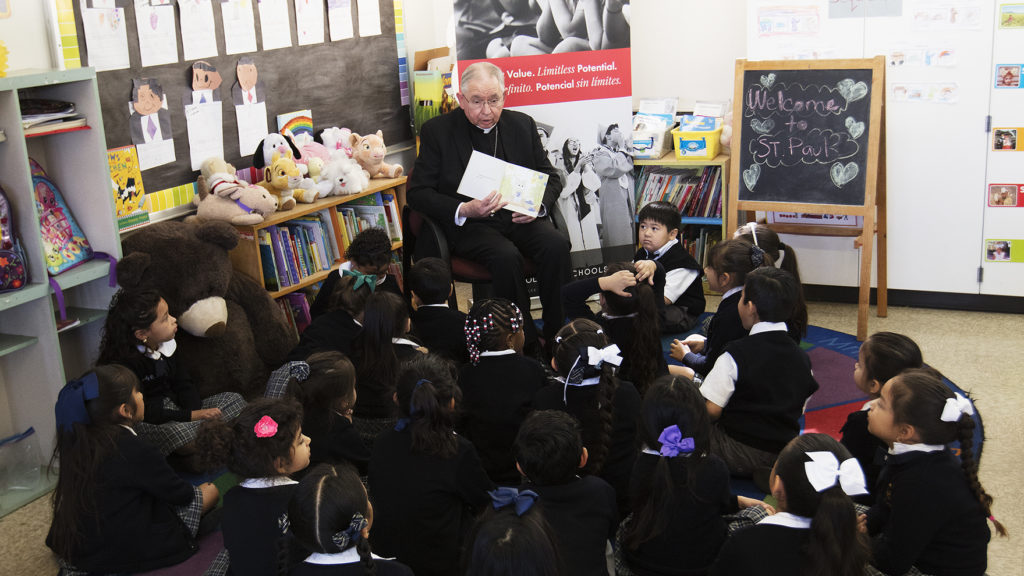
When Archbishop José H. Gomez officially began his tenure in Los Angeles in the spring of 2011, Dr. Kevin Baxter was head of the archdiocese’s elementary schools. Meanwhile, Paul Escala was the president and CEO of St. John Bosco High School in Bellflower.
In the years that followed, both men would go on to work with Archbishop Gomez as superintendent of LA’s Catholic school system — Baxter from 2015 to 2019, and Escala from 2019 to the present.
Looking back at the last 15 years, both men agree that Archbishop Gomez’s leadership style and personal commitment to Catholic education — even under inconvenient circumstances — have paid off big for Catholic families.
“When a guy like me might have radical ideas on how we change the way we see our work, push the envelope and take risks, it would be easy for [Gomez] to say no,” said Escala.
But instead, Escala said, Archbishop Gomez has “always stuck to his core principles” when faced with challenges.
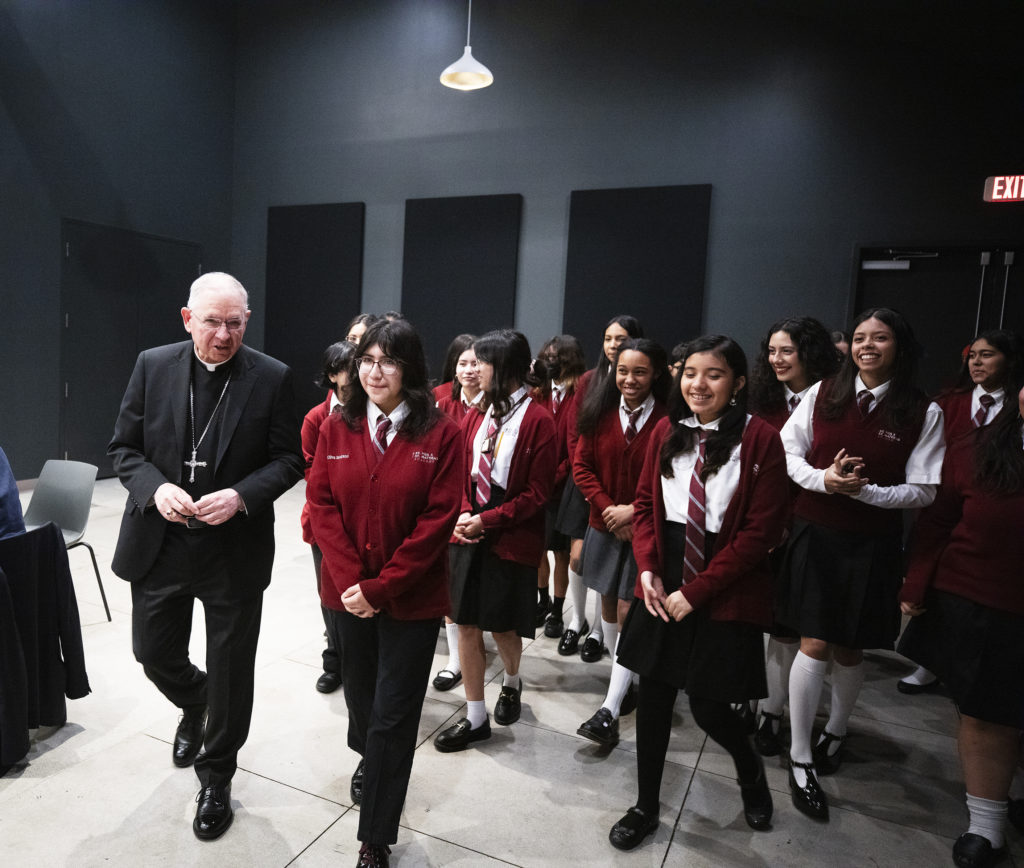
“I’ve gotten to see him in the most risk-filled, crisis environments — public health, fires, social unrest, immigration threats,” Escala told Angelus. “That discipline is something I admire greatly about him.
“He has always led with this idea that schools are not compartmentalized in the life of the Church, they are a function at the parish and community level. That pastoral approach to the ministry protects the essence of Catholic education.”
Escala and Baxter said that approach has translated into better policies, higher test scores, and improved student safety. Nevertheless, Baxter said he saw up close how daunting the task that faced Archbishop Gomez could be.
“He has understood that this is where God has called him in places that are very public-facing,” said Baxter, the current director of the Mary Ann Remick Leadership Program — Alliance for Catholic Education at the University of Notre Dame. “That can be a challenge for someone who is so spiritual and very humble.”
When he hired Baxter in 2015, Archbishop Gomez created a new position, Senior Director of Catholic Schools and Superintendent, that elevated schools’ role in the archdiocesan leadership structure. When he formed a cabinet of directors of each of the archdiocese’s major departments to advise him on leadership, he included Baxter. That meant the superintendent was now in a group dynamic with other major archdiocesan offices, including religious education, communications, and legal counsel.
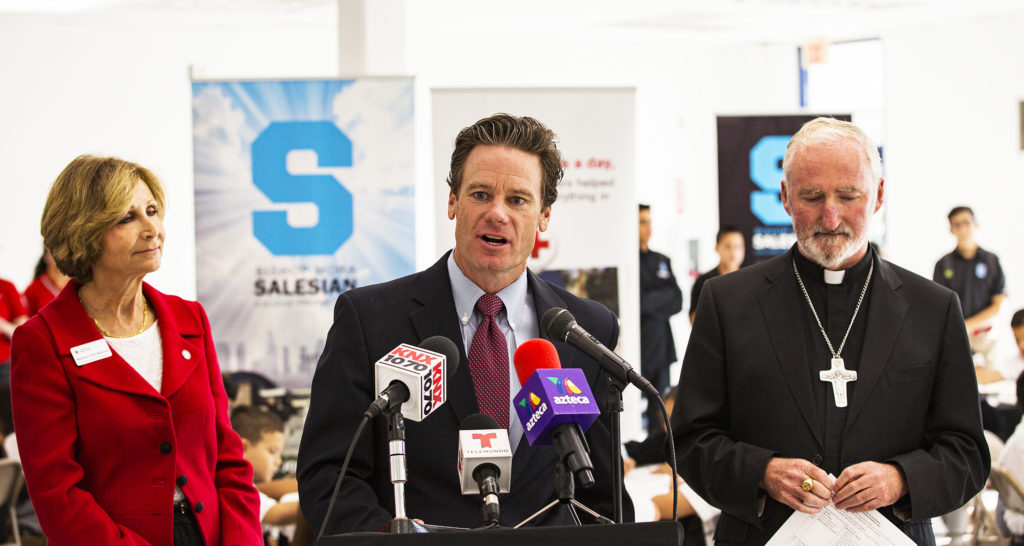
“That was a big deal,” said Baxter, whose 18 years in LA Catholic schools included eight years as principal at St. Columbkille in South LA and American Martyrs in Manhattan Beach. “It said a lot about how he viewed the importance of Catholic schools in the ministry of Los Angeles. I think there were plenty of bishops around the country who wouldn’t have done that.”
Baxter said the regular face-to-face meetings with Archbishop Gomez allowed them to better understand each other. Baxter was also impressed when the archbishop invited him to special meetings with auxiliary bishops for updates and seeking feedback.
“He wanted the Catholic schools to get in front of the other bishops — and to some that might sound like, well, of course that happens,” said Baxter. “But from my conversations with colleagues around the country, that wasn’t so common.
“As I was getting a better idea about the archbishop’s vision and approach, that had a profound effect on the decisions we made and how we made them. The archbishop is great about empowering people to make decisions and then very supportive of what can be decisions made about very difficult issues.”
Baxter saw Archbishop Gomez’s endorsement of the dual-language immersion program crucial at a time when some parts of the ADLA were losing students. All Souls School in Alhambra had to close in 2010 under Baxter’s administration, but it reopened the next year as All Souls World Language School, the first Catholic school in the nation to offer both a Spanish-English and Spanish-Mandarin track. It went from 20 students then to more than 400 today.
“That was one of the best things we ever did, and that model thrived because the archbishop was very excited and supportive of that initiative,” said Baxter.
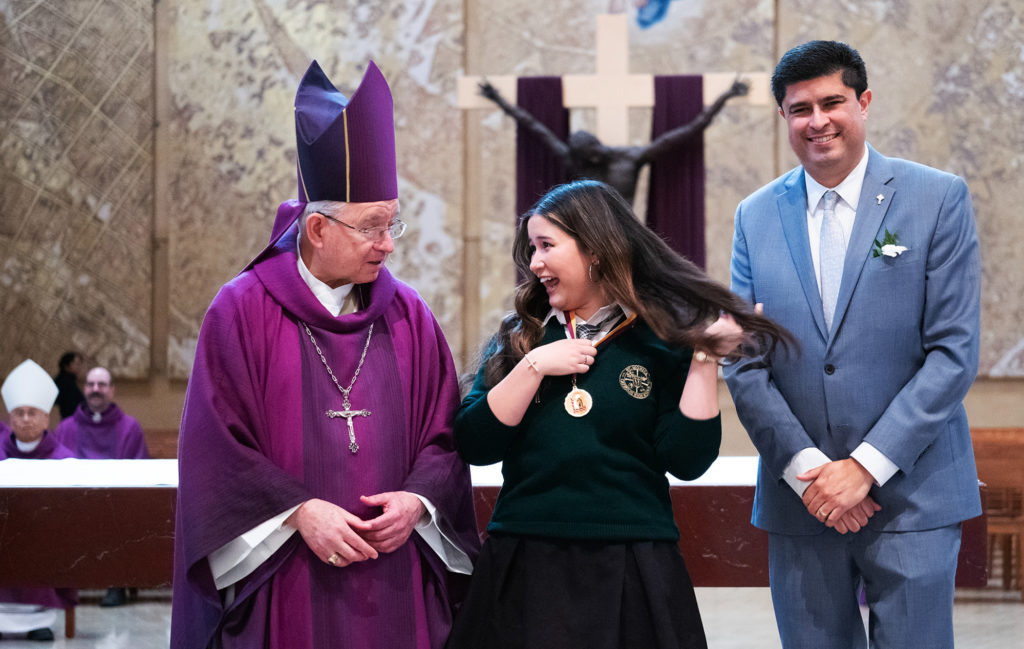
What followed was a national cover story in America magazine titled “How L.A.’s Catholic schools are growing when so many others are closing.” The September 2017 article looked at how the archdiocese had grown to serve some 80,000 students, the most by a Catholic school system in the country.
Besides the emphasis on innovation and the addition of a STEM network, Baxter also credits Archbishop Gomez’s focus on schools providing safety and security at a time when families were afraid of stricter immigration policies following the 2016 elections.
When Baxter left in June 2019 to become chief innovation officer for the National Catholic Education Foundation, Escala was hired to replace him a few months later.
Escala already had a positive first impression of Archbishop Gomez from his arrival in 2011.
“As a Latino who grew up in San Pedro, I thought we needed an archbishop who looked like us, and I was cognizant that both of us were leading as men of Hispanic descent in our roles,” said Escala. “In a city as diverse as Los Angeles, we need to see ourselves in our leaders.”
Escala had worked in various educational leadership roles around California before returning to the archdiocese. He was just six months into his term when the COVID-19 pandemic hit. As schools switched to distance learning, the question of when to return to in-person instruction became a source of anxiety and hesitation for many. The archdiocese’s schools accomplished that before any other school system in LA County.
“That’s where I think he really stood apart from his brothers across the country,” said Escala, referring to the country’s Catholic bishops. “He was engaged and willing to do what was necessary to ensure children can be formed in the Catholic faith even during our darkest times.”
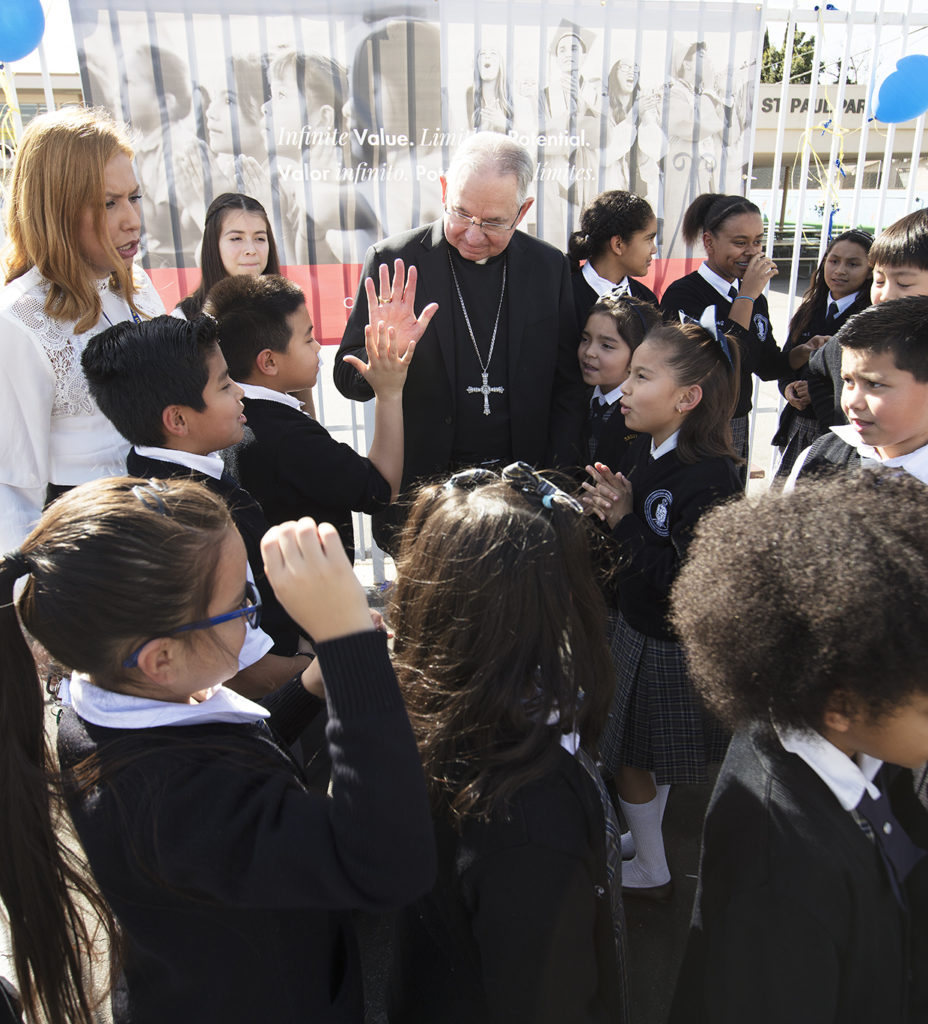
More recently, Escala said that Archbishop Gomez went out of his way to back the Solidarity Schools initiative, launched in 2023 to help kids in disadvantaged areas with reading and math skills.
“We had no financial support for what we were trying to do,” Escala said of the $2 million program serving more than 4,000 students in 18 schools. “The one person who said yes to this was the archbishop. He was the lead investor, and that gave us a way to talk to philanthropists, to school principals, to teachers. With the archbishop on board, that made all the difference in the world.”
Archbishop Gomez’s qualities are ones that Escala said he tries to embrace.
“He is an intentional listener, and his quiet, authentic care is what we need to see more of with our leaders. That’s the difference between success and failure. There is a lesson in his pastoral leadership many in the secular world could learn from, and I know I have.”