Author Richard Rodriguez wrote in a 1987 Los Angeles Times piece on the missions’ impact, “To live here [California] is to submit to the names, to the ruins of a Spanish adventure, to live among Spanish.”
In California, that’s not a sentiment shared by everyone, as the revisionist campaign against the legacy of St. Junípero Serra shows.
But 10 years after the Spanish friar’s canonization by Pope Francis, a little-noticed trip by a delegation from Serra’s home island of Mallorca, Spain, confirmed that the “Spanish adventure” still matters in California.
The group from Mallorca who visited California Nov. 29-Dec. 4 included the Consell de Mallorca (the governing institution of the island of Mallorca, Spain), city council members from Serra’s hometown of Petra, and Serra historians from Mallorca.
The trip was one of a series of activities marking the canonization anniversary in Mallorca this year.
On Sept. 23, the date of the anniversary, Consell de Mallorca President Llorenç S. Galmés Verger visited Petra, where he called Serra “the most universal Mallorcan.”
“Junípero Serra, despite the controversy surrounding him, remains a symbol of our identity and a point of connection between Mallorca and California,” Galmés told the Manacor newspaper of Serra, who oversaw the establishment of the first nine of California’s 21 missions.
The day before departing for the United States, a conference and a special concert were held at the Basilica of Sant Francesc in Palma to mark the anniversary.
While in California, the delegation visited The Cathedral of Saint Mary of the Assumption, the Shrine of Saint Junípero Serra at Carmel Mission Basilica (founded 1770), Mission Santa Clara de Asís (1777), and Mission San Francisco de Asís (1776). The group also met with Archbishop Salvatore Cordileone, and representatives from technology companies in Silicon Valley.
The City and County of San Francisco and Mallorca have a unique relationship when it comes to Junípero Serra. In 1932, the Rotary Club of Mallorca, in an act of friendship, gifted the deed to Fray Junípero Serra’s home to the City and County of San Francisco. The deed had to be returned in 1981 due to a legal prohibition that banned the city and county from owning real estate abroad.
During the height of the COVID-19 pandemic and the George Floyd protests, some tried to cancel Serra, believing he should not be part of the nation’s historical patrimony. Most recently, the state of California removed a statue of Serra from a San Francisco Bay Area rest stop. Questions surrounding the process leading to its removal were raised by the public, including the local archbishop.
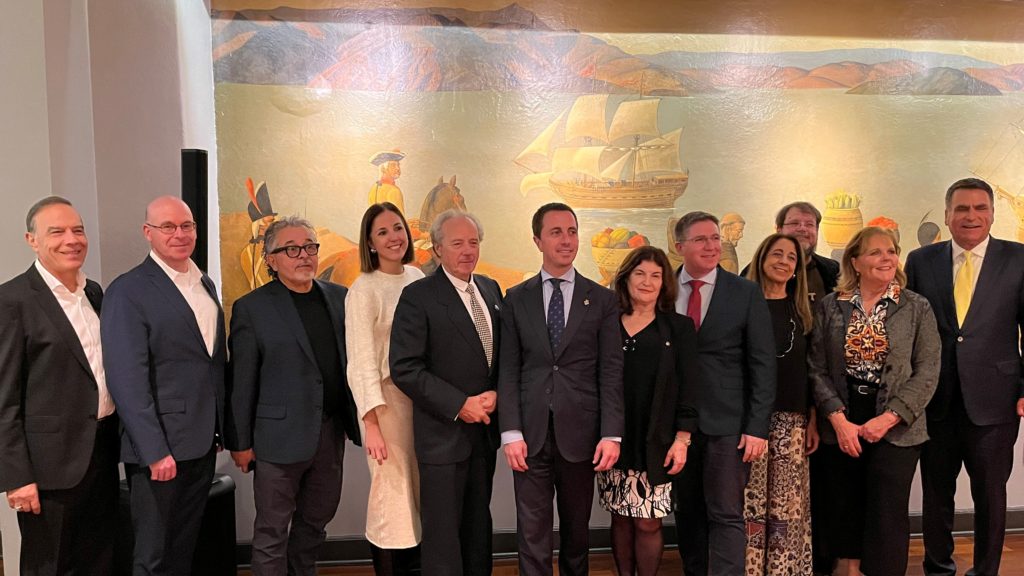
At a Dec. 3 event at the Merchants Exchange Club in downtown San Francisco, Serra experts from both continents participated in a roundtable discussion on Serra’s legacy. Participants included Capuchin Franciscan Father Barbato of the Shrine of Saint Francis; archeologist Dr. Rubén Mendoza; Margarita Martínez, president of the Balearic Association of Software, Internet, and New Technologies; and Salvatore Caruso of the Camino de California Eucharistic Procession.
David Bolton, executive director of the California Missions Foundation, served as the discussion’s moderator.
“The relationship between Mallorca, Spain, California, and the United States continues today, more vibrant than ever,” Bolton said afterward. “It is heartening to see that the bond first forged more than 250 years ago remains strong and meaningful, resonating with people on both sides of the Atlantic.”
At the event, Juan Antonio Tirado, director and producer of Matas Films, also gave a preview of his documentary “California Made in Spain.”
According to organizers, the trip’s objectives included highlighting Serra’s commitment to both his faith and the dignity of native peoples, and his dual roles as a universal Mallorcan and an apostle of California. But during the delegation’s time in Silicon Valley, Serra’s role as innovator got plenty of attention, too.
"It was interesting to hear how Junípero Serra brought the technology of his time to California to build the missions — and that Silicon Valley now sits in the region where he spent so much of his ministry,” said Remee Vargas after attending the roundtable.
Vargas, who oversees the Archdiocese of San Francisco’s youth ministry office, believes that Serra’s motto, “Always Forward,” has left a mark in the region: “Serra continues to bless and influence us today.”
Roundtable participant Catalina Font, who gives tours of the humble home in Petra that Serra grew up in, said the group’s visit to Santa Clara in the heart of Silicon Valley made her think of “the new technologies Serra brought and the technologies of today.’
“Both were cutting edge at their time,” said Font.
Vargas believes that when it comes to debates about Serra’s legacy, the delegation’s visit was an important step in setting the record straight.
“I think the [Consell’s] commitment to retelling Junípero Serra’s story through actual documents and writings will reveal more of his compassion, ingenuity, and intentional discipleship that shaped the communities he walked with,” said Vargas. “As we share more of his truth, the facts will refute the misconceptions surrounding his mission.”