With the Advent season well underway, Catholics are fully expectant, preparing spiritually for the birth of their Savior at Christmas on Dec. 25.
Las Posadas Navideñas (Christmas Inns) are part of the preparations. A lively, faith-filled tradition celebrated in Mexico and by Latin Americans in some parts of the United States they are observed during the nine nights leading up to Christmas, from Dec. 16 to Dec. 24. They commemorate the arduous trek from Nazareth to Bethlehem of the Virgin Mary and St. Joseph as they sought lodging before Jesus' birth.
According to Sister Susi Miranda, a Xaverian Missionary Sister of Mary at St. Bernard Church in Worcester, Massachusetts, the tradition of Las Posadas "was born as a devotion of accompaniment to the Holy Family, who journeyed, who sought, and as a way to say, 'We walk alongside them.'"
The tradition of the posadas was part of an evangelizing initiative during the colonization of the New World in the 16th century -- when the Gospel reached the Americas with the arrival of missionary groups from Spain -- including the Augustinians, Dominicans and Franciscans. Augustinian missionaries gave new meaning to some of the pre-Hispanic practices of Indigenous peoples in Mexico, refocusing them on the way of Mary and Joseph to Bethlehem.
Today, these historical traditions also live on in parishes across the United States.
Father Arturo Corral, pastor of Our Lady Queen of Angels Church (also known as La Placita), the oldest church in the Archdiocese of Los Angeles, shared some details about this beloved tradition of Las Posadas (Spanish for "lodgings" or "accommodations.")
Generally, a night of Las Posadas begins when the faithful gather in their respective parishes, where they share a moment of prayer (for instance, a partial rosary), reflection, or liturgical singing before heading out, said the priest.
The heart of the event, however, is the processions that reenact Mary and Joseph's search for shelter for the night.
In the processions, adults, youth and children bring Mary and Joseph, either as statues or people dressed in their likeness, and go to different houses, asking if there is lodging for the parents to be. At each stop, the innkeeper turns the group away. With caroling from the "pilgrims" embellishing the night air, they eventually reach a house -- selected beforehand as the designated inn -- where they are allowed inside, culminating the reenactment of this cherished tradition.
"It is like a play … people go to different places, to different houses, asking for a place (to stay)," Father Corral told OSV News. "They continue walking until, finally, one of the houses opens the door and says, 'It is the time to open the door for the Queen of the Heavens to come and bring the baby.'"
Often, the groups kneel around the Nativity scene during this final stop and often sing "villancicos" (Christmas carols), pray and share traditional dishes and drinks.
"So, (Las Posadas) is a mix of holy Scripture, a mix of tradition, songs, beauty, walking and offering gifts in different places," the priest added.
A native of Querétaro, Mexico, Sister Susi talked to OSV News about the differences between the posadas she knew and the celebrations in the U.S., where she arrived 10 years ago.
Among the differences she encountered was that parishioners also included statues of the newborn baby Jesus in the processions. "I used to ask them, 'How come we have the child Jesus here if he hasn't been born yet?'" she recalled.
But just as there were differences, there were also several similarities, and for Sister Susi, one stood out: the songs.
"The joy of singing and saying, 'Come, come, child Jesus,' and singing to Mary, 'We'll choose a place for you to stay at our home, for you to spend this night,'" she said. "The songs transmit our excitement, our joy: that we are preparing. That is similar to Mexico," she added.
Furthermore, from her arrival, she welcomed the wealth of Latin American cultures represented at her parish, whose rich traditions are especially highlighted on the last day of Las Posadas, Dec. 24, on Christmas Eve or "Nochebuena" (Spanish for "Good Night"). That day, parishioners of St. Bernard bring food from the nations they hail from, and children bring the Christmas story to life through the lively "Pastorela," a theatrical performance told from the shepherds' perspective.
"That sharing between different cultures, and at the same time, embracing each other, being together, united. That's very different, and we don't have that in Mexico," Sister Susi said.
To enrich the Posadas experience, Cristina Hernandez, diocesan coordinator of Hispanic Ministry for the Diocese of Youngstown, Ohio, has, over the years, incorporated Christmas traditions from various Latin American nations into the observance.
The first Posadas she organized were at a parish that boasted a large Puerto Rican community, she recounted to OSV News, and so she fused it with a "Parranda," a unique, joyful Christmas tradition from Puerto Rico akin to caroling.
"And then I asked members of different countries … how they celebrated this Christmas season in their countries if they did not practice Posadas, and they explained what kind of meals they prepared and ate." Hernandez said, adding, "That is how the first Posada started here: realizing that it was not only a Mexican Posada but a Posada of all the countries we had."
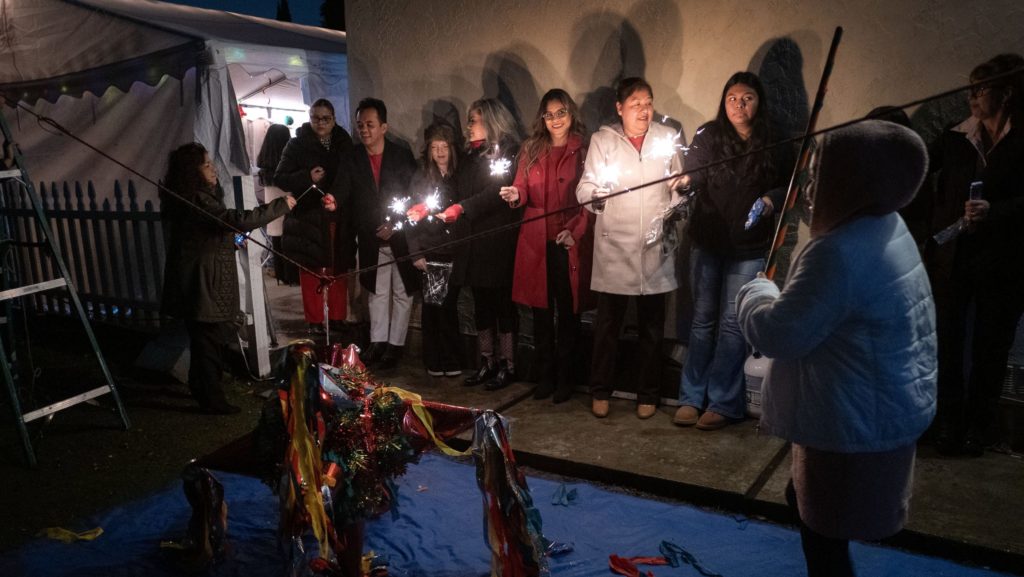
However, no celebration of Las Posadas feels complete until the piñatas are broken, a highlight everyone eagerly awaits once the processions end. Shaped like a seven-pointed star, each cone, as Hernandez explained, stands for one of the seven deadly sins: pride, greed, lust, envy, gluttony, wrath, and sloth.
She went on to explain that wearing a blindfold while breaking the piñata symbolizes faith, showing that even in the darkness, we place our trust in God. The stick used to strike the piñata stands for the strength and virtue to overcome evil, while the treats that spill out represent the love and mercy of Jesus, who delights in giving us gifts to enjoy.