I’ve heard countless testimonies of people who impulsively prayed to God: “I’d like to get closer to you” and then found themselves visited with plagues and trials. The moral of the story is always the same: in the end, amid the suffering, they drew near to God, and they came to know a much deeper happiness.
I believe them all, and their witness confirms everything I’ve been told about God’s providence.
But I confess that my pain-avoidance mechanism kicks in very early in my hearing of such stories. Like most folks, I have a deep aversion to suffering — the very thing these good people seem to have brought upon themselves by cozying up to God. So I make a mental note never, ever to voice anything like that sort of prayer.
I behave the way my children often did when they were toddlers. When it was time for bed or a new diaper, they’d try to make themselves invisible by turning away from me. If they couldn’t see me (they reasoned), maybe I couldn’t see them — and then they could avoid whatever summons threatened their private games.
I found the maneuver amusing. They relied on my adulthood when it was convenient, but really they knew what was best for their lives. They didn’t quite trust me to use my adult powers intelligently.
I hope that God finds me amusing, because my distrust is really no different from theirs. I check the boxes on God’s omniscience and omnipotence. If God could be deficient in knowledge or power, my entire understanding of the world would crumble. If God were not provident, he would not be God.
Yes, I believe, but help my unbelief.
It’s a matter of trust, of course. It was only after hundreds of diaper changes that my kids were ready to concede that their old man’s will was the better course in life.
And I, too, have come grudgingly to such conclusions about my heavenly Father.
Suffering, it seems to me, is the ordinary means of growth in the spiritual life. I wish I could be the kind of person who falls spontaneously into praise and thanksgiving whenever I see a sunrise, a bank of wildflowers, or a mountain range. But I’m not. At sunrise I’m thinking primarily about coffee. Amid flowers I’m thinking about antihistamines.
Prayer — of adoration, contrition, or thanksgiving — is often a struggle for me. But I have no trouble with the fourth category of prayer: supplication. I have no trouble asking for stuff; and I focus on this task especially when I’m suffering. In times of physical pain and in times of grief or worry, I’ve passed entire nights in prayer —for strength or for deliverance — and it seemed hardly more than minutes. “Lord, in your great love, answer me!”
Well over a millennium ago, St. John of Damascus defined providence as “the will of God by which all things are ruled by right reason” — all things, even those that I would have ordered differently from God’s way. The definition leaves no room for chance, no hair uncounted, no sparrow unaccounted for.
“Fear is useless,” Jesus said, “what is needed is trust” (Luke 8:50). Yet my own fear remains.
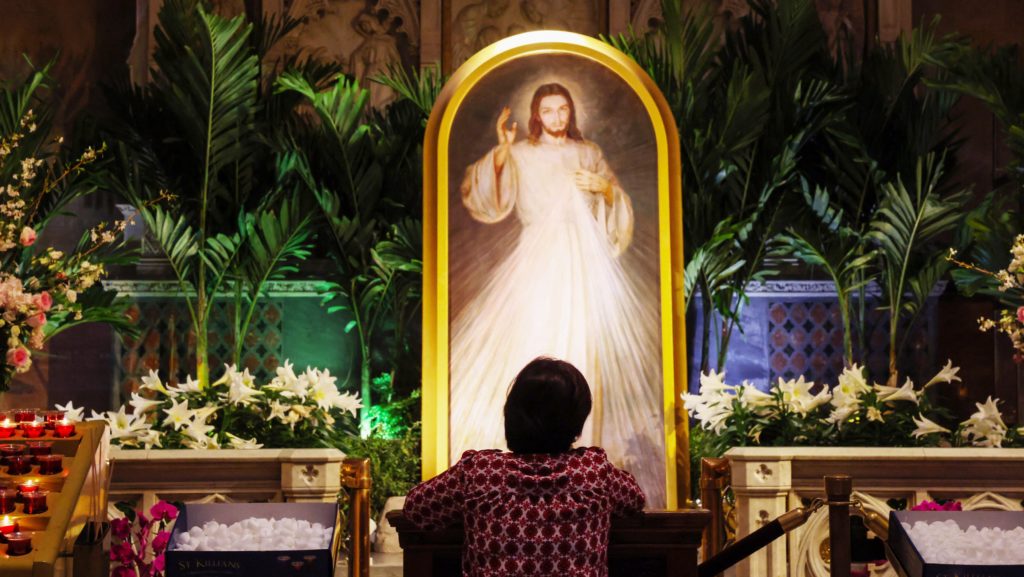
In 1931 Jesus appeared to a Polish nun named Faustina and told her: “Paint an image according to the pattern you see, with the signature: ‘Jesus, I trust in you.’ ” In the Divine Mercy devotions she promoted, St. Faustina taught us to say the line not once, but three times. For people like me, there’s nothing vain about this repetition. What I need is trust.
For God will indeed test the just, but his tests are different from any others. He’s not waiting for the outcome and wondering how we’ll score. He gains no new knowledge from the effort. We gain everything as we recognize our weaknesses, deficiencies, fears, and aversion strategies. Our tests are for our sake, not his.
Maybe I’m not alone in my hesitating trust. Some years ago I sat for coffee with a scholar I revere. He told me that he had never doubted God’s existence, but he found God’s goodness hard to believe. Nature, after all, is red in tooth and claw; and mankind — the crown of creation, made in God’s image — is no less bloody, and uniquely cruel.
I recognize his hesitations. My scholar friend would not have ordered things this way.
And then there’s Gerard Manley Hopkins, SJ, the poet who composed his “Terrible Sonnets” with excruciating politeness and deference.
“Thou art indeed just, Lord, if I contend
With thee; but, sir, so what I plead is just.
Why do sinners’ ways prosper? and why must
Disappointment all I endeavour end?
Wert thou my enemy, O thou my friend,
How wouldst thou worse, I wonder, than thou dost
Defeat, thwart me?”
His measured argument strikes me as familiar. He addresses the Lord twice as “sir.” He keeps a safe, respectful distance. He’s merely asking questions, because things aren’t working out the way he’d planned. But his circumstances move him eventually to complain, and then to spill out his grievances over his many failures. Beneath this sonnet is a rage at first suppressed, then vented — and finally abandoned in the last line:
“Mine, O thou lord of life, send my roots rain.”
That’s the breakthrough I want for myself. What we see here is the end of a son’s struggle to trust his Father’s powers. Hopkins knew sorrow. His family had disowned him when he entered the Catholic Church. He endured the pain and embarrassments of Crohn’s disease. He suffered from persistent melancholy. As a poet, he published little. As a teacher, he never felt effective. He died of typhoid at age 44.
Yet his last words were: “I am so happy, I am so happy.”
This is the view from the other side of the Terrible Sonnets. Happy is where we all want to be. And it’s where our Father wills us to be. For good reason, I’m sure, we cannot arrive at the 14th line of the sonnet except by way of the other, terrible 13.
Life may be hard. Nature is brutish. People are cruel. God’s providence, however, is never caught short. What is needed is trust.