
If various news reports are to be believed, Pope Leo XIV’s first encyclical may come soon after Easter, and will address the subject of artificial intelligence (AI) and its challenges to human flourishing.
There is a lot of anxiety around what AI means for jobs, for human connection, for world peace. How can humanity even begin to figure out protection from innovations whose implications even their creators don’t fully understand?
Until that encyclical arrives, his message on the 60th Day of Social Communications from January is probably the deepest look into Leo’s views on AI to date.
Strange as it sounds, an Italian novel written in the 1970s gives allegorical shape to a specific problem with both AI and social media that Leo identifies.
Imagine this: A couple of winsome young people show up at your door. They’re not selling anything, nor trying to convert you to their religion or their politician of choice. They want your support for a new kind of library, where instead of the standard literary fare, citizens submit their own writing.
“Is it possible that you’ve never written a diary, a memoir, or a confession of some problem that really worries you?” the cleancut, upbeat youngsters entice you. “Why don’t you bring it along? There’s definitely someone who’ll read it and take an interest in your problems.” They are optimistic about the impact it will have on the community: “It’s an important thing we do, considering how hard it’s gotten for people to communicate these days.”
You think about the lack of person-to-person connection that seems to accelerate exponentially with every new convenience or technological innovation. Oh yes, you’ve got thoughts. So you jot them down and deposit them at the Library.
What you do not anticipate is the ensuing mass psychosis, the paranoia, and the wave of grisly murders that will follow.
This is the premise of “The Twenty Days of Turin” (Liveright, $18.99), written by Italian novelist Giorgio De Maria in the 1970s, a period of domestic terror and political turmoil in his country. “Turin” follows the investigative efforts of a nameless first-person narrator to reconstruct what precisely happened 10 years previously, when the Library was established and for 20 days, crowds of Torinese shuffled through the streets at night unable to sleep, and mangled corpses were discovered in the morning.
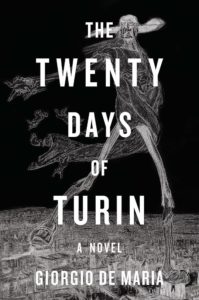
“Turin” is an ominous, symbolic vision of what may happen should we fail to address the dark side of innovation.
I am hardly the first reader to notice De Maria’s eerie anticipation of toxic social media: Turin’s citizens, suddenly free to anonymously share their personal thoughts, desires, and confessions, do not come together in brotherly understanding as the young men promised. Instead, they quickly become alienated from one another. Those who impulsively submit their intimate thoughts and personal experiences for anonymous popular consumption become paranoid. Much of the Library’s content is downright disturbing. No longer able to trust one another, citizens wander the streets in a sleepless stupor. These enervated individuals describe their mental states with adjectives like “drained,” “empty,” and “dry.”
Like De Maria’s Torinese, we digital natives were also pitched a vision of social optimism by enthusiastic young people, in our case, tech bro wunderkind. And without much of a thought about what it might cost us, we started uploading our queries, thoughts, and original work to our own version of Turin’s Library — social media platforms, and AI language learning models (LLMs) like ChatGPT.
Then we began to see mass murderers radicalized online who shot up schools and posted their manifestos for clicks. We saw acts of brutality play out in real time on our screens, and our children’s mental health erode. With the dawn of AI, we became unable to trust our own eyes.
But Leo, who in his first days as pope declared addressing the challenges posed by artificial intelligence as a top priority, thinks we can yet reverse course. To safeguard ourselves from what he calls “naive and unquestioning reliance on artificial intelligence,” we must, Leo said in January, “safeguard faces and voices.”
The pope has warned of AI’s tendency to transform us into “passive consumers” of “anonymous products” who lack “ownership or love,” but he could have been describing De Maria’s zombified Torinese: after consuming the lives of strangers at the Library, they collectively realize what they’ve given up and can’t get back — themselves — and struggle to process it. When the murders begin, having unlimited access to the faceless and voiceless secrets of others’ hearts, they are driven to paranoia.
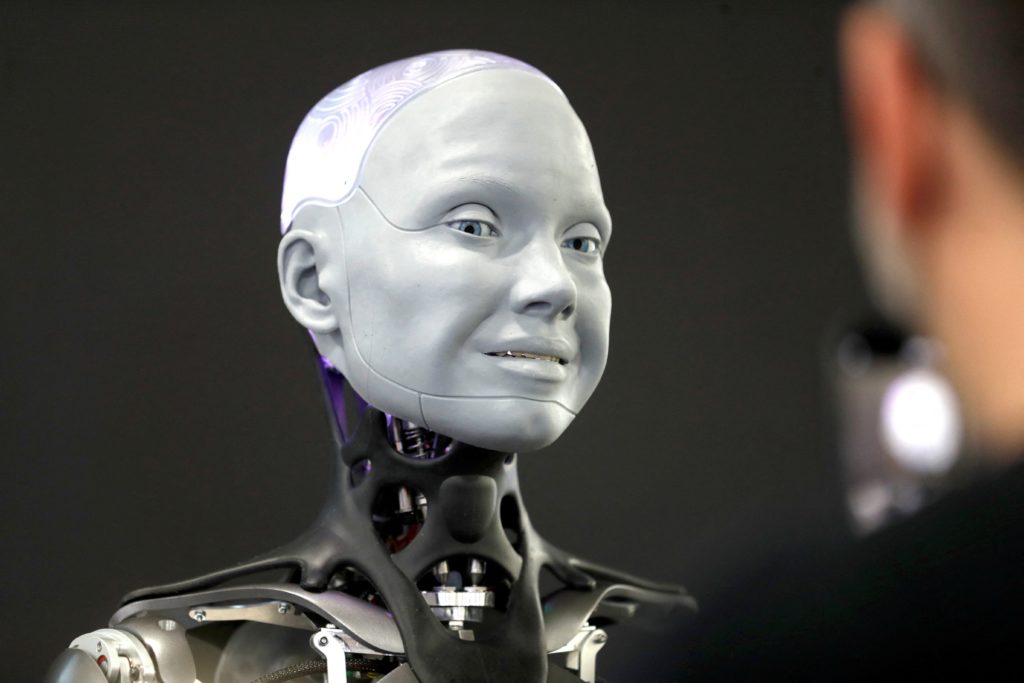
The ersatz intimacy De Maria’s characters get out of contributing to and reading from the Turin Library sounds a lot like the modern attachment to social media. But it also recalls something else Leo has warned against: the uncanny familiarity of chatbots trained on human speech to sound like our buddies, and the addictive emotional feedback loop that isolates the AI user.
In a recent survey, 1 in 3 13-17-year-olds said they have used AI companions for “social interaction and relationships,” which they insist are “as satisfying or more satisfying than those with real-life friends.” Leo observes that unlike our human friends, chatbots are “always present and accessible,” and this easy familiarity allows inanimate intelligences to become “hidden architects of our emotional states” who “invade and occupy our sphere of intimacy.”
The fictional Library also inflicts other chilling harms during the 20 days. People begin to notice that the city’s statues of historical figures are changing places. A monument that was facing one direction yesterday is facing another way. One statue has switched places with another on the other side of town. We learn the statues come to life at night and kill the insomniacs, whose shattered corpses are also discovered each morning.
The relationship between killer statues and anonymous confessions is not as far-fetched as it sounds. In his January Social Communications address, Leo said the same thing De Maria seems to suggest in “Twenty Days”: When we swap out real interpersonal relationships for what he calls “systems that catalog of our own thoughts” — in the novel, the Turin Library, in our world, LLMs, and social media — the result is “a world of mirrors around us, where everything is made ‘in our image and likeness.’”

In a hall of mirrors, the image reflected back can be difficult to distinguish from the genuine article. And likeness can be distorted.
Public statues, of course, are made in our likeness, as well as representing shared values and historical understanding. Distracted and alienated, both from one another and from themselves, the Torinese’ own past becomes unintelligible to them and they are unable to trust even their own memories: “I could swear the statues of Vincenzo Vela and Napoleon Bonaparte had swapped places. It isn’t Vela with his back turned on us, is it?” one character asks, trying to recall the monuments’ correct positioning. “I felt out of place myself, even if I didn’t know enough to say what my rightful condition could be.”
With a citizenry thus disoriented, the statues see an opportunity and the past becomes deadly.
In one of the novel’s eeriest scenes, the narrator comes upon a cassette recording of the statues screaming threats to one another. Speaking in “metallic” voices, their language becomes increasingly florid (and as with LLMs, evidently derived from stolen intellectual property: “Sounds like Kipling to me,” the narrator observes).
When the combative statues go on to duel one another, they use the bodies of the sleepwalking Torinese — the people who made the statues in the first place. Their humanity is gone now, having uploaded it into the Library. “There’s not much life in them left to suck!” one statue remarks to another. Library users have failed, as Leo says, to safeguard their very selves. And it is those hollowed-out selves that malevolent forces weaponize and ultimately destroy.
Which forces? De Maria never actually tells us who the backers of the Library are or what they finally want. For Leo, there is a similar risk associated with mindlessly handing over individual and collective memory to opaque technologies. In getting our news (and thus, our history) from YouTube and ChatGPT, we don’t always know whose version we’re getting and what they want.
“A lack of transparency in algorithmic programming, together with the inadequate social representation of data, tends to trap us in networks that manipulate our thoughts,” he said in January. AI models, Leo warned in the January statement, “are shaped by the worldview of those who build them,” and can “impose these ways of thinking by reproducing the stereotypes and prejudices present in the data they draw on.”

One troubling example that demonstrates the pope’s point is the rise of online antisemitism. The number of social media posts advancing Holocaust denial claims and distorting the history around the Holocaust is growing at alarming rates. Antisemitic language is casually tossed around in X and Instagram replies in ways that would have been unimaginable even a few years ago.
The window to address these issues is closing fast. Roughly two-thirds of U.S. teens ages 13 to 17 say they use an AI chatbot to search for information and get help with schoolwork. For current events, Pew reports that today’s young adults are more likely than other generations to trust the news they get from our modern-day Turin Libraries: platforms like TikTok, X, and Instagram. It’s often hard to know how much of this content is true, or even real, furthering the cycle of mistrust.
Like the Torinese, we’ve been pretty wanton with our humanity until now, mindlessly uploading our original creations, intimate thoughts, and deeply personal stories, without realizing the broader consequence: the human self is fast becoming a commodity put up for consumption.
Leo, meanwhile, says it’s time for “faces and voices to speak for people again.” He wants Catholics to proclaim still more loudly that the individual self is precious and not something to be mined for content, pleasure, or gain.
De Maria’s novel asserts a peculiar irony: the more interested we become in the private self, the more we risk our own dehumanization.