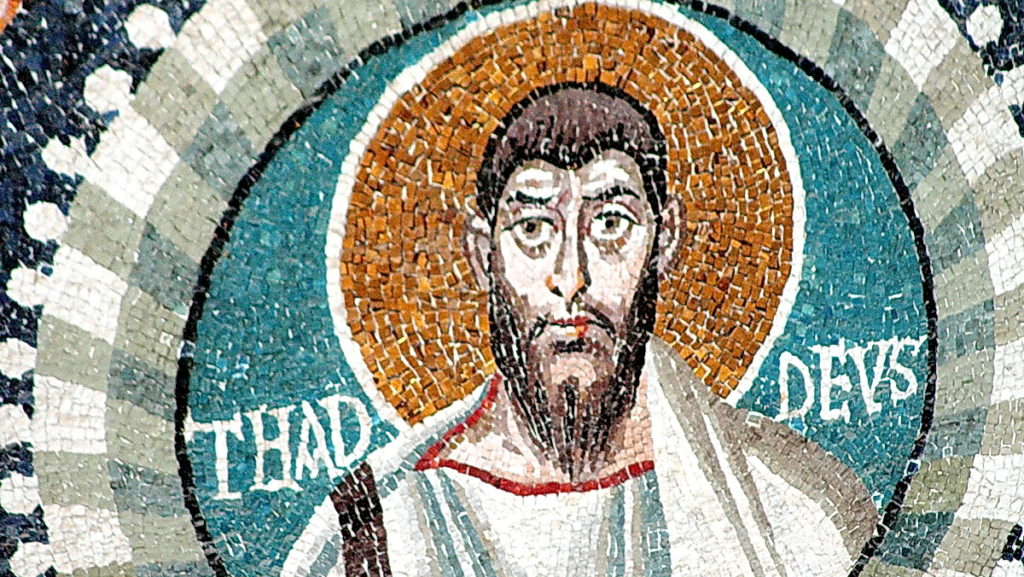
Few parents in the early Church named their sons Judas. The name had once been honorable. It recalled Judah, son of Jacob, and Judas Maccabeus, the great defender of Israel against gentile domination.
But one man went and ruined it: Judas Iscariot, the apostle who betrayed Jesus with a kiss.
This helps us understand why the Gospel writers take such pains to identify another apostle with the same name. Luke calls him “Judas the son of James” (Luke 6:16). Matthew and Mark call him Thaddeus (Matthew 10:3; Mark 3:18). John, determined to prevent any misunderstanding, identifies him as “Judas (not Iscariot)” (John 14:22).
This Judas — also known as Jude or Thaddeus — is the saint whose feast the Church celebrates every year on my birthday, Oct. 28. Tradition remembers him as a missionary who traveled with the apostle Simon into Persia, where both suffered martyrdom.
The Gospels preserve only one sentence spoken by Jude. At the Last Supper, Jesus promises that he will reveal himself to those who love him. Jude asks: “Lord, how is it that you will manifest yourself to us, and not to the world?” (John 14:22)
It’s a good question, and Jesus answers that God makes his dwelling with those who love him and keep his word. So Jude’s question draws from Jesus a magnificent promise: a Christian’s soul can become a home of the Father, Son, and Holy Spirit.
Jude may also have left us one book of the Bible. The brief Letter of Jude begins: “Jude, a servant of Jesus Christ and brother of James.” Scholars debate whether this author was the apostle or another relative of Jesus. But there is good reason to believe the letter comes from the first generation of Christians.
Some have suggested that it was written much later by an anonymous author using Jude’s name. That seems unlikely. A forger hoping to give his work prestige could have chosen Peter, Paul, or John. Why choose Judas? After the betrayal, almost any Christian name would have carried more authority.
And why would the Church preserve this very short letter — only 25 verses — as sacred Scripture if it came from no one of consequence? Its exhortations resemble teachings found elsewhere in the New Testament. Its inclusion makes best sense if the letter came from a man whose authority the earliest Christians knew and revered.
Jude wrote to Christians endangered by corrupt teachers who twisted God’s grace into an excuse for immorality. He urged believers to “contend for the faith” while showing mercy to those led astray. “Save some,” he commanded, “by snatching them out of the fire” (Jude 23).
That verse may help explain his later reputation as the patron of lost causes. Jude does not abandon people who seem beyond recovery. He goes after those nearest the fire.
No cause is truly lost while God’s grace is at work. And perhaps the apostle who bore the most dishonored name became the perfect saint to teach us that lesson.
And I’m pleased today that my youngest grandchild bears his name.