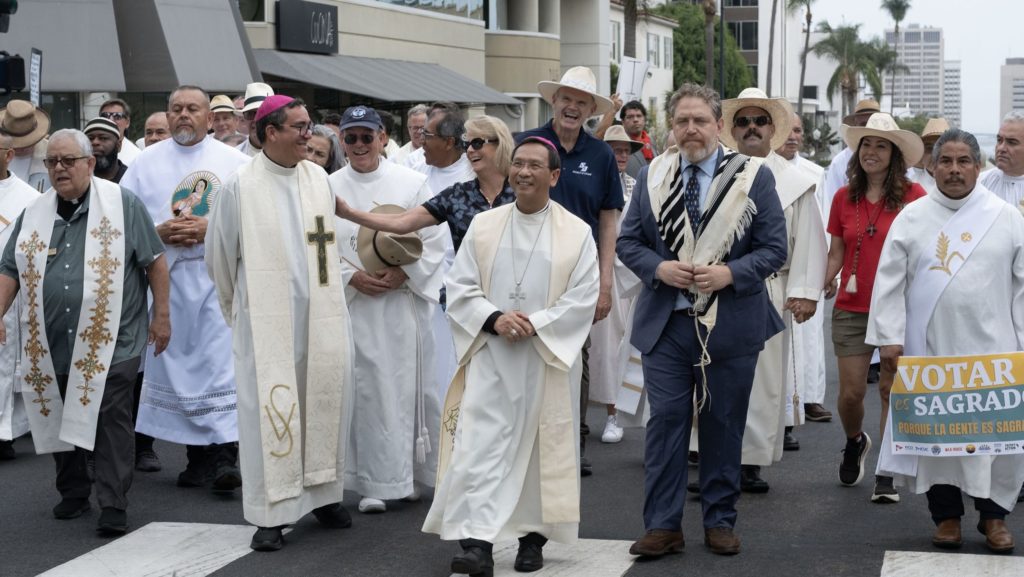
More than 4,000 people of faith participated in an afternoon procession around San Diego's Balboa Park to proclaim that "All Are Sacred" on Sept. 27, the World Day of Migrants and Refugees.
Bishop Michael M. Pham of San Diego led the procession, walking alongside dozens of priests, deacons, men and women religious, as well about 20 faith leaders from other traditions.
Gathered on one corner of the park, the participants -- many of whom had traveled in groups from their parishes -- heard prayers and brief reflections from various faith leaders, including Bishop Pham, San Diego Auxiliary Bishop Felipe Pulido, Catholic parish priests, an imam, rabbis, a Unitarian Universalist minister and an Episcopal priest.
"I'm very, very grateful and thankful for all of you being here today," Bishop Pham said in a reflection he shared with the crowd. "This is a beautiful sight, to see people from across our region gathered together, people of different faith traditions, ethnicities, cultures, languages and life experiences."
"I am especially grateful to my brother Bishop Felipe Pulido, to our priests and deacons, to the religious and community leaders who have joined us, and to all of you who have come today to raise awareness" on this World Day of Migrants and Refugees.
It is, he said, "a day when we stand with our migrant and refugee brothers and sisters. Whether we know it or not, we are all migrants in this world."
Bishop Pham referenced the theme Pope Leo XIV chose for the 112th world day observance "Even just one of these children."
"Those words remind us that before there are questions of politics or policy, before there are arguments about borders and immigration, there is a human person before us, a life in a womb, a child, a mother, a father, a family, an elder, a neighbor -- all are sacred," the bishop said.
"Every human being is sacred. No matter where we were born, no matter where we now live, no matter what language we speak, and no matter what our immigration status may be. That is why we are here," he added.
As a bishop whose U.S. diocese borders Mexico, he said, he has "listened to many of our immigrant brothers and sisters."
"I have listened to families who are afraid, parents who worry about being separated from their children, people who are afraid to go to work, to take their children to school, to seek the help they need, or even sometimes to come to church," he continued.
"These are not simply stories we hear on the news. These are our neighbors. They are members of our congregations and our communities. They work beside us. Their children go to school with our children. They worship beside us."
Bishop Pham noted that some were not participating in the day's event because they were afraid to be there, "but I know many of them are watching us. To you, especially, I want to say, 'You are not alone. We see you. We hear you. And we walk with you.'"
Others were not there, he said, "because they have been deported and have been mistreated, without due process."
Bishop Pham talked about the "special pastoral message on immigration," the body of U.S. bishops issued in November 2025 to voice their concern for immigrants. "We are disturbed when we see among our people a climate of fear and anxiety around questions of profiling and immigration enforcement," said the statement, released at their annual fall plenary assembly in Baltimore.
"We oppose the indiscriminate mass deportation of people. We pray for an end to dehumanizing rhetoric and violence, whether directed at immigrants or at law enforcement," Bishop Pham said, quoting from the message. "We pray that the Lord may guide the leaders of our nation, and we are grateful for past and present opportunities to dialogue with public and elected officials. In this dialogue, we will continue to advocate for meaningful immigration reform.'"
He told the crowd, "We desperately need to remember, behind every debate about immigration are human beings. There are mothers and fathers. There are grandparents. There are young people dreaming about their future."
"Our nation has the right and responsibility to regulate its borders and to establish laws governing immigration, but how we enforce those laws is also a moral and ethical issue," Bishop Pham continued. "We cannot protect borders by forgetting the people who stand before them. We cannot uphold the law by setting aside human dignity. We cannot allow fear to convince us that some human beings matter less than others."
Different religious traditions "may express this truth in different ways," he said, "but today people of many faiths stand together to affirm a common conviction: Human dignity is not something a government gives us. It is not something earned by citizenship.
"It does not depend upon the documents we carry. It belongs to us because we are human beings. For Christians, we say even more: 'Every person is created in the image of God, the image and likeness of God.' All are sacred."
He called immigration "one of the most divisive political issues in our nation," with people having strong disagreements about policy, about borders, and about what our laws should be."
"Those conversations must continue, but we cannot allow politics to take away our faith, inspired values, or our voice. When human beings are frightened, faith must speak," Bishop Pham said.
"When a family faces separation, faith must speak. When people are treated primarily as problems rather than as persons, faith must speak," he said. "And our voice must not be a voice of hatred or condemnation. It must be a voice of conscience, a voice of compassion, a voice of justice, a voice that reminds our nation of its deepest values and reminds each of us of our responsibility to one another."
He also told the crowd, "We have not simply gathered for a rally. Let us make this a procession of faith and solidarity. Let us walk peacefully. Let us walk prayerfully. Let us walk with hope."
"But," he added, "our walk cannot end when this procession ends. Tomorrow, we must continue walking with one another in our churches, synagogues, mosques, and temples."
He urged everyone to keep walking with one another, listening to one another, working to "protect the dignity of families" and accompanying "those who are frightened."
"We must speak when human dignity is threatened, and we must work together for immigration policies and practices that are just, humane, and worthy of the dignity of every human person," Bishop Pham concluded.
Then the crowd set off for a 1.1-mile walk around the park, hoisting signs supporting immigrants, while singing hymns in English and Spanish.
The interreligious procession was organized by the diocese, in partnership with the San Diego Organizing Project, a multifaith network, and Our Lady of Guadalupe Parish.
The Southern Cross is the news outlet of the Diocese of San Diego. This story was originally published by The Southern Cross and distributed through a partnership with OSV News.