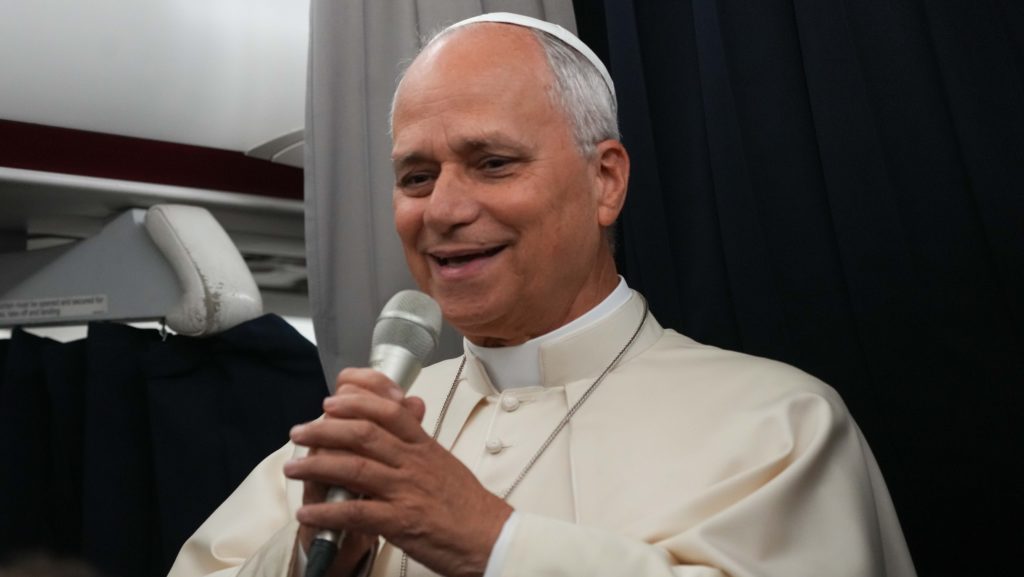
In light of growing concerns about the potential dangers of artificial intelligence, Pope Leo XIV told journalists he can still "sleep at night," even as he cautioned against dismissing warnings about the risks the developing technology could pose to humanity.
"If someone were to ask me, am I in panic mode? No, I'm not," he said Sept. 28 following his four-day apostolic journey to France. "I sleep at night."
"I do think that the concerns raised by many of the experts, specialists in AI, should be taken seriously," he said. "I don't think that that is fake news."
Protecting human dignity in the age of artificial intelligence has been a cornerstone of Pope Leo's teaching for months. He dedicated his first encyclical, "Magnifica Humanitas," to AI and its role in society, urging governments, technology companies and the public to ensure that technological development remains at the service of humanity.
The pope told journalists that the Vatican has formed its own commission on artificial intelligence, initially as a way to coordinate how AI is being used within Vatican City and to examine its risks and benefits.
Since the publication of his encyclical, however, the Vatican has been contacted by people working in numerous fields interested in the issue, he said.
"We are trying to continue to promote dialogue, study, investigation, to find ways to make sure that AI does not get to a point where it could destroy humanity or remove humanity from the conversation," Pope Leo said.
"I am relatively optimistic that that can happen," he added, saying there are enough people seriously interested in addressing the risks. But he warned against allowing questions of power, competition and the race toward artificial general intelligence to dictate its development.
"We have to keep working," he said. "We can't just sit back and pretend nothing is going to happen."
"To simply say, 'Oh, it's not going to happen,' and close our eyes to it, I think is probably not the most responsible way to go about that," he said.
While in France, the pope repeatedly urged political and social leaders to place human dignity at the center of the development and use of artificial intelligence.
Speaking Sept. 25 at the Élysée Palace in Paris to French President Emmanuel Macron, government officials, civil society leaders and the diplomatic corps, Pope Leo warned against losing humanity amid what he called a "paradise of machines" and said ethical discernment is indispensable if technological progress is to promote integral human development.
Recent incidents involving unsupervised AI agents have intensified debates over safety measures for increasingly autonomous systems. During the in-flight news conference, Pope Leo noted reports that AI companies were working to introduce "guardrails" and limits into their systems.
"There is no one, however, that says there should be no limits placed and no government regulation," he said, calling for political leaders, technology companies and civil society to work together to examine "what is happening already and what could be down the road."
During the roughly 20-minute news conference, Pope Leo also addressed clergy sexual abuse, the rise of far-right political movements in Europe, the war in Ukraine, France's tradition of strict secularism and the housing crisis affecting many European cities.
During his visit, Pope Leo met privately with seven people who had suffered sexual abuse within the Catholic Church. Following the meeting, some of the survivors told reporters that the pope had acknowledged the systemic nature of abuse in the Church.
Asked about those accounts on the flight, Pope Leo said several of the survivors had spoken to him about systemic abuse and acknowledged that some organizations within the Church had, at times, been abusive "as a system." But he said he preferred to distinguish between those cases and sexual abuse more broadly.
"Sexual abuse is first and foremost a human problem," he said. "When it happens within the Church, it actually has another whole dimension added to it because people's lives of faith are deeply wounded and sometimes even destroyed."
"There's a particular responsibility of the Church to walk with them and to help them seek healing," he said.
The pope also responded to a question about the growth of far-right political movements in Germany and their relationship with Christianity.
Pope Leo said it would be worthwhile to examine whether there is a relationship between the decline in participation in Germany's Christian churches and the growth of far-right groups, noting that some of those movements have themselves splintered as factions become more extreme.
He particularly warned about attempts to combine far-right political views with religion, saying Catholic and Protestant leaders in Germany have spoken out against such movements as "not an authentic expression of Christianity."
The values of the Gospel, he said, "are not about hatred and division, but about understanding and compassion and accompanying."
He expressed hope that people would participate in political life and "make clear choices for the common good and not for extremist ideas that perhaps will do much more damage than we are even aware of right now."
"Again, on our part as a Church, social doctrine of the Church: talking about, teaching about, preaching about what we believe are these life-giving values and not destruction, division and hatred," he said.
Asked about France's tradition of strict secularism, known as "laïcité," and whether his repeated defense of human life during the trip had crossed the line between religion and politics, Pope Leo said he did not believe it had.
"When the Church speaks about defending life, when it speaks about questions of social doctrine, we're not entering into politics, we're applying the Gospel to people's lives," he said.
The pope repeatedly spoke against euthanasia during the trip, including during his visit to Lourdes, as France implements recently approved legislation permitting the practice under certain circumstances.
"If that's politics, I did that, but it was not to get involved in French politics," Pope Leo told journalists. "It was to teach what the Church really believes."
Pope Leo was also asked to clarify comments he made earlier in the trip that countries must have the courage to sacrifice certain positions for the greater good of peace, particularly in relation to Russia's war against Ukraine.
He reiterated the Church's opposition to violence, hatred and an escalating arms race, criticizing the enormous sums spent on weapons while hunger, health, education and other human needs remain unmet. The pope said the Church must continue to encourage negotiations even when diplomatic efforts appear to have little effect.
"I believe that the Church has a responsibility to promote these values, continually inviting the leaders of Russia and Ukraine, other countries, to come, to sit down, to dialogue, to look for how to solve problems without continuing these wars that no longer make sense," he said.
"We cannot force anyone," he added. "Sometimes it seems that it can be useless, but we are going to keep talking, we are going to keep inviting, we are going to keep announcing the Gospel."
The pope also called for greater cooperation among governments, local communities and the Church in confronting housing crises that have made it increasingly difficult for people, particularly young people, to afford homes in major European cities.
A Spanish journalist asked Pope Leo about the case of Maricarmen Abascal, an 87-year-old woman with a disability who was forcibly removed Sept. 23 from the Madrid apartment where she had lived for more than seven decades.
Abascal had lived in the apartment since 1956 under Spain's old system of rent-controlled leases, but subsequent changes to national rental law restricted the inheritance of such contracts. A court ultimately ruled that her decades-old lease had expired.
Pope Leo said he was unfamiliar with Abascal's particular case but said situations like hers demonstrate the need to search for "more just solutions so that these cases don't happen."
"I think it would be a case where the neighbors, the community, the parish, the diocese or the state would have to come together and say: How is it possible for a case like this to happen?" he said. "What is the problem in the system that allows the case of an elderly woman with a disability or with some difficulty to be kicked out of her home?"
The Church speaks both about the throwaway culture and injustice, he said, but the housing crisis requires action from political leaders and public authorities as well.
"Many times we react only at the moment of emergency," he said, "but we have to see in reality what is the systemic cause of this problem and how to help."
Asked about his future travel plans beyond Latin America in November, and when he might visit Germany, Pope Leo said no date had been set.
"The only trip definitely planned is World Youth Day in Korea," he said, which is scheduled for August 2027.