“It is indeed singular that the Western man, while refusing to place credence in anything he cannot see, should at the same time deny the evidence of his own eyes.”
— English writer Osbert Sitwell (1892-1969)
The small island hamlet of Widow’s Bay, the titular setting of Apple TV’s popular new show, is cursed. Not metaphorically, like with bad weather and a lack of Chipotles (though this is also true), but actually supernaturally cursed.
The town’s Puritan founders forged a devil’s pact in order to survive on this godforsaken spit of rock 50 miles off the coast of New England, and hundreds of years later their descendants still reap the consequences. Ghosts, witches, and basically anything Stephen King has ever dreamt up plague the poor denizens of Widow’s Bay — and they’ve come to terms with it.
The human spirit is resilient, though perhaps the better word is malleable. The townsfolk of Widow’s Bay take it all in stride, if only because they have no other choice. They shrug off what they can and pass on hard-earned advice to visitors. (“It’s perfectly safe to drive by the old hospital,” says one local when giving directions, “just don’t slow down.”) There’s something of the medieval about it all, the supernatural as a matter of course. I’m reminded of St. Joseph of Cupertino, who levitated so often his superiors complained he was being a distraction.
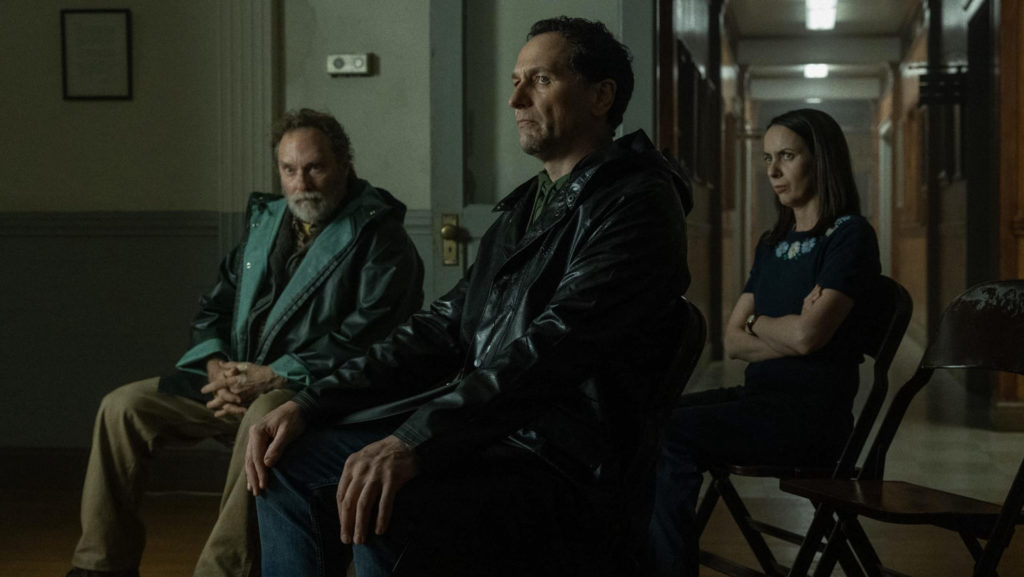
The only one who hasn’t accepted it is the town mayor, Tom Loftis (Matthew Rhys). Tom won the office, but only because he ran unopposed: after all, you didn’t see many volunteers for captain after the Titanic struck its destiny. Tom is an outsider; he summered on the island as a child, but was otherwise raised in a world where werewolves aren’t a matter for pest control.
Tom means well, but he’s a typical man of his time, our time. He still operates on the logic that the supernatural doesn’t exist because the supernatural can’t exist; any evidence to the contrary is safely dismissed because it adds up to a conclusion he’s already deemed impossible. This leads to mutual antipathy between him and his constituency: as he tries to drag them into the 21st century, they try to inform him it matters little to the sea hag that sea hags don’t exist.
Tom dreams of turning Widow’s Bay into the next tourist hot spot, with the beaches of Martha’s Vineyard and the spooky history of Salem. This isn’t the worst plan: New England has a track record of selling what was once lower class back to the wealthy at a premium. Just look at what they did to lobster, turning peasant food into a dish you can only order with a cosigner. They do the same with decaying, hollowed shells of industry with ominous pasts, whitewashing them into bourgeois vacation towns the locals can’t afford to live in anymore.
This plan is a hard sell to both townies and tourists. The sweet old docent in the town museum shows an exhibit on their past witch burnings, “We caught ’em, we burned ’em,” she says with regional pride. Salem at least pretends to feel a little bad about it before profiting.
And despite their resignation to their fate and their distaste for mainlanders, Widow’s Bayers would prefer to keep the body count down. The tourists, meanwhile, share Tom’s baseline skepticism and have less financial investment in ignoring the warning signs. Widow’s Bay pulls the neat trick of making the mayor from “Jaws” into the protagonist, rooting for him even as he maneuvers everyone into a catastrophe.
This is the fun of the show, seeing how modernity grapples with the supernatural and how the supernatural grapples in return. In the famous words of William Faulkner: “The past is never dead. It’s not even past.” We expect ghosts in old attire and old attitudes, but the present is just a future past: ghosts have always adapted to the times for the best way to scare us. I remember watching “Pirates of the Caribbean,” and it occurred to me that a haunted pirate ship wasn’t antiquated to people at the time — it would be like getting chased down by a possessed Boeing 737 today.
My favorite episode involves one lonely resident of the island finding a self-help book in one of those little free libraries you see in neighborhoods. The book seems precisely attuned to her many insecurities, but the advice isn’t exactly constructive. (One section asks you to write down what you like and dislike about yourself; the first part gets a paragraph of space and the second several pages.)
It’s not until she comes out of a trance in pagan headdress, standing over a witches' brew bobbing with severed chicken heads, that she realizes something is amiss. The woman has actually stumbled upon a spellbook, as the supernatural has realized that the self-help book is the closest thing modernity has to a religious text and adjusted accordingly. (Conspicuously, the author’s name is Lucy Fours.)
“Widow’s Bay” is the best new show of the year (it’s received 19 Emmy nominations this year), funnier and spookier in one fell swoop than other shows that don’t have to multitask. It’s also a reminder of the great continuum of the past, how even as old problems become new problems, that just means you can still rely on the old solutions. No matter what decade you’re in, a rosary has four more.