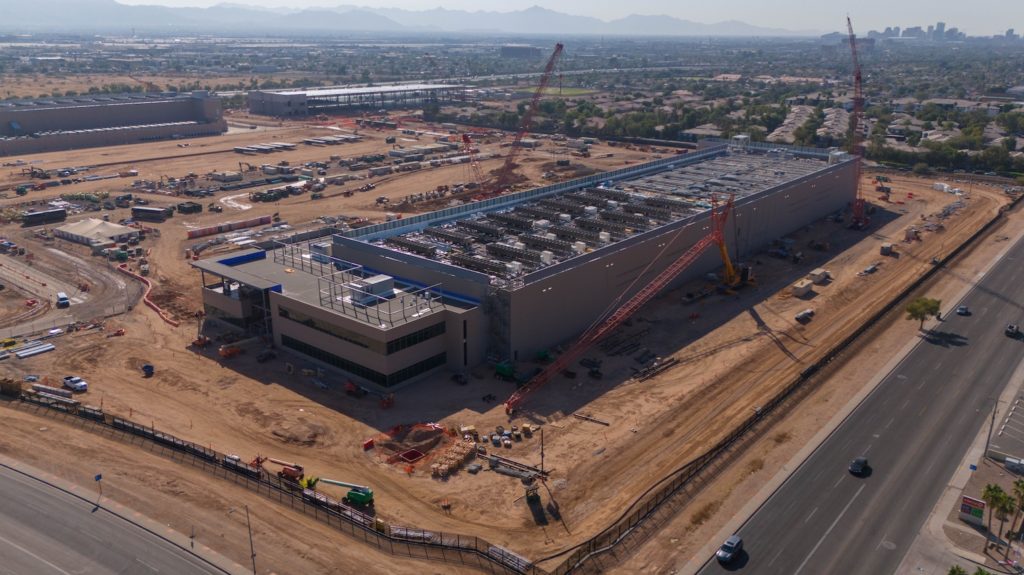
As artificial intelligence drives a rapid expansion of energy-hungry data centers across the United States, Catholic environmental advocates are urging lawmakers, technology companies, and consumers to evaluate the industryʼs growth through the lens of Catholic social teaching.
Catholic leaders in social teaching, environmental stewardship, and advocacy said the Church is not opposed to artificial intelligence itself.
“The Church is not anti-tech. It is not, in a sense, anti-AI,” Scott Hurd, vice president of leadership development and Catholic identity at Catholic Charities USA, told EWTN News. “But it is very concerned about the ethics involved in the design of these tools and the data centers.”
Why data centers matter
Data centers house the computer servers that process and store information behind artificial intelligence systems. Their rapid growth, however, has also prompted concerns over electricity use, water consumption, electronic waste, and impacts on nearby communities.
Hurd said the issues can be understood in simple terms.
“They require immense amounts of energy,” he said, noting that facilities also consume large quantities of water to keep servers cool. In some areas, he added, residents have reported concerns over water quality, while aging computer equipment contributes to growing amounts of electronic waste.
Hurd also pointed to local concerns including electrical grid demands and noise from cooling systems.
“Water, energy use, the type of energy being used, and e-waste are big problems,” he said. “Then locally for people who live there, the noise pollution can really impact a community and the well-being of the people who live there.”
Kayla Jacobs, director of advocacy and youth mobilization for the Catholic Climate Covenant, said her organization regularly hears from Catholics living in communities where data centers are planned or under construction.
“We’ve been hearing a lot about the huge strain on resources,” Jacobs said in an interview with EWTN News. “That leads to higher energy and water bills for common people because, at the moment, those companies putting in these data centers aren’t required to pay for that.”
She added that residents also express concerns about air quality, construction impacts, light pollution, and the overall quality of life near the facilities.
Industry response
The Data Center Coalition, which represents many of the industryʼs largest operators, disputed claims that data centers are driving higher utility costs or failing to pay for the resources they consume.
“Data centers are committed to being responsible and responsive neighbors,” Dan Diorio, the coalitionʼs executive vice president for state policy and government affairs, said in a statement to EWTN News.
Data centers provide the infrastructure behind not only artificial intelligence but also online banking, hospitals, schools, manufacturing, telehealth, air travel, and other essential digital services. The group said the facilities are increasingly critical to the U.S. economy and modern daily life.
Diorio said research from states including Virginia and Arizona indicates the industry pays its full energy costs, while studies have found data centers have not been a primary driver of electricity rate increases nationally.
He also said many facilities use relatively modest amounts of water compared with other industries. In Virginia — the world’s largest data center market — 83% of data centers use the same or less water than an average commercial office building.
Diorio pledged continued collaboration with local communities and policymakers on responsible resource use.
The coalitionʼs assessment differs from concerns raised by Catholic environmental advocates, who argue that communities are already experiencing higher resource demands and other local impacts.
A question of Catholic social teaching
While environmental concerns surrounding AI infrastructure often enter political debate, environmental advocates said Catholics should view the issue primarily through the lens of Catholic social teaching.
“It is a doctrinal matter to be considered,” Hurd said, noting that concern for the environment is closely tied to concern for local communities through the Church’s understanding of integral ecology.
Molly Burhans, an environmental researcher and the Ignazio Danti, OP, fellow in geography at The Catholic University of Americaʼs Leonine Institute for AI and Emerging Technologies, said Catholics should resist treating the issue as a choice between embracing or rejecting technology.
“We need to distinguish where they make sense and how they can make sense,” Burhans told EWTN News. “We can’t really go backwards in time now. We can’t get rid of this technology. How can we work with it and align it with human flourishing and the common good?”
Burhans said Catholics should evaluate AI development according to the principles of human dignity, the common good, and stewardship of creation.
Burhans also argued that environmental stewardship itself is a pro-life concern.
“Pollution almost always disproportionately falls on the vulnerable,” she said, including unborn children, who are especially susceptible to environmental toxins during development.
She described creation not as “a warehouse” for human consumption but as “a gift entrusted to us for stewardship.”
What can Catholics do?
Rather than seeing the issue solely as one for lawmakers or technology companies, Catholics have a role to play, advocates said.
Hurd encouraged Catholics to become familiar with the Church’s growing body of teaching on artificial intelligence, including the Vatican document Antiqua et Nova, Pope Leo XIV’s recent encyclical Magnifica Humanitas, and the U.S. Conference of Catholic Bishops’ guidance on AI.
He also suggested that Catholics examine their own use of AI.
Pope Leo’s call for “digital sobriety,” Hurd said, challenges Catholics to use artificial intelligence intentionally rather than frivolously, recognizing that every AI interaction relies on physical infrastructure with real environmental costs.
“I think an ethical case can be made to use this with intention,” he said, “understanding that there’s a real environmental impact.”
Jacobs likewise encouraged Catholics to think critically about their personal use of AI, not only for environmental reasons but also for the social impact it can have on humanity.
“People are using it without even thinking about it,” she said. “But we really need to reduce our use of AI, not just for the environmental impacts, but also we need to consider the effect it has on human interaction,” Jacobs said.
She said local governments often hold public hearings before approving projects, allowing residents to ask questions about environmental impacts, water use, and community planning.
Balancing innovation with responsibility
The advocates stressed that artificial intelligence itself offers significant opportunities, from medical advances to improved education and scientific research. The challenge, they said, is ensuring that technological progress does not come at the expense of people or the environment.
“We need an equally ambitious commitment to renewable energy, responsible water stewardship, transparency, and just economic participation,” Burhans said.
For Catholics, the argument ultimately extends beyond technology.
“Caring for our common home is not just an act of environmental care,” Burhans said. “It’s also an act of gratitude.”
As artificial intelligence becomes an increasingly permanent part of daily life, Catholic leaders say the challenge is ensuring its development serves the common good while respecting both human dignity and Godʼs creation.