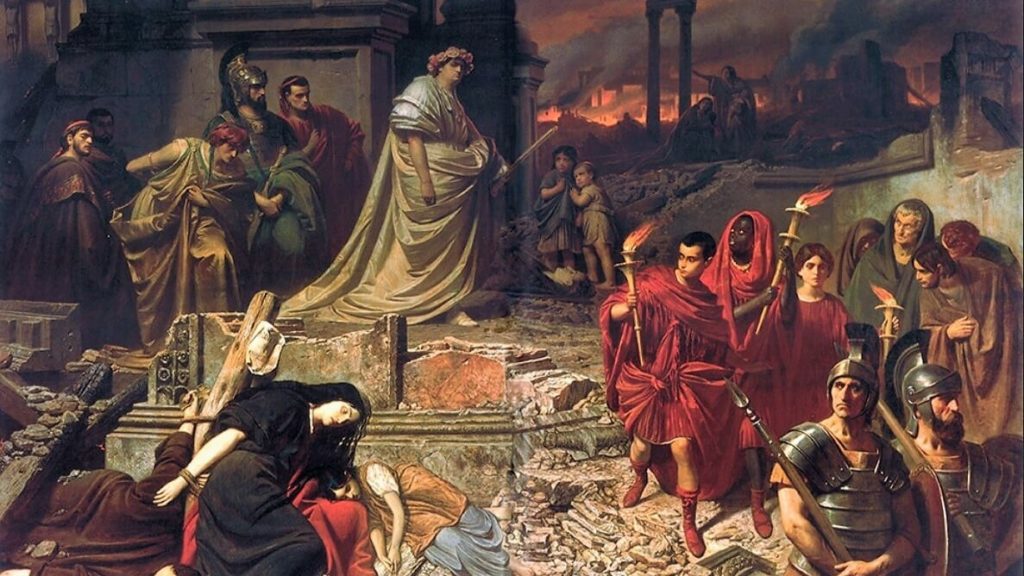
The feasts come in quick succession at the end of June. The Church remembers the first martyrs of the city of Rome. Then, the very next day, she honors Sts. Peter and Paul. Tradition tells us they all died in the same terror, unleashed by the emperor Nero after the great fire of Rome in A.D. 64.
The catastrophe devastated the capital. Ancient historians describe whole neighborhoods consumed in flames. Rumors spread quickly that Nero himself had ordered the fire. He needed someone else to blame. So he turned against the Christians — a small, misunderstood minority already viewed with suspicion by their pagan neighbors.
The Roman historian Tacitus preserved the grisly details in his Annals. Christians were arrested in large numbers. Some were wrapped in animal skins and torn apart by dogs. Some were crucified. Others were covered in pitch and burned alive to light up Nero’s gardens at night.
It was the first great persecution of Christians by the Roman state, and it established a precedent that would haunt the Church for the next two-and-a-half centuries. Rome learned that Christians could serve as convenient scapegoats in moments of public crisis.
Yet something in the story deserves closer attention. Why did these Christians endure such horrors without renouncing Christ? What fortified ordinary men and women to face torture, public humiliation, and death?
Part of the answer may lie in a text they had heard proclaimed aloud in their liturgy: St. Paul’s Letter to the Romans.
Only a few years earlier, the apostle had written his great letter to the Christians in Rome. By the year 64 they would have known many of its words by heart. They had heard them repeatedly in worship. They prayed them. They measured their lives against them.
And perhaps, in the hour of trial, one passage especially returned to them: “I appeal to you therefore, brethren, by the mercies of God, to present your bodies as a living sacrifice, holy and acceptable to God, which is your spiritual worship” (Romans 12:1).
That line must have sounded strange in pagan Rome, where sacrifice usually meant slaughtered animals offered before stone idols. But Paul taught something radically different. The Christian’s own body, offered in union with Christ, became a sacrifice pleasing to God.
The martyrs of Rome took those words literally. As the flames rose around them, as the crowds mocked, as the beasts approached, they understood that they were uniting themselves to the sacrifice of Jesus Christ — the sacrifice he made on the cross — the sacrifice re-presented in the Mass. Their suffering was not meaningless. Their deaths were not defeat. Their bodies themselves had become an act of worship.
The Roman authorities hoped terror would extinguish the Church. Instead, the blood of the martyrs became the seed of Christian Rome.
The city that once illumined its nights with burning Christians would eventually fill its basilicas with their relics and celebrate their feast days on the calendar of the universal Church.