Headlining the June 10 public session of the U.S. bishops' spring plenary in Orlando were addresses by the president of the U.S. Conference of Catholic Bishops and the new apostolic nuncio to the United States, along with a preliminary presentation on proposed updates to the bishops' landmark document on protection policies for children and minors.
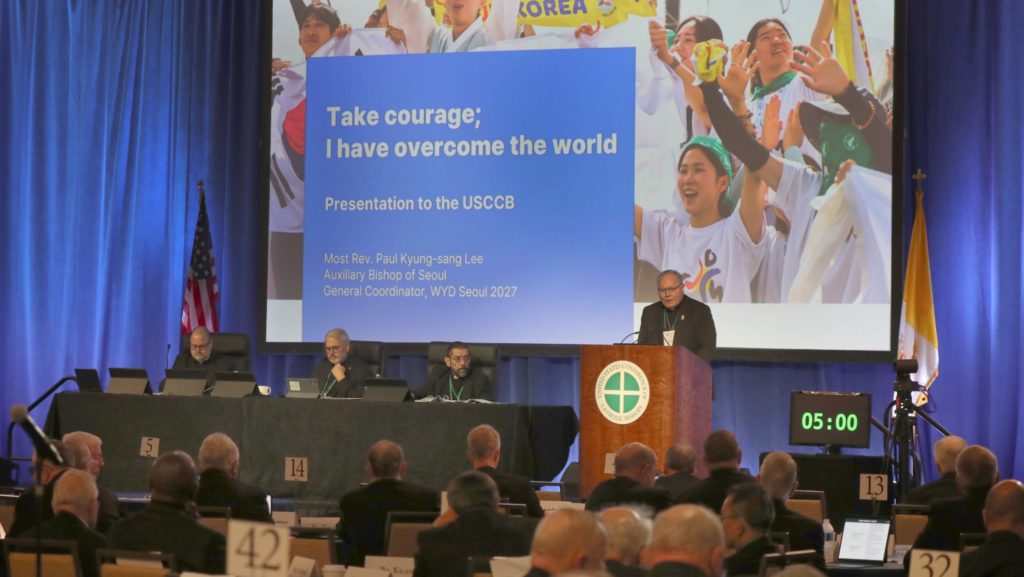
A highlight in the afternoon was a report on World Youth Day 2027, accompanied by a gift of traditional Asian paper fans for each bishop from South Korea -- whose capital, Seoul, will host the international event.
In a morning presentation, Bishop Barry C. Knestout of Richmond, Virginia, chairman of the USCCB's Committee on the Protection of Children and Young People, said the bishops are reviewing proposed updates to the "Charter for the Protection of Children and Young People," seeking to define key terms while balancing care for victim-survivors with accused clergy's right to a presumption of innocence until proven otherwise.
The suggested changes would keep the charter focused "exclusively" on clergy abuse of minors, with a new document being developed to address abuse involving vulnerable adults, Bishop Knestout said. Voting on the agenda item was scheduled for June 11.
He said the revised text includes a glossary of terms in response to diocesan requests, and -- drawing on canon law -- the integration of"the right of an accused to the presumption of innocence."
Following the presentation, Archbishop Shawn McKnight of Kansas City, Kansas -- citing several factors, and calling for a "more synodal approach" -- asked if it would be possible to suspend the vote on the revisions pending further consultation among presbyteral councils and diocesan review boards.
At the start of the public session, Msgr. Michael J.K. Fuller, the USCCB's general secretary, read a message from the U.S. bishops to Pope Leo XIV thanking him for his new encyclical "Magnifica Humanitas" and for shining "the light of the Gospel and the tradition of the Church on the new opportunities and challenges posed by the rise" of artificial intelligence and "emerging technologies."
The bishop said the pope's teaching is a timely reminder that human life and dignity must remain at the center of technological development. Marking the first year of Pope Leo's pontificate, they prayed that he would continue to be a guiding light for both the Church and the wider world.
Archbishop Paul S. Coakley of Oklahoma City gave his first address to the body of bishops as USCCB president, having been elected during the conference's annual fall meeting in November 2025.
The Church must "put out into the deep" and "create hope in Christ," he said. He told the bishops he was "especially pleased to recognize the impact" of the USCCB's special message on migration, released during the conference's November 2025 plenary assembly amid the Trump administration's hardline crackdown on immigration, which has seen sweeping mass detentions and deportations.
The USCCB message "demonstrated our united concern as pastors for the dignity of every person, especially our migrant brothers and sisters," said Archbishop Coakley.
Archbishop Gabriele G. Caccia gave his inaugural address to the bishops as nuncio to the U.S.
He was named to his new post in March, after having previously served as the Holy See's permanent observer to the United Nations.
In his remarks, he highlighted the consecration of the U.S. Church to the Sacred Heart of Jesus, urged the bishops to fulfill their mission as missionary disciples by welcoming immigrants in their midst, and reminded his brother bishops he is there for them, especially in moments when their responsibilities as episcopal shepherds leads them to feel isolated.
"My service here is one of listening, trust, and shared discernment within the Church that we are all serving together," Archbishop Caccia said.
In the late afternoon, as chairman of the USCCB's Committee on Laity, Marriage, Family Life and Youth, Bishop Edward J. Burns of Dallas gave a report on World Youth Day 2027, which is to take place Aug. 3-8 in Seoul, and he introduced Auxiliary Bishop Paul Kyung Sang Lee of Seoul, general coordinator for WYD 2027, who brought traditional Asian folding fans as a gift to the bishops.
Bishop Burns said some 10,000 to 15,000 young pilgrims will travel to South Korea, a number he said would be comparable to the U.S. presence at WYD in Brazil (2013) and in Panama (2019).
Bishop Lee said he hopes all U.S. bishops will inspire young people of their dioceses to participate in the global event. The bishop detailed how the Catholic Church of Korea began in the hands of the laypeople, became strengthened by the blood of 10,000-plus martyrs, and served as a sanctuary for democracy and human rights.
"I have a simple hope that by the end of this presentation, Seoul will feel a little less far away," Bishop Lee said. After the Korean War (1950-1953), he said, "Korea was one of the poorest countries of the world. In 80 years, Korea moved from devastation to renewal. The hardships did not have the final world. Hope can renew and heal a nation."
Bishop Lee also spoke about three special WYD events that are to take place with Pope Leo XIV -- a meeting with people facing hardships, interreligious dialogue, and prayers for world peace.
World Youth Day promises to be a "powerful opportunity" for young people from across the globe to witness how "God's love never ceases, regardless of circumstances," the bishop said, adding that three special events with Pope Leo XIV are planned -- a meeting with people facing hardships, interreligious dialogue and prayers for world peace.
The bishops also heard from mathematical biologist Santiago Schnell, a Catholic scientist and provost of Dartmouth University. He was invited to speak June 10 by Bishop Kevin C. Rhoades of Fort Wayne-South Bend, Indiana, USCCB secretary and chair of its Committee on Priorities and Plans.
The talk anticipated the bishops' discussion of the 25th anniversary of the USCCB's implementation of "Ex Corde Ecclesia," St. John Paul II's apostolic constitution on Catholic universities.
The Catholic imagination needs to be reawakened in academic life to nurture leaders who can become "voices for the Catholic Church," Schnell advised the nation's bishops.
During his presentation, Schnell -- formerly dean of the University of Notre Dame's College of Science -- warned that Catholics were, as his presentation title asserted, "educated, yet absent" from American intellectual life.
"The Catholic paradox is that we have a massive infrastructure of higher education with average outcomes," said Schnell. "We are not educating sufficient Catholics in our Catholic higher educational system. And we're not educating them, actually, to become leaders."
The bishops also heard a preliminary presentation on portions of two texts for consideration: a new edition of the Lectionary for Mass, which provides the Scripture readings and psalm for each day's liturgy; and the 2025 Roman Missal-Liturgy of the Hours Supplement.
In a voice vote they showed support for the local advancement of two separate American canonization causes: Bishop Daniel J. Felton of Duluth, Minnesota, gave a presentation on the cause opened in his diocese for pioneer missionary priest Msgr. Joseph Buh and Archbishop Thomas G. Wenski of Miami presented the cause of entrepreneur-turned-evangelist John Rick Miller.
The consultation of a body of bishops -- at either the regional or national level -- is required by Church legislation governing the canonization process as a cause gets underway.