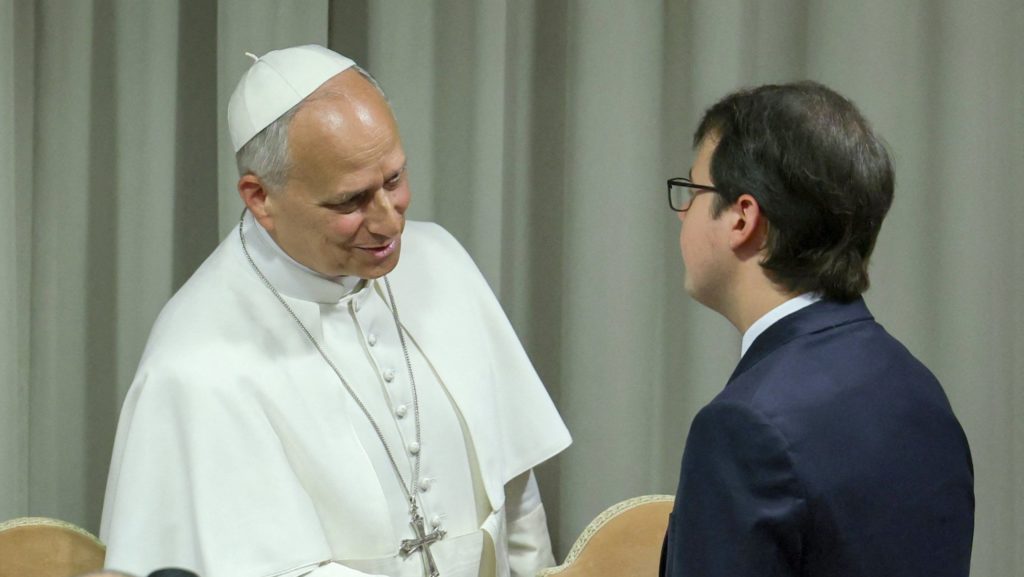
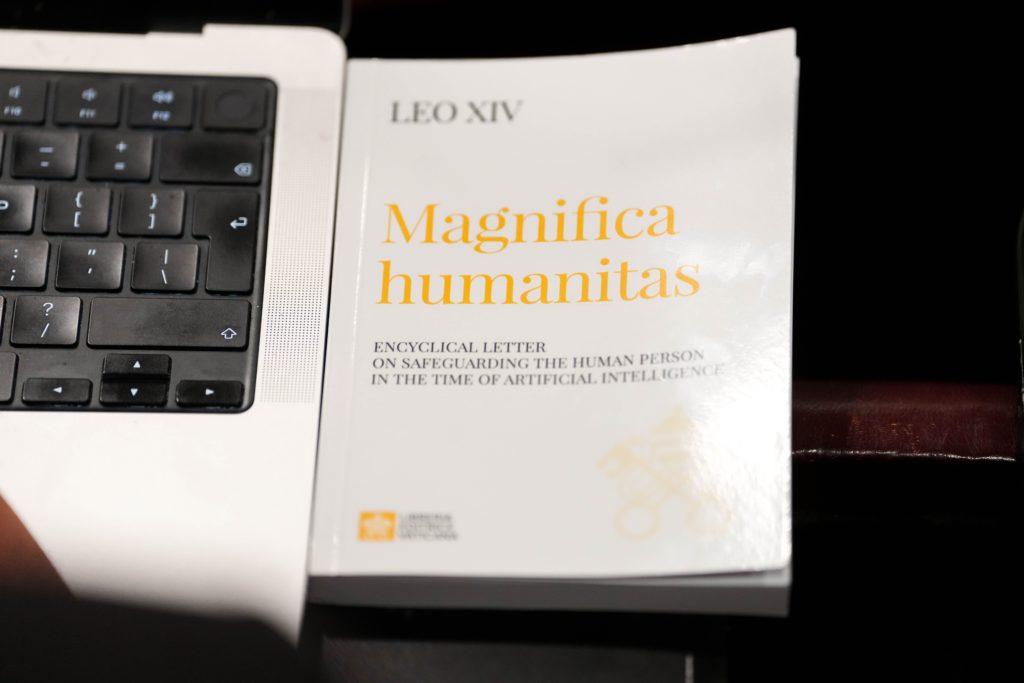
Few documents from a successor of Peter in modern times have generated as much media reaction as Magnifica Humanitas (“Magnificent Humanity”), Pope Leo XIV’s long-awaited encyclical on Catholic social teaching in the age of artificial intelligence (AI).
And few people are as familiar with the relationship between the Vatican and Silicon Valley — where much of AI technology is being developed — as Father Philip Larrey, a philosophy professor at Boston College who has spent the last several years introducing tech executives to Church leaders, including Pope Francis.
Larrey spoke to Angelus about his thoughts on Magnifica Humanitas, his biggest worry about the direction of AI, and why Silicon Valley has been slow to react to the document so far.
To you, what is the most novel feature of this encyclical?
The framework that Leo establishes to talk about the dignity of the human person and what makes us human. This document is more about the social doctrine of the Church than it is about AI.
The first two chapters are about the social doctrine of the Church, and the fifth one is on war, so there are really only two chapters on AI, and they're not terribly specific. They talk about technology and its dominance and things like that.
I think that’s because before the pope can talk about the relationship between human beings and AI, he needs to present what the view of the Catholic Church is about the human person. Of course, he’s also doing that because he framed this as a sequel of Rerum Novarum, Pope Leo XIII’s encyclical on capital and labor.
What are a few other misconceptions about MH?
Some critics have said that Pope Leo XIV is a Luddite who’s afraid of technology, others that he’s a philo-tecnologist who’s gung-ho on all this stuff, who’s saying “let’s do more.” Neither are true.
He’s very cautious about how we use these tools. I think that the genius of Pope Leo is that he strikes a balance: on the one hand, he understands that AI can threaten humanity and human flourishing, but also that AI is here to stay, and we have to learn how to use it.
The fact that he had Christopher Olah, the co-founder of Anthropic next to him when he presented the document speaks very loud at how Pope Leo is trying to reach out to the tech industry and especially the leadership.
Olah’s appearance at the presentation got a lot of attention. But judging from his remarks that day, there are still obvious differences between his vision and the pope’s. For example, Olah seemed to suggest that AIs may be showing signs of introspection. Is this gap too wide to bridge?
The relationship between Anthropic and the Vatican goes back about two years. If you read the 80-page constitution of Claude (Anthropic’s chatbot), you’ll see the acknowledgements include Archbishop Paul Tighe from the Vatican’s Dicastery for Culture and Education and Brian Patrick Green of the University of Santa Clara.
Remember that a few months ago, Olah’s colleague, Anthropic founder Dario Amodei, said he can’t rule out that Claude is conscious, and backtracked on eliminating a previous version of Claude because it may be conscious, and it may be against the dignity of the machine to do that now. That assumes that these machines are already in some sense self-aware, and I disagree with that on a philosophical level. But it is part of the culture at Anthropic.
I think we can get a bridge, simply because the more development we see in the AIs, the less and less they’re going to seem conscious and self-aware. I think it’s going to work itself out. At least that’s my hope.
To be self-aware is something which is specifically to the human being. It’s because of the immortal soul, and this goes back to Aristotle, who wasn’t even a Christian. He was a pagan but he understood that. Centuries later, St. Thomas Aquinas said it takes a man, a woman, and God in order to create a soul.
So we’ll see. I’ve learned the worst thing you can do is tell someone in Silicon Valley they can’t do something. If you tell them a machine will never be conscious, well, that’s what they’re going to try and do.
What have you heard from your contacts in Silicon Valley about the encyclical so far?
Nothing. And I’m sorry to say that, but I think a lot of them are just going to ignore it. One reason is that it’s not an easy document to read: it’s very long, it’s filled with quotations from other popes, and written in the style which I call Vaticanese, which has a specific vocabulary and a way of saying things that I think people in Silicon Valley just are going to miss.
Unfortunately, I don’t think it’s on their radar. I wish it were, and maybe we can help put it on their radar.
I wish there were more people like Sam Altman or Elon Musk or Mark Zuckerberg alongside Olah at the introduction. I’m sorry to name names, but these are very important people in the construction of AI and will probably become even more important as we go on. So the fact that Pope Leo wanted to incorporate and encourage the presence of leadership in the tech industry, I think is amazing. It was a great role for him to play.
Leo identifies a few aspects of our lives that AI threatens to upend. Which of them is the most concerning?
All of them! One that’s especially concerning is the inherent difficulty of establishing emotional or romantic relationships with AI.
Another concern that he raises is the labor market and the jobs that will be lost to AI, which is already happening and is going to keep happening. But to be fair, you have to admit that people in the AI industry have been warning us about this for a long time — five or six years, at least. So if this catches you unaware, it’s kind of your own fault. We’ve been hearing voices that are telling us that this is coming, and we have to get ready.
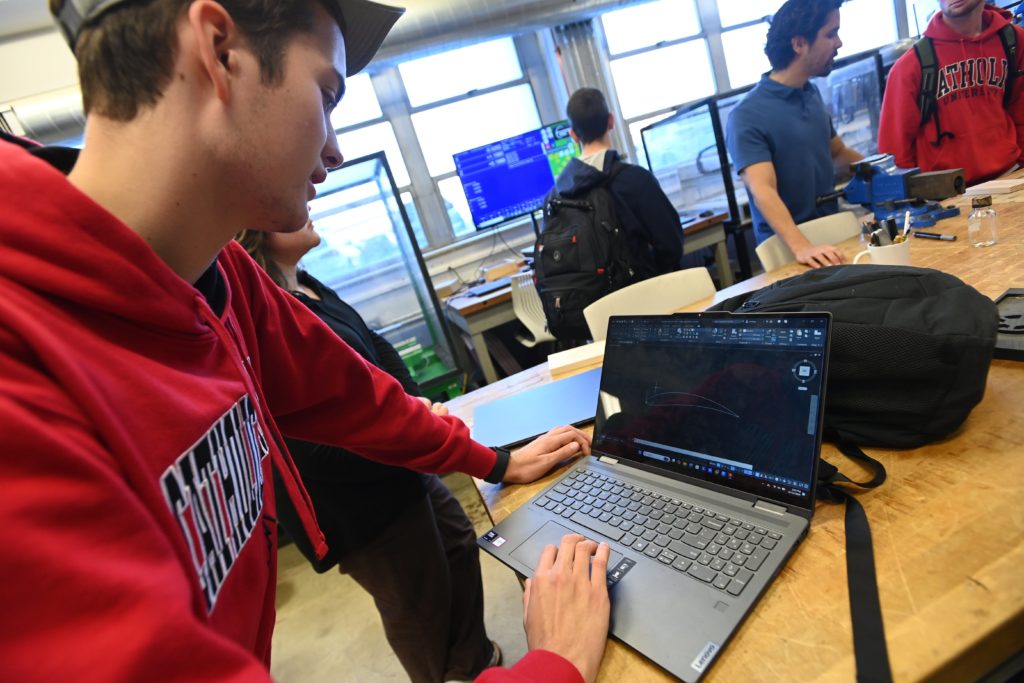
Probably the biggest concern is the spiritual, and what AI does to the human being, in terms of alertness and long term development. Some psychologists are saying that children’s brains are being altered because of AI. In higher education, there’s a lot of discussion on whether, or how, to allow students to use AI and make sure that that’s done in a good way.
This is not an easy argument. I’m on the steering committee at Boston College for the use of AI, and it’s a thorny topic. But let’s not bury our heads in the sand: a lot of students use AI.
MIT released a study recently saying that a greater increase in the use of AI corresponds to a greater decrease in cognitive ability. You may think that makes perfect sense, but now we have the empirical evidence. That helps us as educators to persuade students to not use it as often as they do.