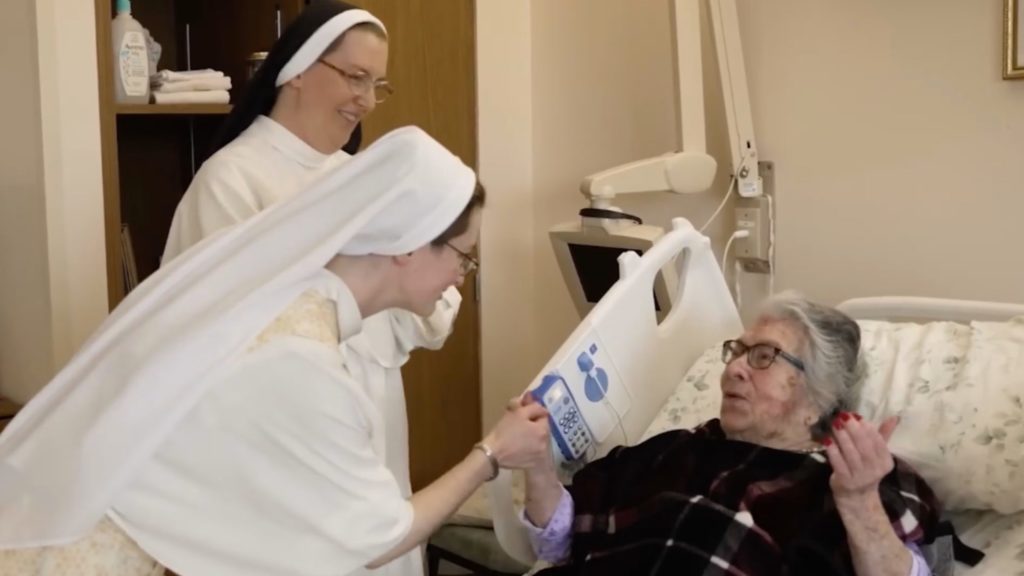
A group of Catholic religious sisters has taken care of terminal cancer patients free of charge in New York for almost 125 years without a problem.
Now, state officials are warning the sisters and other nursing home administrators about restricting rooms and bathrooms to one sex and failing to use preferred personal pronouns for patients who identify as transgender. The state is also requiring public postings of an antidiscrimination notice.
The Dominican Sisters of Hawthorne, who operate Rosary Hill Home, a 42-bed facility, have received three letters from the state’s public health agency, including one warning about “refusing to assign a room to a resident other than in accordance with the resident’s gender identity,” “prohibiting a resident from using a restroom available to other persons of the same gender identity,” and “willfully and repeatedly failing to use a resident’s preferred name or pronouns after being clearly informed of the preferred name or pronouns.”
The letters took the sisters off guard; a state agency’s website shows zero complaints against Rosary Hill Home, located in Hawthorne, a hamlet in the Westchester County town of Mount Pleasant, about 30 miles northeast of Manhattan.
But complying with the state’s rules is not an option for them, since the directives contradict their Catholic faith, the sisters told the National Catholic Register, the sister partner of EWTN News.
The Catholic Church teaches that sex can’t be changed or separated from gender, although it also says people identifying as transgender must be treated with respect and compassion.
“I think the most important thing is that we are adamant in keeping our Catholic identity. Without that, there’s no purpose for us to do what we’re doing,” Mother Marie Edward, OP, the superior of the religious congregation, told the Register.
The sisters filed a lawsuit against the state on Monday, claiming the state is violating their rights under the First Amendment of the U.S. Constitution.
The lawsuit, filed in U.S. District Court for the Southern District of New York in White Plains, names as defendants New York Gov. Kathy Hochul and four state administrators in the New York State Department of Health. All are sued in their official capacity.
The complaint claims that the state is violating the sisters’ freedom of speech by requiring them to state a point of view they don’t agree with and their free exercise of religion by requiring them to make statements against their Catholic faith.
The complaint also notes that the state statute appears to exempt institutions run by the Church of Christ, Scientist — it doesn’t apply to those “whose teachings include reliance on spiritual means through prayer alone for healing” — which the complaint says violates the Catholic sisters’ religious freedom by favoring one religion over another.
A spokesman for the governor did not respond to a request for comment by publication of this story.
Cadence Acquaviva, senior public information officer for the New York State Department of Health, also contacted by the Register, emailed the Register the following statement: “While the department does not comment on pending or ongoing litigation, the department is committed to following state law, which provides nursing home residents certain rights protecting against discrimination including, but not limited to, gender identity or expression.”
New York law
The letters to the sisters from the state’s public health agency stem from a statute that the New York Legislature passed in 2023 with little fanfare and almost no opposition, known as “The Long-Term Care Facility Residents’ Bill of Rights for LGBTQIA+ New Yorkers and People Living with HIV.”
The state Legislature’s website shows no public hearing for the bill that created the law. When it was introduced on the floor of the lower chamber, the New York State Assembly, in June 2023, the bill drew questions from three Republicans over the course of about 10 minutes, mostly informational and none hostile. Religious liberty did not come up.
The Assembly passed the bill 144-2. The New York Senate passed the bill 55-7. Hochul signed the bill into law on Nov. 30, 2023, the eve of World AIDS Day.
“New York’s seniors should be able to live their lives with the dignity and respect they deserve, free from discrimination of every kind,” Hochul said, according to a press release issued by her office at the time. “LGBTQIA + and HIV-positive seniors are among our most vulnerable populations, and today we are taking steps to ensure that all New Yorkers — regardless of who they are, who they love, or their HIV status — find safety and support in places where they need it the most. Hate will never have a place in New York.”
The sisters told the Register they had never heard of the bill until the letters from the state started arriving about two years ago. State officials have not taken steps against the sisters, but the sisters say they’re worried that they will.
“Over 125 years, as far as they know, they’ve never once had a patient who was wanting to make the gender journey, to transition. And that’s significant, because why are we going through this?” said L. Martin Nussbaum, the sisters’ lawyer and a partner with First & Fourteenth, a law firm with an office in Colorado Springs, Colorado, in an interview. “This law imposed on the Dominican Hawthorne Sisters is a form of gender ideology virtue signaling, to require these sisters to be trained in an ideology entirely contrary to Catholic belief.”
“Why are we doing this? We don’t even have such patients,” Nussbaum said. “It’s the state requiring these holy nuns to bend the knee to an ideology contrary to their faith.”
One letter from the state warned the sisters that their nursing home can’t “restrict a resident’s right to associate with other residents or with visitors, including the right to consensual expression of intimacy or sexual relations, unless the restriction is uniformly applied to all residents in a nondiscriminatory manner.”
Rosary Hill Home belongs to the Catholic Benefits Association, which advocates for free exercise of religion rights of members in providing employee benefits. Nussbaum, who represents the association, said the state’s gender-identity requirements are creating a problem where there was none.
“The sisters do not want to litigate. They want this resolved, and they want to focus on their ministry,” Nussbaum said.
The congregation
The Dominican Sisters of Hawthorne was founded by Mother Mary Alphonsa, who was known as Rose Hawthorne Lathrop (1851–1926) before she entered religious life. She was one of three children of the 19th-century novelist Nathaniel Hawthorne, author of “The House of the Seven Gables” and “The Scarlet Letter.”
Raised Unitarian, Rose converted to Catholicism during the 1890s. In 1896, she opened an apartment on the Lower East Side of Manhattan for patients with incurable cancer.
“I set my whole being to endeavor to bring consolation to the cancerous poor,” she later wrote, according to a biography of her on the congregation’s website.
She founded a religious congregation in 1900, which opened a nursing home in Hawthorne, New York, in June 1901.
Pope Francis in March 2024 declared her venerable, which is two steps below canonization. Her cause needs a miracle to proceed to beatification and another to qualify her to be declared a saint.
The congregation currently has 44 sisters, split between New York and another nursing facility in Atlanta called Our Lady of Perpetual Help Home.
In the New York facility, about 14 sisters tend to sick patients with the help of lay certified nursing assistants, sisters told the Register.
The home has no limit on the length of stay, and some patients stay for years, sisters told the Register, though the average stay is about two to three months. The vast majority of patients who come to the nursing home die there.
‘We’ve given our life to God’
The New York facility was the subject of an admiring photographic essay and short article in The New York Times Magazine in May 2016, spearheaded by a photographer who appreciated the care the sisters had given to her Jewish mother-in-law when she was dying of cancer.
Mother Marie Edward, who joined the congregation in 1979, told the Register that living their Catholic faith and witnessing to it to others are essential for the sisters, whose work is only partly about taking care of the sick.
“Nursing is a marvelous work in and of itself, but our sisters are, we’re all consecrated, we’ve taken vows, we’ve given our life to God, and certainly prayer is utmost, primary. That we consider a work, and the sisters live a very enclosed life of prayer first, and then it spills over into the care of the patients, so that we are to care for the patients as if they were Christ, the suffering Christ,” she said.
“And to do that, we have to be very strong in our identity as Christians, and to follow the teachings of Christ,” she added. “So to do something that goes contrary to that, it just wouldn’t work.”
The superior general cited John 14:6 as one of the reasons the sisters can’t treat males as if they were females, or vice versa.
“Christ is the center, and the Eucharist sustains us. But Christ is also, as he said, the way, the truth, and the life. And if he’s the truth, then we cannot practice what we do, incorporating something that is an untruth,” she explained.
“And it is an untruth to say that a male should go into a female patient’s room. You’re just trying to contort things, for whatever reason. So we have to stand by the truth of what has been taught to us in the natural law. It is not to be changed,” Mother Marie Edward said.
“For us, this is what sustains us,” added Sister Stella Mary, the superior of Rosary Hill Home, who joined in 2006.
“This is our strength. If our faith wasn’t there, the type of care we provide would not be the same,” she said.
“I’m not saying that other people cannot do so, but the things and the environment that permeates in this place is very different because of our faith, because Christ is here present in the Eucharist,” she continued.
“And anybody that comes in here will always say how peaceful it feels in here, the difference from any other place that they’ve been to,” she said. “So I think there is no way we could do what we do day in and day out, with the difficulties that caring for the sick means, without having our faith.”
Nussbaum, the congregation’s lawyer, told the Register that the state’s requirements on gender identity pose an existential threat to the nursing home, because both the home and the staff members who work there need to renew their licenses under state rules.
The Register asked the sisters if they are concerned that the state might force their nearly 125-year-old nursing home to shut down if they don’t comply.
“I’m not really worried, because I know the Lord is going to take care of us,” Mother Marie Edward said.