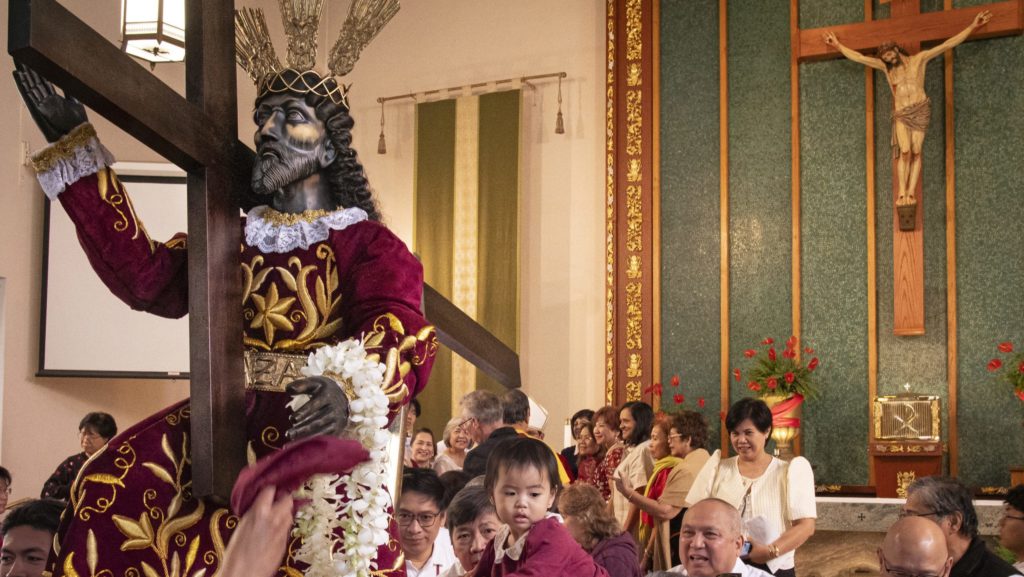
Love was in the air on Feb. 14 at Holy Family Church in Artesia, but this was no Valentine’s Day celebration.
Instead, more than 1,500 Filipino Catholics packed the parish to welcome an official replica statue of the Jesús Nazareno statue, also known as the “Black Nazarene,” as the figure traveled from the Philippines to its new home in the Archdiocese of Los Angeles and Holy Family’s chapel.
Bishop Rufino Sescon of the Diocese of Balanga in the Philippines presided over a welcome Mass and turnover celebration of the replica, a gift from the Nazareno’s national shrine in Manila — a project coordinated by Father John Cordero, Holy Family’s pastor, and with support from the archdiocese’s Filipino Ministry.
Sescon, joined by Filipino priests from different parishes, pointed to the image of the dark-colored Jesus carrying the cross as the heart of the devotion.
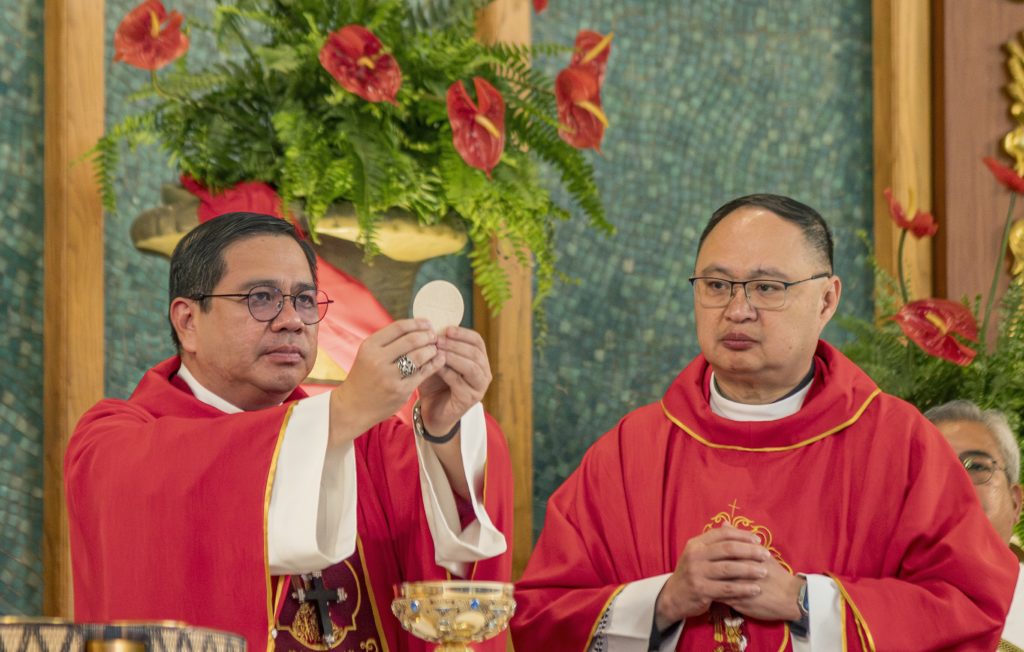
“The cross, that is what makes him dear to many Filipinos, aside from his color, which identifies us with him,” said Sescon, highlighting the deep connection Filipinos feel toward the icon. “As if Jesus is telling all of us, I am one of you. I’m like you.
“I’m like you suffering. I’m like you, carrying a heavy burden.”
The original Black Nazarene statue is kept in Quiapo, Manila, where every year on Jan. 9, thousands of devotees from across the Philippines gather for the feast day procession, most walking barefoot.
The replica will now have a permanent home at Holy Family in its St. John the Baptist chapel.
“From now on, this will be its home,” Cordero said.
Plans are in the works for the replica to tour other parishes around Southern California. The statue was also expected to make an appearance at the archdiocese’s Religious Education Congress in Anaheim on Feb. 20-22.
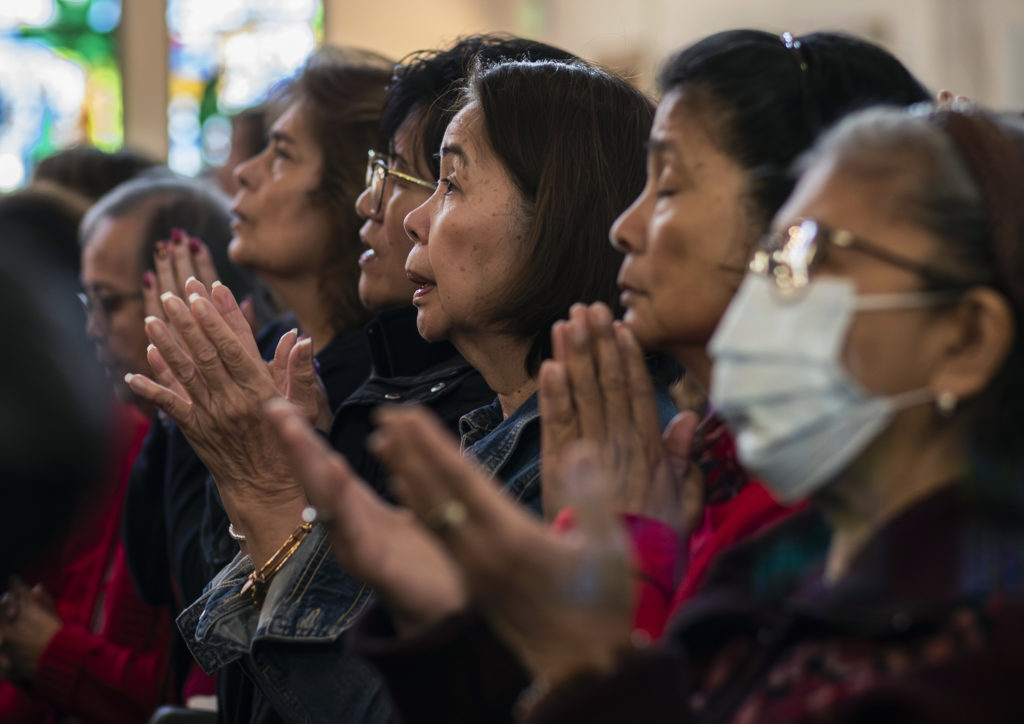
In Artesia, an hour before Mass, the pews were already filled, and the majority of the Filipino Catholic community, dressed in burgundy and yellow clothing similar to what the statue wears, overflowed with joy as they eagerly awaited the replica’s appearance. Many clutched small Black Nazarene replicas of their own.
Cordero walked through the church, welcoming families from neighboring parishes and greeting first-time visitors. The devotion, he’s seen, has a wider appeal beyond the Filipino community.
“I saw that we had a representation from our Hispanic ministry and even our own Portuguese parishioners. When it comes to our faith, we are more connected than we know.”
Eileen DeLeon and her 17-year-old son, parishioners at St. Basil Church in Koreatown, traveled nearly two hours on side streets to attend the Holy Family event, praying they would get to the Mass on time. And they did.
“We made it here,” she said, with relief.
DeLeon believes that thanks to her Jesús Nazareno devotion and the intercession of Padre Pio, “my cancer is gone,” following a 2017 diagnosis. She said she was grateful to witness the Nazareno’s arrival with her son.
Noemi Nocon remembered attending church in the Philippines and seeing the Black Nazarene image everywhere despite her family living 45 minutes from Manila. Now with a miniature Jesús Nazareno statue that her sister-in-law gave her, Nocon is thankful for the image being a “miraculous patron” for her family.
“Trust, prayer, and devotion” have helped her parents maintain good health, though it’s still difficult for them because of their age — they both use a walker, Nocon said. As a devotee, Nocon said she will bring her mom when “it’s less crowded.”
For Joshua Nuique, it was his first time seeing the image and learning about the replica. A member of the archdiocese’s Filipino Ministry, Nuique was invited by their ministry president, Noel Motus.
“He [Motus] knows that I’d really like to learn more about the Filipino Catholic faith,” said Nuique, 23, a parishioner at Nativity Church in Torrance.
“Being born in America, I didn’t really grow up with our Catholic traditions,” Nuique said, and it wasn’t until he pursued higher education in the Philippines that he began to learn more.
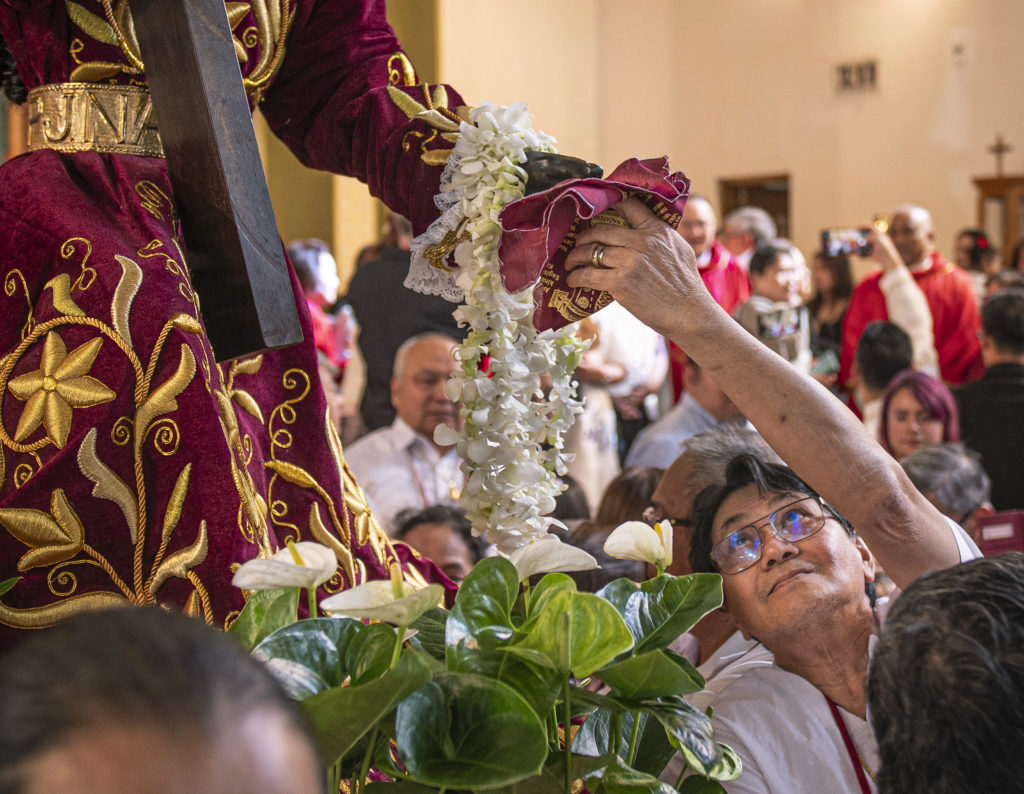
After Mass, hundreds of people rushed forward to get close to the replica with their burgundy handkerchiefs, reminiscent of the hemorrhaging woman in the Gospel who reached for Jesus’ garment in faith.
People shared tears of joy and quietness as they reached the replica, sharing an intimate moment with Jesus.
“When the Filipinos see the Nazareno, especially those who are devoted to him, they don’t just see an idol, a relic; they see God,” said Raven Butaya, 23, a friend of Nuique’s who drove from Alhambra. “Just like what the priest said, they see their suffering through him, and they see someone who can uplift their sufferings.”
A former student from Holy Family School, Seth Monzon came with his father to see the replica. He recalled doing a project on the Black Nazarene when he was young.
“When I first discovered the Black Nazarene, I was around 12 to 13 years old, and today I am now 20 years old,” he said. “Seeing this in person … it’s really meaningful to me.
“Not many people of our generation seem to know about this, and I want to encourage others to come forth in seeing this and learning about the Black Nazarene, especially toward our Filipino culture.”