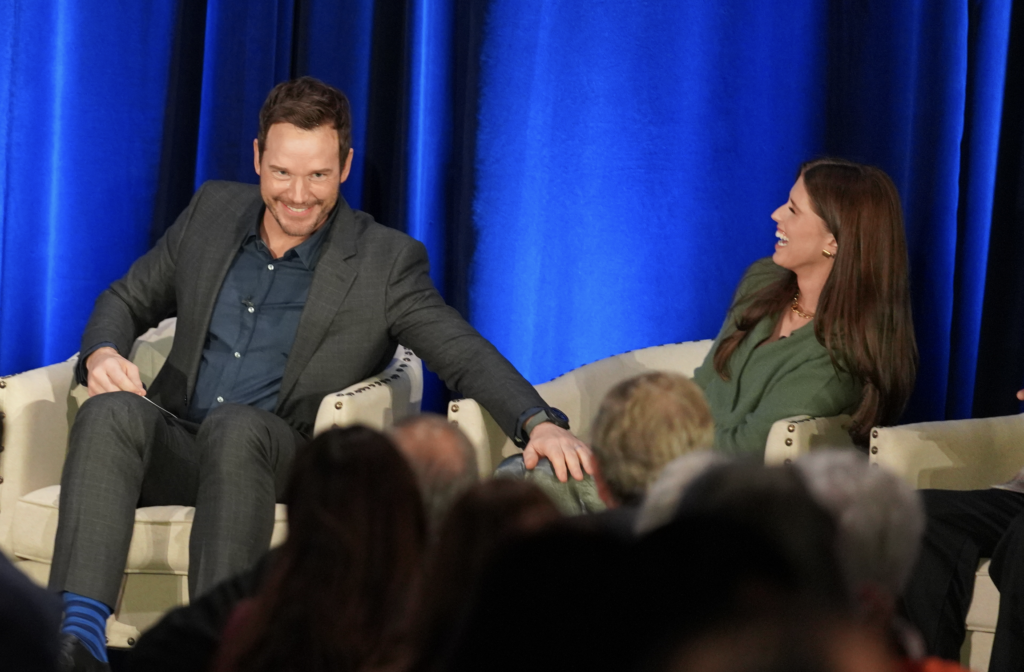
Two Hollywood power couples and a pair of Homeboy Industries veterans told very different stories about how their Catholic faith has shaped their lives and career paths at this year’s annual Ethical Leadership Lunch hosted by the Archdiocese of Los Angeles.
“When you think about this very moment and the ‘nows’ that we live through, there’s an incredible need for witness,” said Chris Pratt, one of the world’s highest grossing actors, who shared the stage with his wife Katherine Schwarzenegger.
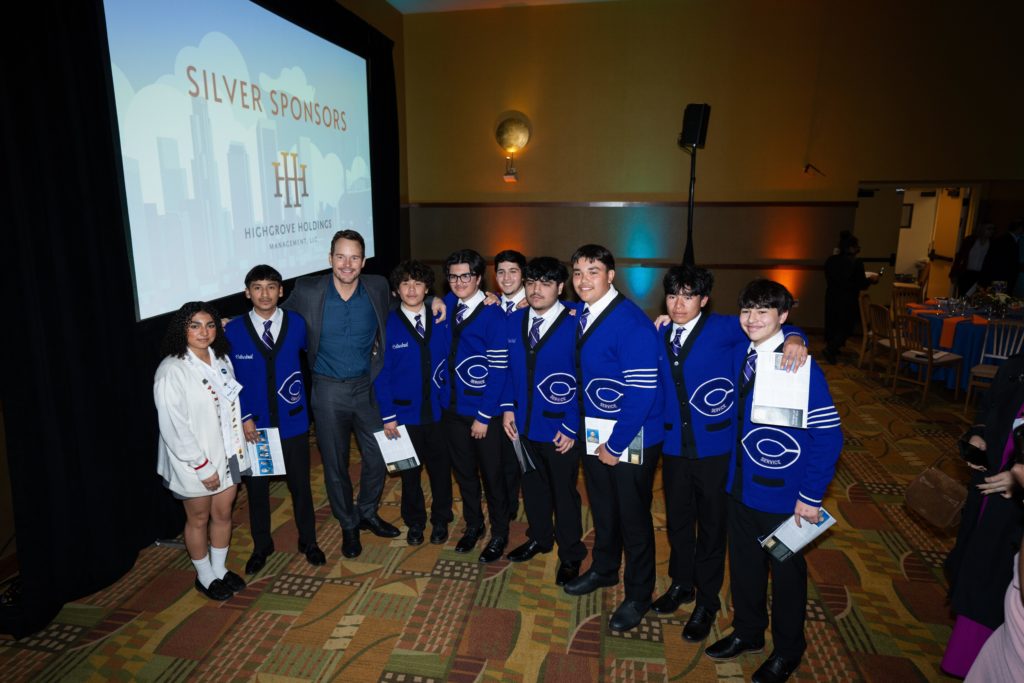
Hosted by Archbishop José H. Gomez, the Jan. 28 lunch drew more than 400 local entrepreneurs, executives, and Catholic educators to the Cathedral of Our Lady of the Angels’ conference center. The lunch was held during national Catholic Schools Week and raised more than $300,000 for Catholic school scholarships.


In a panel discussion moderated by Alessandro DiSanto, co-founder of the Hallow prayer app, Homeboy co-CEO Shirley Torres said nothing in her upbringing had prepared her to work with former gang members at Homeboy.
Torres spoke of being raised Catholic by immigrant parents in a poor, crime-riddled South LA neighborhood, before going off to college at UCLA.
When she arrived at Homeboy, which serves ex-gang members who have served prison time, Torres said she “had to surrender everything I thought I knew.”
“And for the first time working at the margins, I never felt closer to God,” she added. “I saw a kind of abundance, and a kind of depth, and a kind of resilience that made me question my purpose.”
DiSanto reserved his most pointed question for Pratt. Had his openness about his Christian beliefs in recent years, DiSanto asked, brought him more anxiety, or more peace?
“Far more peace,” answered Pratt, who quoted the words of Jesus: “What does it profit a man to gain the whole world if he loses his soul?”
Pratt went on to respond to criticisms that he speaks too much about religion and too little about politics.
“I’m not passionate about politics. I never talk about politics because it’s not worth it to me to potentially lose a person going to the movie theater because I say something that they disagree with politically,” Pratt replied. “That doesn’t mean enough to me to risk it. But my relationship with Jesus does.”
While several of DiSanto’s questions were centered on the theme of partnership, the conversation soon turned to a reflection on the role of family life in shaping ethical leadership.
Fabian Debora, an acclaimed muralist who heads Homeboy’s art academy, spoke about his troubled childhood: a father who was mostly absent from their East LA home, his mother’s despair, and hiding under a coffee table to draw — and escape the turmoil around him.
“It gets heavy as a 5 to 6-year-old, you have no coping mechanism, no skills,” said Debora. “But the one thing that I did have, and I think it is through the power and the grace of God, was that he blessed me with a beautiful gift … the gift of art.”
After getting caught in “cycles of violence” and becoming a drug addict, Debora said he had a spiritual awakening that changed his life.
“I looked into the mirror, and I looked just like my father,” said Debora, who credits Homeboy founder Father Gregory Boyle, SJ, with helping give him a second chance in life. After a failed suicide attempt, Debora said he “realized that there is something much more greater than myself, and then I discovered God.”
“It is only through the grace of God that I’m sitting here to this day.”

Veronica Grazer, CEO of the educational technology platform REEL Genius, spoke fondly of her own father’s role in shaping her future: a professor of cinematography at a nearby university, he saved up to buy a VCR machine and introduced his four children to the world of film.
“You know the way God’s plan works, I ended up with somebody who’s an actual filmmaker,” said Grazer, whose platform for teachers incorporates movie clips into classroom lessons. “The two never got to meet because my dad passed away, but I always thought he was moving things around up there.”
Grazer was joined by her husband, Brian Grazer, a longtime Hollywood producer who has worked on more than 100 movies, including several with famed director Ron Howard. She described how for several years she tried to get Brian to attend St. Monica’s Church in Santa Monica with her.
“I’d try to guilt him into it,” said Veronica, who spoke of her Catholic upbringing in central Pennsylvania. “I became overbearing and actually, really annoying.”
Brian interjected to say the story had a “good ending”: when Veronica stopped pleading, he started accompanying her, leading to an experience that he said helped him overcome bad childhood memories associated with church.
“I’ve met many other priests, I’ve met the pope, but I just never allowed myself to really enter,” said Brian.
The Pratts said they’d begun to learn the importance of giving their kids a “normal childhood,” despite their celebrity status.
Chris praised Katherine’s father, actor and former California governor Arnold Schwarzenegger, and her mother, former journalist Maria Shriver, for drawing a clear line between their careers and parenting duties.
“She had seen maybe two of [Arnold’s] movies,” said Pratt, who said the couple has purposely avoided telling their small children what he does for a living. “I couldn't believe I had to show [Katherine] ‘Predator’ when we first started dating.”
The Grazers and Pratts have attended St. Monica Catholic Church in Santa Monica over the years, and both couples singled out longtime pastor Msgr. Lloyd Torgerson for praise.
While Brian credited Torgerson’s “chemistry and wisdom and know-how” for convincing him to join his wife at church, Katherine recalled that the priest had officiated her wedding and baptized her, her siblings, and her own children.
“I’m sure a lot of people think that they have the best location or the best pastor, but we truly have the best pastor,” said Katherine to laughter and applause.
But the afternoon’s boldest reflection came from Pratt, who mused as to why a one-time door-to-door salesman with no Hollywood connections was given his platform to speak about his belief in Christ.
“Part of me believes — actually, all of me believes — that the reason I am where I am is because it was meant to be that I’d be here.”