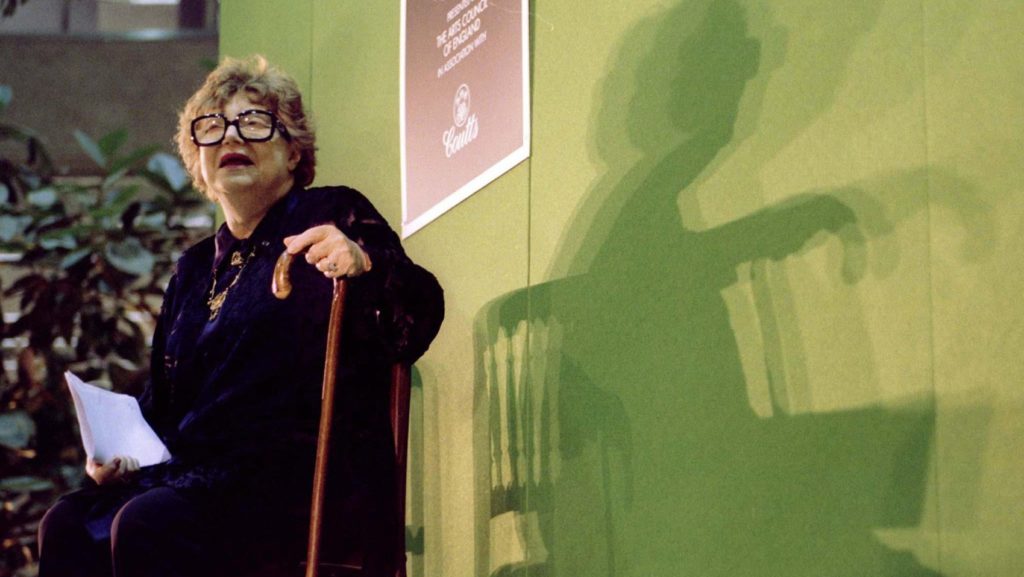
Muriel Spark (1918-2006) was a Scottish writer and poet considered one of Britain’s great postwar Catholic literary figures, alongside Evelyn Waugh and Graham Greene.
She was also a woman who declared publicly that her faith had made her the artist she became.
Consequently, any serious biography should look at her faith, right? Spark has a character say in one of her novels, “There was a time when I greatly desired not to believe, but I found myself at last unable not to believe.”
Not, it turns out, if you are Frances Wilson, who has written a new literary biography of Spark. Its title, “Electric Spark” (Picador, $24), while supposedly an allusion to Mary Shelley’s “Frankenstein,” about which Spark wrote very incisively, is not the most subtle of her jests.
Spark’s Catholicism seems incidental and unimportant to Wilson. Her conversion was very much on the level of ideas and influenced in great part by the writings of St. John Henry Newman, with whom Spark identified a great deal. In fact, she coedited a collection of Newman’s letters with a man she lived with until her conversion: He edited the letters from the part of Newman’s life as an Anglican, while she took care of the “Newman as Catholic” portion.
Although Wilson is correct that Spark was not a conventional Catholic, one would never know from “Electric Spark” that she was very serious about her faith. Another character in one of her fictions says, “The True Church was awful, though unfortunately, one couldn’t deny, true.” Critic Christopher Scalia says that Spark’s specifically Catholic point of view faded over time, but even in her last novel, “The Finishing School,” Spark quotes the Catechism and has a character raised as a Catholic who goes on retreat to a Carthusian monastery.
Her first novel was about a young woman convert to the faith, and many other of her fictions had Catholic angles to it. The satirical “The Abbess of Crewe,” in which a cloistered community of nuns is electing a new abbess, was received as a political take-off on the Watergate scandal. But it was also a stinging sendup of post-Vatican II Catholic mores (the book was turned into a film called “Nasty Habits”).
The biographer, however, is much more interested in Spark’s health, her mental and emotional problems, her nervous breakdown, her paranoia and fascination with parapsychology, and especially her estrangement from her son, who became an Orthodox Jew and apparently never forgave her for abandoning him in order to escape her husband in wartime Rhodesia.
The author sees Spark’s style as “surrealist.” I am not sure what she means, but I know that Spark’s spare and witty writing was an artistic strategy. In an interview, Spark said:
“I only say that the art and literature of sentiment and emotion, however beautiful, however stirring in its depiction of actuality, has to go. It cheats us into a sense of involvement with life and society, but in reality, it is a segregated activity. In its place I advocate the arts of satire and of ridicule. And I see no other living art form for the future. Ridicule is the only honourable weapon we have left.”
I suppose satirists, especially one so biting and clever as Spark, cannot be expected to be endearing to all. Reading of her difficulty in getting over grievances, her emotional vulnerability, and her ability to end relationships, I can see why she could identify with the extreme sensitivity of Newman.
As Newman biographer Wilfrid Ward once observed: “In reading Newman's correspondence, as when we watch a man in great pain, we hear, perhaps, at moments cries which are not musical, we witness movements not wholly dignified.”
The biography has other shortcomings that do a disservice to Spark’s legacy.
“Electric Spark” is written in a casual, almost conversational style, and the author is free with characterizations and speculations she doesn’t bother to support with any footnotes. Here is her description of Spark’s self-assessment as a writer:
“[She] clearly had superpowers, she was in no doubt about this. She was aware from the start of “a definite ‘something beyond myself,’ ” an “access to knowledge that I couldn’t have gained through ordinary channels,” including a “sixth” literary sense possessed only by certain readers and critics.”
Superpowers? Scalia compared Spark to Flannery O’Connor, another not-warm-and-fuzzy Catholic novelist. “In a similar way, Spark and O’Connor tend toward, for want of a better word, a more cynical perspective on their characters.”
Wherever she can, Wilson works in things that Spark might have read or thought about other writers, hence the categorization of “literary biography.”
The Wilson book has some insights about Spark’s identification with Romantic figures like Mary Queen of Scots (about whom she wrote a radio play and who is alluded to in her last novel), the Brontë sisters, and Mary Shelley.
But Spark, the sometimes “cynical” artist, was impressively self-contradictory, as evidenced in what she once wrote about her favorite cardinal: “Newman’s writings are not a neat and well-rounded whole. He is inconsistent, and that because of his personal approach to things together with his great capacity for development.” She could have written that about herself.
I think books we have read, learned from, and appreciated can be imagined as a kind of library in our brain. There is no need to put Wilson’s biography of Muriel Spark on the shelf there, but it is a reminder that some of Spark’s books do belong there. If Jesus wants us to be as wise as serpents, Spark’s novels — with all their understanding of the complexity of life — can help us with that.