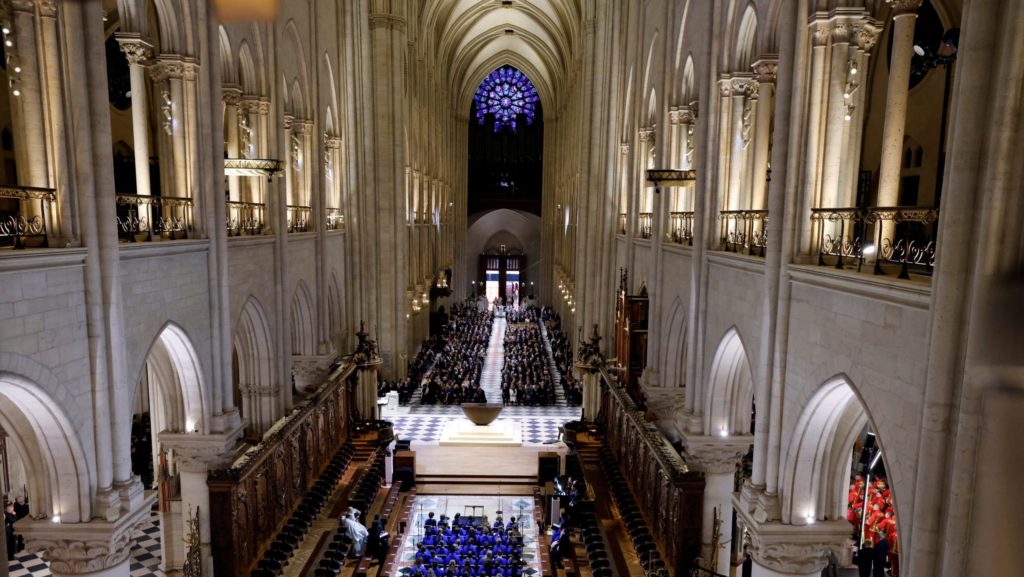
Notre Dame de Paris celebrated the first anniversary of its reopening Dec. 7 with a major milestone: more than 11 million people have visited the iconic cathedral in the past 12 months. The cathedral had been closed since April 15, 2019, when a fire destroyed much of the iconic structure. It was reopened Dec. 7, 2024, amid much fanfare. Prior to the fire, an estimated 8 to 9 million people visited the cathedral each year.
For the cathedral's rector, Msgr. Olivier Ribadeau Dumas, this year has been "extremely rich," while also being "a year of fine-tuning in terms of organization." "We had to relearn how to run the cathedral," he explained. "We had to rebuild what you might call the 'family' of the cathedral, which has grown since the restoration work."
Today, the cathedral employs eight priests and one deacon, 45 staff members, 310 active volunteers, and more than 50 people responsible for the cathedral's security operations.
"All are motivated by the same desire to welcome visitors," Msgr. Ribadeau Dumas explained. "I am struck by the efforts of everyone, including external service providers, to welcome them with a smile, thus giving the cathedral a smiling face!"
On average, 30,000 to 35,000 visitors from all over the world enter the cathedral every day.
"This does not prevent the cathedral from being a sanctuary where one can find silence and peace," the rector said. "All our efforts are aimed at introducing visitors to the mystery of this cathedral, which is first and foremost a place of prayer."
During the course of the year, 1,600 liturgical services were celebrated at Notre Dame, during which visitors continued to wander through the side aisles and behind the choir.
"Their numbers were slightly reduced during services to preserve the contemplation of the faithful," the rector explained.
Since its reopening, Notre Dame has taken on a new dimension as a pilgrimage destination. "This is new, and it is growing," Msgr. Ribadeau Dumas told OSV News. "Many dioceses in France now organize pilgrimages to Notre Dame."
In total, more than 650 pilgrimages took place, a third of which were from abroad, including 60 from North America.
"Americans have always shown great interest and generosity toward Notre Dame," Msgr. Ribadeau Dumas noted. "It is important that they be able to come here."
For the rector, the richness of this year lay in the diversity of the people who entered the cathedral. "We welcomed many patrons and heads of state with some 600 protocol visits," he said. "But we have welcomed with the same care many elderly or sick people, associations for people with disabilities, in precarious situations or isolated. Our Lady is Our Lady of humanity, of all humanity," he emphasized.
For the rector, it is of high importance that entry to the cathedral remains free, and he insisted that visitors should not be categorized as tourists or pilgrims.
"Many who entered as simple visitors came out having had a truly spiritual experience," he said, referring to the "spiritual fruits" of the visits he has witnessed this year. "We did not expect it to this extent. What happens to each person at Notre Dame is the secret of the Holy Spirit, but something happens. Some were touched very deeply."
According to testimonies, the passage in front of the reliquary of the crown of thorns, behind the choir, moved visitors deeply throughout the year.
"It is the most important relic in Christianity, and it is very evocative," the rector noted. Msgr. Ribadeau Dumas proposed a major change for 2026, which went into effect on Dec. 5: The crown of thorns will now be displayed every Friday of the year, from 3 p.m. to 6:30 p.m., and no longer only on Fridays during Lent and on the first Friday of the month, as was the case until now.
The crown of thorns, placed on Jesus' head by his captors to cause him pain and mock his claim of authority, was acquired by St. Louis, then-King Louis IX of France, in Constantinople in 1239 for 135,000 livres -- nearly half of France's annual expenditure at the time, according to the BBC.
Firefighters and police officers formed a human chain to rescue the crown of thorns from the inferno at Notre Dame on the day of the 2019 fire. On Dec. 13, 2024, this holiest relic of Paris' cathedral was returned to its proper home on the Île de la Cité.
Many visitors were also struck this year by the discovery of the cathedral's 29 side chapels, which have been completely restored and refurbished with a new identity and coherence.
Throughout the years, Chinese visitors discovered the St. Paul Chen chapel, honoring the 19th-century Chinese seminarian later canonized by St. John Paul II. Mexicans and other Latin Americans found the renovated post-World War II chapel of the Virgin of Guadalupe. On May 28, a new chapel for Eastern Christians -- home to eight icons -- was inaugurated. And on Nov. 8, the restored icon of Our Lady of Czestochowa returned to her chapel during a Mass for the Polish community.
"Everyone should be able to come home and say, 'this is our Notre Dame,'" the rector said.
A year into reopening, Notre Dame is a "living cathedral," he added. "When I celebrated Mass there for the first time a year ago, I strongly felt that these stones had witnessed centuries and centuries of prayers before mine. Since then, praying there every day, I know that I am continuing what has been accomplished by the generations that preceded us."
On Nov. 29, the rector blessed a large Nativity scene featuring 150 figurines from Provence, in southern France, and on the same day the Christmas market opened at the cathedral square. It brings together French artisans and creators. In the evening, the illuminated facade of Notre Dame lights up a square joyfully occupied by musicians and singers, where tastings of typical French regional cuisine delight everyone.