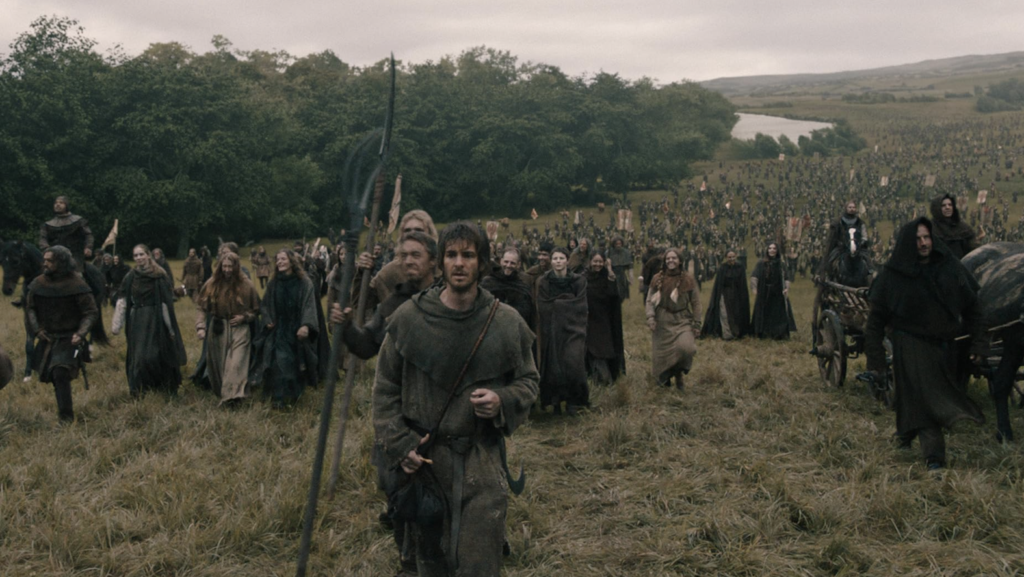
Whenever I hear about a film that claims to be a “true story,” I approach it with caution. This is especially relevant when the “true” event depicted is a film based on an historical event. The film “The Uprising” tries to have it both ways. It is at once a gritty recreation of 14th-century Britain and also an attempt at a Robin Hood myth origin story.
But if you are looking for a dashing hero in green tights with a group of merry men, you are not going to find it in ‘The Uprising.’ The film is in color, although it is hard to tell when every scene is overwhelmed with gray skies, gray sets, and the gray demeanors of its heroes and villains. This is a truly angry film. It opens with a reference to another rather bleak true historical event, the Black Death, and gets more depressing from there. It is not the world of Errol Flynn swinging on a chandelier in beautiful technicolor to rescue Maid Marian from the clutches of Sir Guy of Gisborne.
The “true” event depicted in “The Uprising” is the Peasants’ Revolt in A.D. 1381 England. It was bloody, chaotic, and sent reverberations through British culture that remain to this day. The question remains of how much of this “true” story is actually true.
Not having the time to travel to Oxford and rifle through ancient transcripts and accounts of the revolt, I took my research to the internet. While not everything in your search results is guaranteed to be accurate, there are dependable and enlightening channels and “The Rest is History” podcast is one of them. It is like sitting in a History 301 classroom as two British historians provide context and insights to a wide variety of historical subjects. In 2024, they dedicated two hours to the Peasants’ Revolt.
The first casualty to the truth is the very name of the event. It was not a peasant uprising. Like many revolutions that followed it whether it be the American, French, or Bolshevik variety, it was a movement born out of either the upper class or a rising middle class. The British ruling class already had their revolution in A.D. 1215, when they got King John to sign the Magna Carta, curtailing the absolutism of monarchy and paving the way for further freedom to trickle down slowly but surely in centuries to follow.
“The Uprising” got it right with the scale of the revolt. It was huge. A large mob did infiltrate the streets of London, knocking on the king’s castle door demanding to be heard. And the “bad guys,” as stereotypical as they may seem, evil counselors of the king, corrupt and greedy bishops, are sadly pretty close to the historical record.
The film is also accurate with its depiction of the level of violence the revolt engendered: mass killings, beheadings, and broad-scale destruction. But facts can be interpreted in more than one way, and the way the facts of this revolt are depicted in “The Uprising” says a lot more about the principles that reside inside 21st-century movie industry boardrooms than what was going on in the minds of people inside a 14th-century king’s throne room.
The historians on “The Rest is History” channel lean in the same direction as the film does, suggesting the peasant revolt was a proto-Protestant and proto-socialist movement. In passing, they admit it could also be seen as a kind of capitalist/libertarian movement. After all, these people were challenging a system where the State controlled every aspect of their lives, and the nobles had instituted a plan to artificially stifle wages.
The strongest truth in this film, and one backed up by the historical record though, is how poorly the Church looks. There is an old saying that since the first Pentecost, wherever the Church is and whatever the date on the calendar, she will always be one of two things; either that culture’s martyr or her mistress.
Sadly, this is the part where the film and the historians make the strongest case about the Peasants’ Rebellion’s proto-Protestantism. Among the many demands the rebels made was a dissolution of all Church property and removal of all bishops (with the exception of one papal representative) due to the abuse and collection of temporal riches and political power the Church in 14th-century Britain represented. Church and State were attached at the hip and many of the highest-ranking churchmen were wealthy landowners serving the political needs of their class over the spiritual needs of their flock.
The poor showing of the clergy in this film notwithstanding, “The Uprising” has too much modern day “truth” in it for my comfort level. The number of extrajudicial killings and mob rule does not comport with any Catholic moral teaching I am familiar with. And the hero being consumed by hate and a bloody thirst for vengeance is also hard to find in the “Catechism.”
The Peasants’ Revolt was a watershed moment in history, no doubt — but no matter how deep a dive one takes to test the historicity of any true event, thousands of years of human existence will be tainted in one way or another through inadequate data or personal biases brought to bear on facts.
“The Uprising” is a film much too comfortable with mob violence, so if I ever need to revisit the 14th century for entertainment, I will stick with Errol Flynn.