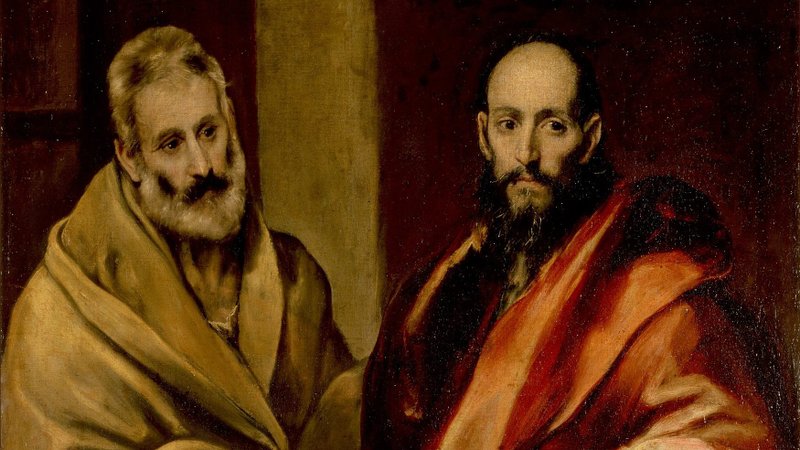
Just as God had mercy on St. Paul, so will he on us
If God had merely had pity on young Saul, that would have been enough. But mercy is far more than pity. God did not just forgive Saul. He healed him and empowered him to move beyond his past sins and ignorance.
It’s January, and my thoughts naturally turn to St. Paul, whose feast day comes late in the month. I’ve taken him as a personal patron. He’s my role model in the practice of biblical theology. Twenty-five years ago, I founded an institution named in his honor: the Saint Paul Center for Biblical Theology.
The Church gives him two feast days every year, and one of them — the Feast of the Conversion of St. Paul — falls on Jan. 25. So, as my thoughts turn to him, I’m not alone. The whole Church is with me.
His writings are so rich that they can take us in many directions. His words, since they appear in Sacred Scripture, are God’s words as well. As he wrote to Timothy: “All Scripture is inspired by God” (1 Timothy 3:16). So Paul’s doctrine is itself the very foundation of Catholic doctrine.
Right now I’m thinking of his doctrine on mercy.
Paul knew mercy better than anyone else. He knew “the God and Father of our Lord Jesus Christ” as “the Father of mercies and God of all comfort” (2 Corinthians 1:3). He knew that he held his ministry only “by the mercy of God” (2 Corinthians 4:1). As a convert to the Gospel, he knew God’s mercy in an especially powerful and personal way: “I formerly blasphemed and persecuted and insulted him; but I received mercy because I had acted ignorantly in unbelief” (1 Timothy 1:13).
I, too, am a convert, and so I sympathize with my patron. Many years after coming to Christ — 40 years after entering full communion with his Church — I still feel like a beginner. I am a beginner in prayer, constantly picking myself up and starting over. I am a beginner in the moral life, wanting to be charitable, but struggling.
Paul comes to my aid with his Gospel of mercy: “but I received mercy for this reason, that in me … Jesus Christ might display his perfect patience for an example to those who were to believe in him for eternal life” (1 Timothy 1:16).
If God had merely had pity on young Saul, that would have been enough. But mercy is far more than pity. God did not just forgive Saul. He healed him and empowered him to move beyond his past sins and ignorance. Through grace, Paul became the man who could say, “I can do all things in him who strengthens me” (Philippians 4:13). Paul’s life proves that mercy is God’s omnipotent love in action.
If God permits my struggles and my falls, it is so that I can learn to call on him, as Paul did, in everything. If I can succeed (with God’s help), then surely anyone can (with God’s help). “God has consigned all men to disobedience, that he may have mercy upon all” (Romans 11:32).
I assure you that my celebration of his feast day will include a visit to the sacrament of mercy. I hope yours will too.

Scott Hahn is the founder of the St. Paul Center for Biblical Theology, stpaulcenter.com.
He is the author of “Joy to the World: How Christ's Coming Changed Everything (and Still Does)” (Image, $24).