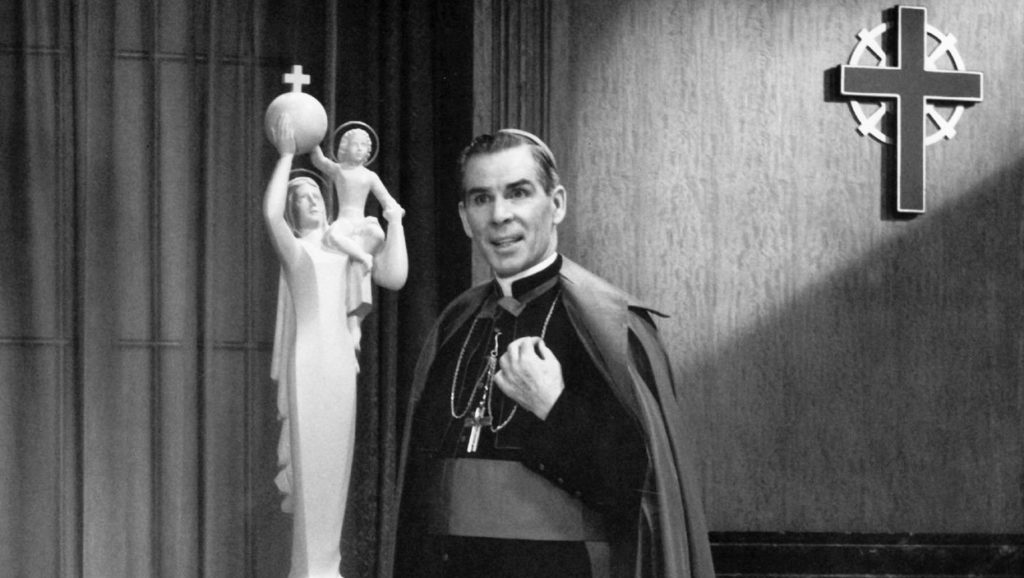
When word came several years ago that the beatification process for Bishop Fulton Sheen had been suspended, it was a big “oh no” moment for me. Was he going to be exposed as something other than what we all thought he was? He would not be the first high-profile person who lived many years in the public eye, and cloaked something dark in private. And he certainly would not have been the first “celebrity” priest who let his fame and popularity feast on the worst of his weaknesses.
Praise God, news came this week that the beatification is now back on track and will take place in Sheen’s home diocese of Peoria, Illinois.
We can fully expect a flood of “experts” on social media and the internet telling us the reason this process was stalled for six years, and why it is back on track. The prevailing narrative will, no doubt, be that an American pope, born in the same state as Sheen, is the reason the beatification is going forward. Their shared histories could definitely have some bearing in the decision-making process, but we are talking about eventual canonization, so the divine element is also in play.
Who knows, it could be God’s hand that placed an American pope, with an American experience growing up in the 1950s and 1960s, to have altered the trajectory of this holy man.
I never thought I would have a lot in common with a pope. For the first 21 years of my life, I never thought I would see a non-Italian pope, and now there have been 48 consecutive years with no Italian pontiffs.
Other “firsts” unbeknownst to me were also in the offing. An American pope, like me. A pope who grew up in the Catholic bubble of the mid-20th century, like me. A pope who attended parish grade school and then Catholic high school, check and check. After that, our paths diverged a little, but the news of Sheen’s forthcoming beatification is another connection between the Holy Father and me.
I have no empirical evidence to prove this, but I would wager that when Pope Leo XIV was just plain Robert Francis Prevost growing up in his Catholic family in an Illinois suburb, he was influenced by Sheen. Like me, he was too young to feel the full breadth and scope of what Sheen meant to Catholic America with his “Life is Worth Living” television program, but I will bet his parents did.
Though canonizations have taken a kind of “fast track” approach of late, with three popes that I lived through being elevated to saintly status, there is something different with Sheen’s beatification and Leo. When Pope Pius X oversaw the beatification of St. Joan of Arc, she had been dead for 498 years, with oil paintings and Church histories being the only cultural touch points. Pius was separated from Joan by centuries of time, as well as language and national origin.
But Sheen and Leo come from the same place. They grew up speaking “American,” and they were obviously both part of their world, if not “of” it. And although they were not contemporaries, thanks to modern technology, the younger Prevost could have and most certainly did see Sheen in action.
And again, this may be speculation on my part, but it is not unreasonable to suggest that Leo’s parents probably had a strong connection to Sheen, as any serious Catholic living in 1950s America had with a man who dominated the fledgling television industry as strongly as Sheen did.
I know my parents, especially my mother, had a strong affinity for Sheen. She read and re-read many of his books. When I was growing up, if there were reruns or nostalgic journeys back to television bygone programs featuring Sheen, we watched them. A national Catholic radio network continues rebroadcasting old Sheen programs on Sunday mornings, and there are times I listen — and learn.
Even though Mrs. Prevost’s boy turned out with a little higher status than Mrs. Brennan’s, both their sons share something special, and that is the life and example of Bishop Fulton Sheen.