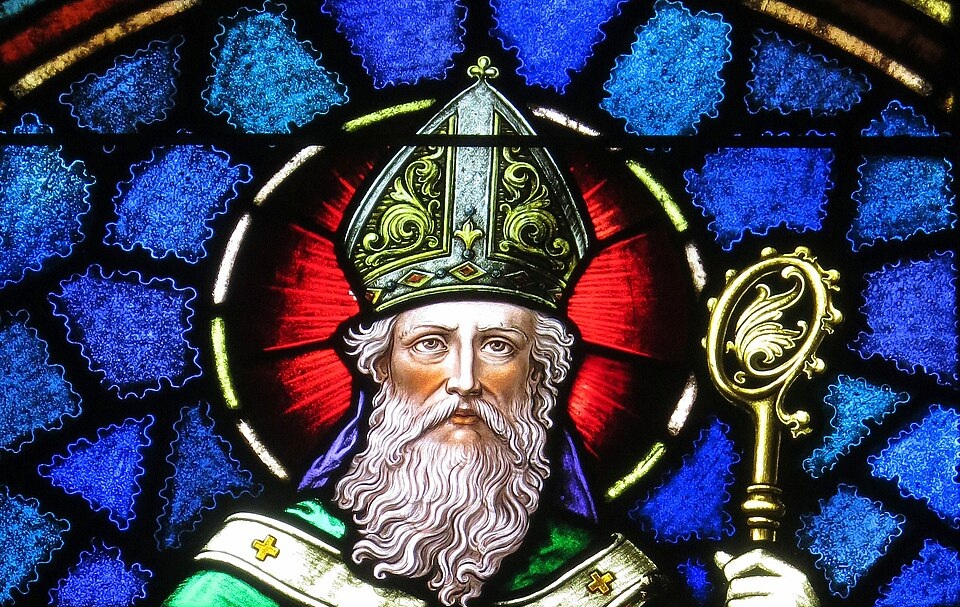
Years ago I visited the island of Crete and saw the reliquary that holds the skull of St. Titus, the companion of St. Paul. You can’t see much of the old bishop’s bones. The relic is mostly encased in precious metals and gems.
That memory returns this year as we approach St. Patrick’s Day. I can see, from a simple search of the web, that some of Patrick’s relics are similarly covered and jeweled. I don’t begrudge him the honor. His body was divinized by baptism, and by grace Patrick grew more Christlike through his bodily actions.
What irks me a little is the accretion of legends that sometimes obscure the real life of the Apostle of Ireland. They emphasize the extraordinary. They focus on feats of power.
I have no doubt that Patrick’s preaching was accompanied by miracles, but I suspect his true power is most evident in the words of his two undisputed works that have survived: his “Confession” and his “Letter to the Soldiers of Coroticus.”
Scholars speak of Patrick’s clumsy Latin. They count up his grammatical errors. They puzzle over passages that are frankly indecipherable.
Patrick had to use Latin, because Latin was still the universal language in his part of the world. But he probably composed his work originally in Celtic or Irish. Then he dragged it, to the best of his ability, into the language of literature and government.
He lived in the years of Rome’s decline. And, even though Patrick grew up in a family of small-town aristocracy, he was kidnapped by pirates before he could go far in his education.
What he knew of Latin he had learned from the Mass. By his own admission, he wasn’t a particularly devout child, but he was there in church with his family every Sunday, and he absorbed the basic stories from the Bible.
Later in life, when it came time to write in Latin, the best he could do was build sentences out of phrases he knew from the Bible — as it was then proclaimed in the Mass.
By the time he became a bishop, Patrick had been steeped in the Sacred Page. His works show his familiarity with the Vulgate Bible of St. Jerome, which was then fairly new, and the Old Latin lectionary, which was still used in remote parts of the empire.
When he told his life story, he used words taken verbatim from the story of the Exodus (his kidnapping and escape), from the account of Samuel’s vocation (his call to be a missionary), from the life and letters of St. Paul (his life as Apostle to Ireland). In the two brief letters that have survived, Patrick draws from 54 books of the Bible!
He grew up speaking a Celtic dialect. He later learned Irish. But Scripture, it seems, became his primary language.
I cannot imitate St. Patrick’s miracles or feats of strength. But I can certainly strive, in this runup to his feast day March 17, to imitate him in his love for Scripture.