The town of Guadalupe, California, is on the farthest reaches of the Archdiocese of Los Angeles’ Santa Barbara Pastoral Region.
To get to it, exit the 101 in Santa Maria and take West Main Street for 10 more miles through fields of, depending on the season, strawberries, broccoli, cauliflower, and celery.
At the railroad crossing, bang a right and you’ll come upon a hidden gem, a town seemingly frozen in time, lined with mom-and-pop taquerias, the late lamented Far Western Tavern steakhouse (its successor is in nearby Orcutt), an old-school hardware store, and various other locally owned markets and cafés.
Our Lady of Guadalupe Church is tucked away on a side street.
Here live some of the many farm laborers who make this area of the Central Coast one of California’s breadbaskets.
Drive on for a couple of miles and you’ll come upon a sign directing you to take a left to Oso Flaco (translation: skinny bear).
An 800-acre day-use area in the southern portion of the Oceano Dunes State Vehicular Recreation Area, Oso Flaco Lake is part of the 22,000-acre Guadalupe Nipomo Dunes Complex.
Technically in Arroyo Grande, on the southern end of San Luis Opisbo County, the area has been designated for hiking, fishing, bird-watching, and general nature study. No motorized vehicles of any kinds are allowed, nor are dogs.
The trail from the parking lot goes through a riparian area, bordered by tall trees and brush, that smells sweetly of moist earth. After a bit you turn left and come upon a breathtaking lake, filled with a staggering variety of bird life.
Cormorants perch on pilings, their wings outstretched cruciform-style to dry. Northern harriers soar. Egrets skim, bufflehead ducks and cinnamon teal glide across the glass-like surface of the water, and Great blue herons lurk in the shallows.
According to the site, ebird.org, 183 species were sighted in 2025, with an all-time total of 293.
On any given day, you might see scrub jays, northern flickers, spotted towhees, California thrashers, red-tailed hawks, turkey vultures, or Western swallowtails.
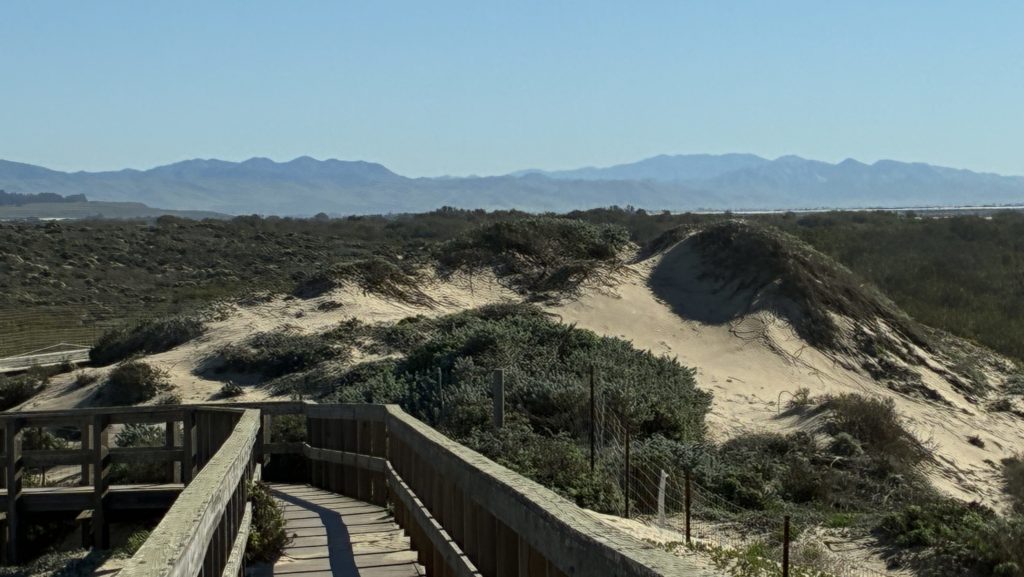
A beautifully built and designed wooden bridge leads across the water, with benches spaced every so often so you can sit down, peer through your binoculars, say a decade of the rosary, or meditate on the shortness and preciousness of life.
But tear yourself away and keep going, through coastal sand dunes, more beauty, and protected nesting grounds for Western snowy plovers and California least terns.
Interpretive placards scattered along the trail inform the walker of the surrounding natural features and how they interact.
Wind, waves and salt spray, for example, create an environment where dune plants — pink verbena, silver dune lupine, coyote bush — have developed incredible resilience in order to survive the hot summers.
The dunes often burst with wildflowers that provide nectar for pollinators like bees, butterflies, and hummingbirds: among others, California poppies, seaside daisies, beach evening primrose, and dunes paintbrush.
The air smells of beach wrack — a mélange of seaweed, driftwood and miscellaneous debris in which various insects and shellfish make their homes.
As you approach the ocean, you can take the boardwalk trail to the left, a short spur with an elevated viewing deck.
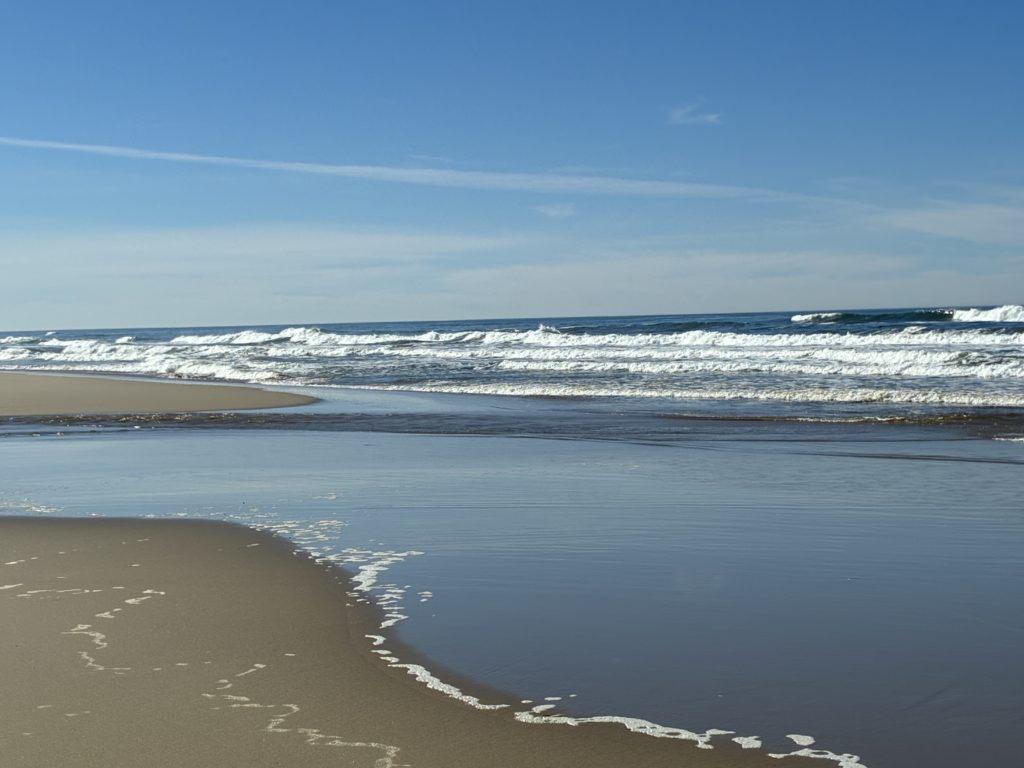
And there it is — the mighty Pacific, stretching in both directions as far as the eye can see, so vast that phone photos can capture only a portion of the splendor.
The day before Thanksgiving last year was perfection: California sun glinting on the waves, a balmy breeze, friendly families heading down to the shoreline toting coolers and blankets.
I made my way down there eventually, too, sending out a prayer over the waves. “O Beautiful for Spacious Skies.” I was raised on the Atlantic, and what grace, I reflected on this day of national gratitude, had brought me to California, and allowed me to live for so many years by this other shining sea?
Indigenous Americans arrived in the area 13,000 years ago, but the first European to explore the California coast was soldier and navigator Juan Rodríguez Cabrillo, sailing for the Spanish crown.
Up he and his men had come from San Diego, to what is now the port of San Pedro, and on up north of San Francisco to Cape Mendocino. Days like this, it was easy to imagine on this relatively wild stretch that the Spanish explorers, and the Indigenous before them, would have seen very much what I was seeing now.
I walked a long time on the shore, marveling at the curled-in-on-themselves cowries, iridescent mussel shells, and perfect sand dollars; listening to the waves ebb and recede, and the cries of the gulls.
The trail is a perfect length for families: a mile from the trailhead to beach overlook; two miles total round trip, totally manageable even with young children or older folk.
Come, bring a picnic, and make a day of it. Our Lady of Guadalupe will be holding you in her embrace.