Recently, The New York Times ran a piece about the rising popularity of plastic surgery, titled, “Three People on Why They Wanted New Faces.”
Jo C., 62, a restaurant owner from Saskatchewan, Canada, felt her prettiness was fading as she aged. After a deep-plane face-lift and a deep neck-lift — as she admitted, procedures that are “quite invasive” — she was photographed in pink pajamas, head bound in bandages. Then the swelling went down. “Now I look at other women all the time and think, ‘Why wouldn’t they do this?’ ”
R, a gorgeous 18-year-old with long blond hair, is an incoming college freshman from Colorado who was troubled by her jawline. Pictured before a closet overflowing with high-end clothes after her deep neck-lift and rhinoplasty, R was so heartened post-surgery that she took to French-braiding her hair — a style for which she previously lacked the confidence.
Harley H., 53, a male engineer from Idaho, got a deep-plane face-lift and a deep neck-lift, procedures that cost in the “low six figures.” Having been relieved of what he felt was the unsightly fat beneath his chin, he now hoped to telegraph the message that he’s “a guy who cares about his health.”
That people are feeling better about themselves is wonderful. Who would begrudge another human being even a moment of such solace?
Still, elective cosmetic surgery always evokes a frisson of underlying … is it dread? Queasiness?
It’s not so much the surgery itself, though even a second of video footage turns the stomach. It’s that many of us can’t quite buy the lie that cosmetic surgery will make things better for us in any lasting, meaningful way. It’d be one thing if the person undergoing the knife emerged from anesthesia more generous, tolerant, or compassionate. Instead, the hope is inevitably to be admired more, approved more, loved more.
But what happens if, after having undergone surgery, the patient realizes people are no more adoring or accepting than they ever were? Or that after shelling out over a hundred thousand bucks, nobody much cares whether you’re a guy who cares about his health? Or that your new jawline is only the tip of the iceberg?
What happens, after the initial excitement dies down, when you look in the mirror and still don’t like what you see? Still you’re not perfect?
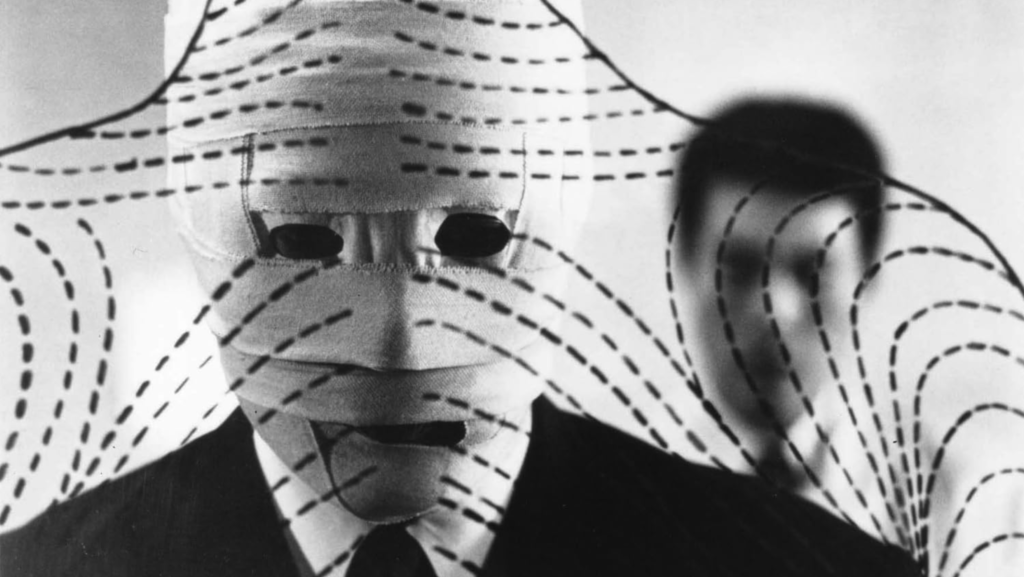
My mind drifted to “The Face of Another” (1966): a Japanese New Wave film and existential sci-fi masterwork about a man who also wanted to change his looks.
Directed by Hiroshi Teshigahara (“Woman in the Dunes”), the film stars Tatsuya Nakadai and is based on the 1964 novel by Kōbō Abe, known as an exemplar of avant-garde Japanese literature.
The protagonist, Mr. Okuyama, has been hideously burned in an industrial accident. He spends the first half of the film with his head swathed in white gauze, like Claude Rains in “The Invisible Man.” Lounging around the apartment in a silk robe smoking (“A cigarette dangling from a crack in the bandage … It looks freakish,” he remarks), he delivers disturbing monologues to his unfortunate wife.
“The face is just a few dozen square inches above the neck covered with a layer of dough. Isn’t that right? ... But now I’m not so sure. When the face is closed off, so too is the soul. Nobody is allowed inside. The soul is left to rot, reduced to ruins. It becomes the soul of a monster, rotten to its core.”
He visits a psychiatrist-plastic surgeon whose motives are murky and whose office — “a theater of cruelty,” notes one commentator — is filled with disorienting transparent partitions, mirrors, jars of ears, plasticine limbs, stencils of Leonardo da Vinci, and videos of floating hair. “Inferiority complexes dig holes in the psyche,” he remarks to himself, “and I fill them in.”
The psychiatrist crafts a realistic mask from a random stranger’s facial mold, then glues it to Mr. Okuyama’s scarred visage. “We’re violating a cardinal rule of humanity,” he tells his assistant.
The mask, he predicts, will call the shots more and more.
Sure enough, Okuyama starts dressing differently. Over time, memory dissolves, desire morphs, morality dies.
Both mesmerized and appalled by what he may have unleashed, the surgeon insists that Okuyama relay his every thought. He also constantly goads him, under the guise of compassion, with catastrophic possibilities. “What is the purpose of this double life with the mask?” he asks. “Are you more interested in rejoining society, or in escaping it? ... What if the mask lives on by taking over your body?”
In the next breath he muses, “I could mass-produce them. A face, easily removed. A world without family, friends, or enemies. … Unbounded freedom, hence no yearning for it. No such thing as home, thus no dreams of escaping from it… Trust among people, now so richly prized, would become obsolete.”
Jealous and curious as to whether his wife would cheat on him, Okuyama makes a move, and she succumbs, annihilating the last vestiges of his trust and love. He loathes himself; he loathes her. The transformation is complete. The mask has eradicated his entire past, future, and identity as a human being.
So much for the plastic surgery patient. But what of the surgeons who produce these transformations, who make a fortune cutting and pasting people’s faces? What of those who hawk false promises and encourage us to hide our true selves?
When Okuyama meets the psychiatrist on the street at the end of the film, does he thank him?
No. He produces a knife — a scalpel of sorts — and stabs him dead.