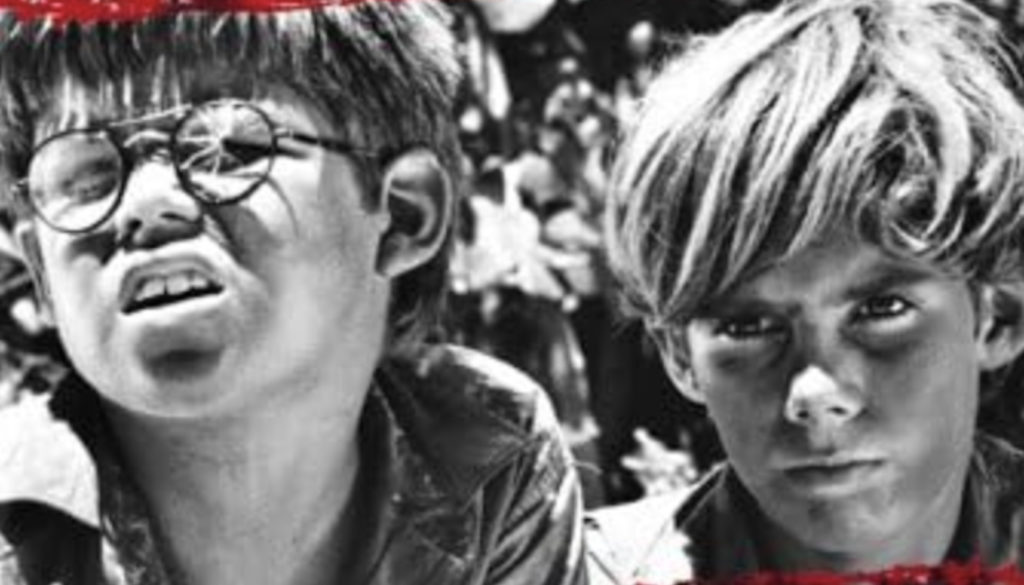
An unnamed war, a plane crash, a group of British schoolboys, ranging in age from 4 to 12 or so, marooned without adults on a tropical island.
That’s the setup for William Golding’s “Lord of the Flies,” the 1954 dystopian novel that unforgettably treats the themes of civilization, leadership, morality, and good and evil.
The boys have been inculcated with the idea that the British do everything best. Two leaders, very different alpha males, emerge right away. Ralph is thoughtful, smart, well-trained in the concepts of order, rules, and hierarchy. He’s declared chief by more or less democratic vote, if for no other reason than his height, pleasing looks, and that he possesses the conch shell that summons the boys to gather.
Jack is a bully, arrogant, and, interestingly, the head of the school choir. Its members first appear in their black robes and insignia-ed caps, marching down the sand in almost military formation.
In the 1963 film version, they’re chanting the “Kyrie Eleison” (“Lord, have mercy”): a note of supreme irony, we discover as the story unfolds.
“Lord of the Flies” is the translation of an ancient Hebrew name for Beelzebul: Satan, the ruler of a kingdom as worthless as dung.
The book’s central question is whether man, left to his own devices, is essentially evil or essentially good.
On a desert island, will we choose civilization or savagery?
To put it in contemporary terms, what would happen if we really did defund the police?
Piggy is the anti-hero: overweight, bespectacled, asthmatic, anxious to please, he immediately attaches himself to Ralph.
Rescue is essential, Ralph insists from the start, and the first order of the day is sending up smoke signals that will be visible to passing planes or ships.
The boys use Piggy’s glasses to refract the rays of the sun and start a fire that, with no pre-planning, becomes a conflagration.
A young child with a mulberry-colored birthmark apparently dies in the blaze, but not before mentioning a “beastie”: a frightening being of indeterminate shape he insists he saw roaming the island.
His disappearance is never mentioned out loud. Still, vague fears abound and the younger children especially have nightmares: “As if it wasn’t a good island,” Piggy sagely observes.
Though keeping the fire going is paramount, Jack, crucially, has a knife. From the beginning, he doesn’t much care about the fire: he cares about hunting.
With clay and charcoal, he and his crew paint their faces, ostensibly for camouflage: in fact, they’re beginning to lose touch with civilization. They kill a pig with gleeful savagery. Instead of “Lord, have mercy,” in other words, no mercy.
“Kill the pig. Cut her throat. Spill the blood,” is the triumphant, chilling war chant with which Jack leads his followers. Note the “her.” The feminine, all tenderness and sympathy, are likewise being butchered.
Simon, a central figure who doesn’t speak much, is “strange,” given to wandering off by himself. The younger ones look up to him. He’s kind, a helper, a kind of mystic. He doesn’t take sides, nor does he seek power for himself.
And he has the clearest insight of anyone on the island as to where the real darkness lies. When Ralph calls an assembly at night and says they need to settle the issue of beasts and ghosts, Simon tentatively pipes: “What I mean is … maybe it’s only us.”
This messiah figure will be sacrificed.
With consequences and punishment for immoral behavior removed, Jack and his crew revert increasingly to barbarism.
A ship — a possible rescue ship! — one day hovers into view, but to Ralph’s despair, Jack and his hunters have let the fire go out. They wanted instead to be out killing.
Eventually, the power dynamic shifts entirely from Ralph to Jack: domineering and dictatorial. Boys who are basically good but malleable are easily persuaded to carry out his dark whims. A genuine sadist emerges.
Piggy neither whines nor cowers. He protests when he’s treated unfairly. He patiently, doggedly, makes sensible suggestions. He sees who Ralph is, at his best; he sees who Jack is, at his most evil, and that he’s taking over.
The weakest of the older boys, he’s also in a way the most courageous and is indubitably the most loyal to Ralph. He, too, will be sacrificed.
Golding, a disillusioned veteran, supposedly based the novel on the behavior he had witnessed in his own countrymen during World War I.
The boys are rescued at last by the Royal Navy. The reader breathes a sigh of relief, but many commentators have noted that military personnel, of any nation, carry out their own savagery under the protection of a flag, high ideals, and spotless uniforms.
Some have protested that the picture painted by “Lord of the Flies” is too bleak. Golding himself observed that the moral of the book is that “the shape of a society must depend on the ethical nature of the individual and not on any political system, however apparently logical or respectable.”
To me, the hope comes in Ralph’s tears at the end. His innocence has been lost. The effects of the trauma he’s experienced will last a lifetime. He has seen the darkness of the world.
But his parting thought is of Piggy, who he realizes at last, has been true, wise, and — perhaps the most beautiful word in the whole book — a friend.