Leo Politi (1908-1996) walked, loved, wrote about, and illustrated the streets of LA, especially Bunker Hill and downtown’s Olvera Street.
His children’s books number over 20 and include “Pedro: The Angel of Olvera Street” (J. Paul Getty Museum, $15.95), “Juanita” (J. Paul Getty Museum, $77.34), “Little Leo” (NY Scribners, $69.99), “Moy Moy” (Charles Scribner’s Sons, $30.32) and “Mieko” (Golden Gate Junior Books, $49).
Perhaps his best-known is “Song of the Swallows” (J. Paul Getty Museum, $16.95), about a little boy who plants a garden to welcome the annual return of “las golondrinas” to San Juan Capistrano. The book won the Caldecott Medal in 1950 for the “most distinguished American picture book for children.”
Born in Fresno, the younger of two children of Italian-American descent, Politi would die at 87 in the city he had served and celebrated for decades.
When Leo was seven, the family returned to his mother’s hometown of Broni in northern Italy. He displayed artistic talent from an early age, retained a lifelong affection for village life, and frequently sketched Broni’s houses, residents, and street life.
In 1920, the family moved to London for a year where Leo was exposed to art, theater, film, and sidewalk chalk artists.
Three years later, at the age of 15, he won a scholarship to the National Art Institute at the Royal Palace of Monza, near Milan. He served a six-year apprenticeship, studying architecture, drawing, and sculpture, and returned to California by way of the Panama Canal in 1931.
Captivated by the “earthy qualities of the life and vegetation of the tropical Central American jungle,” he would adopt its ochre yellows and burnt siennas for his own work.
In 1934 (some accounts say 1933 or 1938), he married Helen Fontes. The couple would have two children, Paul and Suzanne, and lived in a rented house on LA’s Bunker Hill.
During the Depression, Politi’s habit became to sit at a café on Olvera Street, alive at the time with traditional handcrafters, food vendors, and strolling musicians. He’d sketch or paint watercolors of the colorful members of the passing crowd, or the surrounding buildings, or the high points of a religious fiesta. Or he might carve from a block of wood, hoping to sell a piece or two to tourists or locals and make some spare change.
In addition to the watercolors for which he was best known, he was also adept at wood engraving, lithography, and oils. He took his deepest inspiration from children: their openness, their playfulness, their spontaneity. A devout Catholic, he emphasized the sanctity of the mother-child relationship and, long before DEI initiatives, reveled in LA’s melting pot of races, ethnicities, and traditions.
He made frequent visits to the Children’s Literature Department of the Central Library. The children crowded round to hear him read, tell stories, and give weekly drawing demonstrations.
A historian as well as an artist, Politi wrote also for adults, in such books as “Tales of the Los Angeles Parks” (Best-West Publications, $295) and “The Poinsettia” (Best-West Publications, $46).
These, too, were illustrated: with watercolors of the now-vanished Victorian houses that once stood proudly atop Bunker Hill; with LA’s flowers, birds, and trees; with the city’s “everyday” street life: packages being delivered, gossip exchanged over backyard fences, laundry hung out to dry.
Though never wealthy, he once refused to sell the rights for his popular Pancho character to Disney, preferring to retain his artistic integrity.
In 1965, Politi’s art was given an exhibit at the Central Library, after which the Board of Library Commissioners approved a $3,000 purchase, chose a selection of Politi’s paintings that had been used in his book “Bunker Hill, Los Angeles: Reminiscences of Bygone Days” (Desert-Southwest, $99.75) and added them to the library’s California collection.
In November 2023, a selection of these paintings was placed in the Children’s Literature Department at Central Library where, clearly, Politi is remembered and treasured to this day.
Many of Politi’s books are available at the library. An LAPL blog post by Tina Princenthal, principal librarian, is a rich source of information about Politi’s life and work, and also features several wonderful photos of Politi surrounded by children.
His legacy lives on. His name is attached to an elementary school in Koreatown, an open area north of Dodger Stadium, a square in Echo Park, and a branch library in Fresno, the city of his birth.
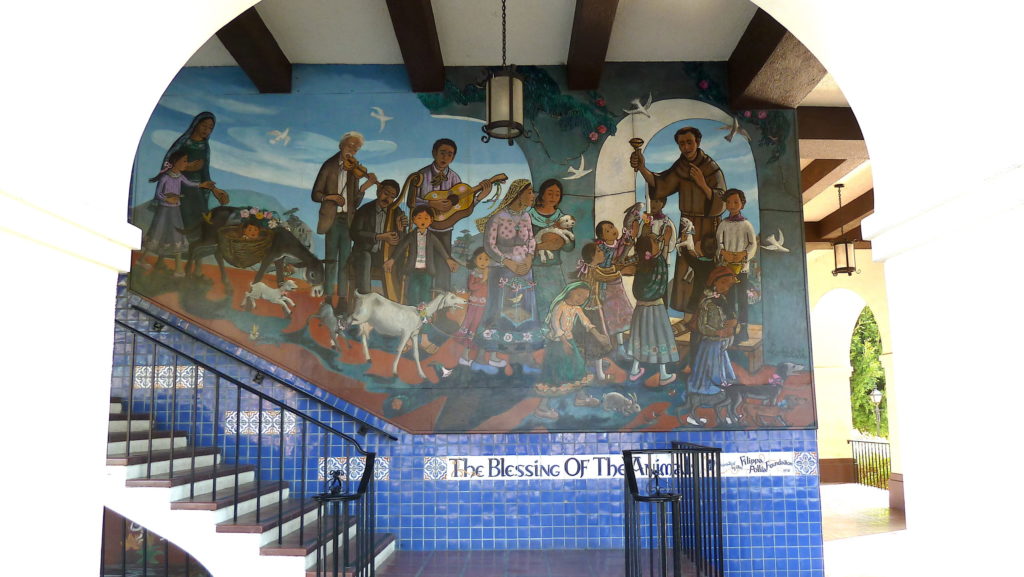
A mural painted by Politi in 1979 called “The Blessing of the Animals” adorns the sides of Olvera Street’s Biscailuz Building, and commemorates a traditional event still held here annually on Easter Saturday.
This year’s blessing, by Archbishop José H. Gomez, will be on April 4, at 12 p.m. Bring your pets!
Practically every person who ever met Politi spoke of his generosity of spirit, his infectious enthusiasm, and his air of goodwill. His principal biographer, the legendary LA priest and Tidings scribe Msgr. Francis J. Weber, entitled his book “Leo the Great” (Mission Hills, $60).
What a beautiful example Politi set for all of us: to see the extraordinary in the everyday; to celebrate the man, woman, and child on the street; to remind us that no matter the political, economic, or spiritual climate, our real life is lived in tiny moments of connection, shared laughs and meals, and the ability to see God in our neighbor.
May we all, like little Juan, plant a garden — and pray for the return of the swallows.