If ever there is a man who deserved two retirement parties, it is John Carr.
In 2012, when the U.S. Bishops’ Conference offered early retirements to many of its most experienced and senior staff, Carr stepped down from his role as director of justice and peace efforts after 25 years of service. His retirement was noticed by the Washington Post, which gave its typical inside-the-beltway appraisal of Carr’s role: “For the past quarter-century, Carr has been the most important policy adviser to the country’s Catholic bishops, their Karl Rove on everything from health care to clergy sex abuse.”
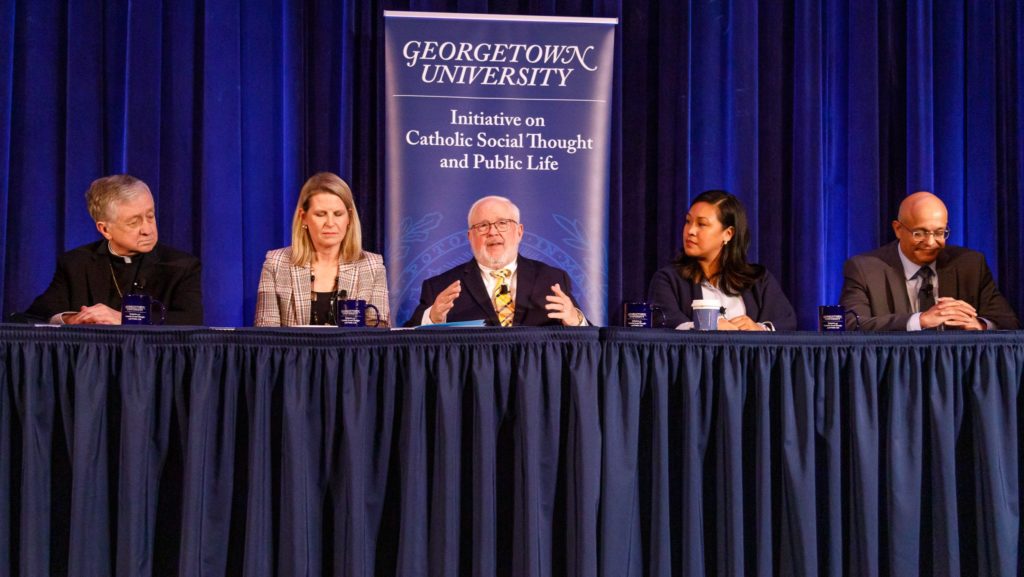
Calling it quits at age 62 was way too early for a man driven to help others and to serve the Church. After a short stint at Harvard’s Kennedy Center Institute of Politics, he founded the Initiative on Catholic Social Thought and Public Life at Georgetown University in 2013. Over the past 12 years it has reached almost half-a-million people, hosting more than 210 dialogues and other gatherings and featuring more than 620 speakers, including a who’s who of bishops, journalists, politicians, activists, youth, and Hispanic leaders, and even a president.
In only its second year, Carr put the Initiative on the map by convincing President Barack Obama to be on a panel talking about overcoming poverty in the United States. Columnist Mark Shields, himself a frequent panelist for the Initiative, wrote with some awe, “Presidents don’t do panels,” and called the gathering “unique and important.”
Over the years, the Initiative has addressed a wide range of topics convulsing our civic life, from immigration and the environment to race and the papacy. With COVID-19, the Initiative began livestreaming its discussions, introducing Catholic social principles to tens of thousands of people across the country.
This January, Carr is retiring a second time. A celebration of all he has accomplished with the Initiative will include tributes by Cardinal Christophe Pierre, apostolic nuncio to the United States, Cardinal Joseph Tobin, political commentators David Brooks and E.J. Dionne, and Catholic Charities CEO Kerry Robinson.
Carr founded the Initiative at a time when both national and ecclesial divisions were growing more acute. His instinct was to look for ways to bridge that gap. Carr’s vision for the Initiative, a vision that has now been passed on to Kim Daniels, his successor as director, is that it would be a place of civil dialogue focused on the principles of Catholic Social Teaching and their application today. He also sought out Evangelical and non-Christian thought leaders who were sympathetic to, or willing to engage in the discussion, as well as the voices of the young and the marginalized.
Carr always tried to straddle the great divide between Catholic pro-lifers and Catholic social justice advocates. Despite the criticism he occasionally took from both sides, Carr insisted there was no divide. He criticized the Obama administration for its contraceptive mandates, and he criticized the Bush Administration for the Iraq War. He would argue that he has been perfectly consistent with the Church’s teachings and the bishops’ leadership, but he recognizes not everyone sees him that way.
Both Trump administrations have provided numerous topics for the Initiative to address. Last February, during a panel discussion on the “Big Beautiful Bill’s” proposed cuts to a wide range of services, Carr examined the budget in the light of Matthew 25.
“The Scriptures tell us the moral measure of our lives in our society is how we respond to the least of these,” Carr said. “Jesus literally told us that our salvation depends on feeding the hungry, welcoming the strangers, caring for the sick and lifting up the least of these, our brothers and sisters. In the weeks ahead, we face stark choices on whether we protect the lifelines, or reduce the health of kids who could go hungry and families who need health care.”
Carr founded the Initiative the same year Pope Francis was elected pope. He is retiring in the first year of Pope Leo’s reign. Both popes have been strong defenders of the principles of Catholic social teaching, most recently in the apostolic exhortation they co-authored, “Dilexi Te” (“I Have Loved You”).
The text is in many ways a primer on Catholic social teaching and could serve as a mission statement for Carr’s long service to the Church. In it, Leo called on Christians “to appreciate the close connection between Christ’s love and his summons to care for the poor. I too consider it essential to insist on this path to holiness, for ‘in this call to recognize him in the poor and the suffering, we see revealed the very heart of Christ…’ ” (3)
Carr has spent his long career as a fierce advocate for the marginalized, from the unborn to the urban and rural poor to the refugee. His Initiative has become a national classroom for Catholic social teaching. It is a fitting legacy for a lifetime of service to its principles.