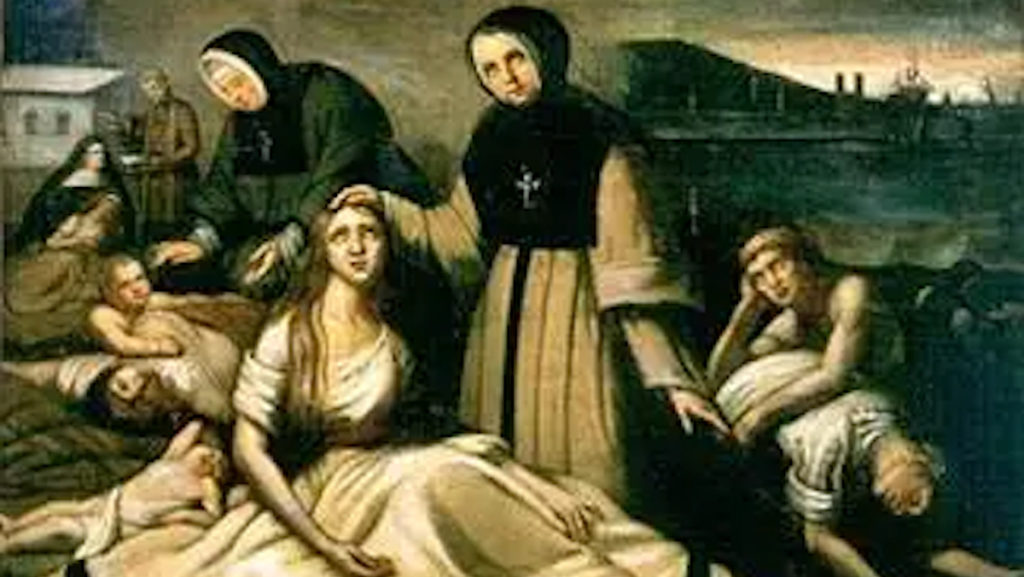
The story that found its way onto my online newsfeed read like a movie pitch. It is a story 180 years old and takes place on the other side of our continent. But it is a story relevant to everyone, regardless of their era or what geography surrounds them.
For us Catholics, especially of the Irish persuasion, it is particularly elevating and consequential.
It was the summer of 1847 in Montreal, and a dire, human disaster was in full bloom an ocean away. It was the Irish potato famine. We will not go into the politics of that because there are more words than I have at my disposal to describe this. If you have the time and inclination, I recommend the book, “Paddy’s Lament” (Mariner Books, $11.40) by Thomas Gallagher for a more complete story.
The short version is that due to the blight on the potato crop, one million Irish people would starve to death, and the total population of Ireland, due to mass emigration, would decline by 25%. That would translate today to 82 million Americans vanishing from our shores.
Hundreds of thousands of Irish men, women, and children fled to North America. Most went to the United States. Others went to Canada. To be polite, the welcome mat was not unfurled for the Irish. There are a lot of corollaries to today as far as the struggles “strangers” have in a new land.
In Montreal, though, not only was there no welcome wagon, but there were ships unloading Irish immigrants riddled with typhus. By August of that year, 75,000 Irish immigrants had arrived, with so many of them sick that the Montreal government began building fever sheds. No hospital would take the sick, and no doctors or nurses would go to the sheds.
The science of the day only understood that typhus was deadly and easy to contract, but they did not understand that the disease was spread by the lice that plagued so many immigrants bunched together on what would be known as “coffin ships.”
The dead were thrown into the harbor, and angry mobs attempted to throw some of the living into the sea as well. The dozens of fever sheds — some as long as half a football field — were guarded day and night by British soldiers to keep the sick inside. It was still not enough to quell the anxiety and fear of the Montreal citizens, so there were attempts to burn the sheds with the Irish inside.
The mayor of Montreal courageously stood up to the mobs, and when things were at their worst, with dozens of ships full of the sick and dying, the bishop of Montreal looked for help and found it in the religious order of women called the Grey Nuns. Many of them were young as they went into the horror of the fever sheds, cared for the sick, and stayed with the dying until many of them succumbed. In a remarkable exposé of God’s power, more nuns came — the Sisters of Providence and even the Sisters of Hôtel-Dieu, a cloistered order that received special permission from the bishop to leave their convent and enter the fever sheds.
Like a movie, the locals began to be either shamed or inspired by these women and started supplying food and other essential items. Even more remarkably, young women began applying for membership in the Grey Nuns’ order. By the time the epidemic ended, between 3,500 and 6,000 Irish immigrants had died, as did dozens of nuns and others who came to help.
They did not cure a single person. At that time, typhus either claimed a victim or someone suffered through it and lived. But what these nuns did — what they have been doing for more than a thousand years, whether in fever sheds of Montreal, plague-ridden streets of medieval Europe, or the modern-day gutters of Calcutta — is show those alone and suffering that Jesus is with them.
I am glad I found out about this little piece of long-forgotten history; this moment in time where the 25th chapter of the Gospel of Matthew incarnated in the form of simple holy women. Their memory deserves something more than a few short words on a social media post. I suggest you do yourself a favor and dive deeper at the Irish Famine Archives online.
I hope we can all be touched by their example and be like the citizens of Montreal, who saw firsthand faith in action and were moved to help. We may not have fever ships, but we have an ample supply of people who need help, and thus almost limitless opportunities to do as the Grey Nuns did and make the words of Scripture live in our actions.