I came into the Church in 1996, and I sometimes joke that my only regret is that I missed out on the days before pre-Vatican II.
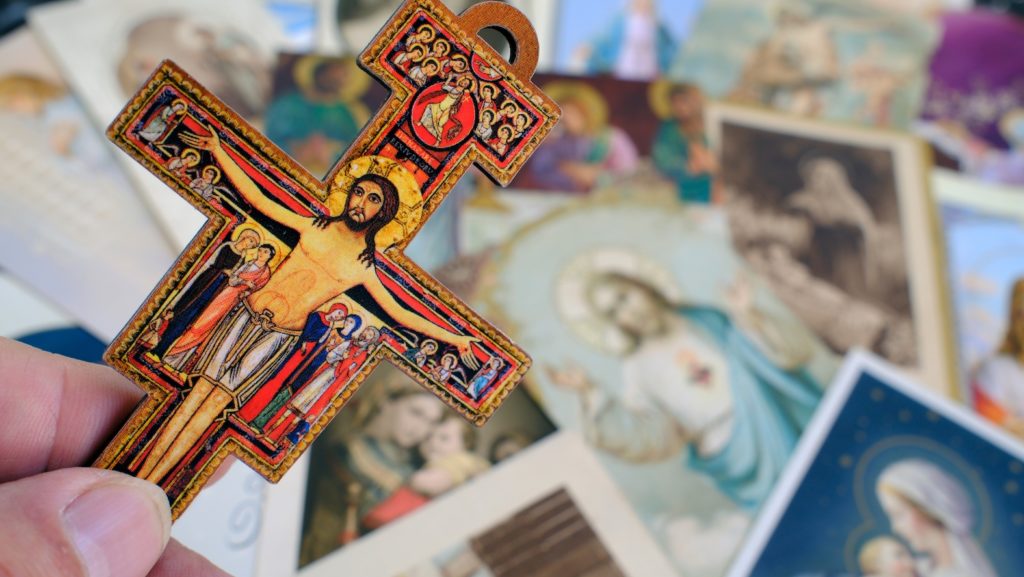
Holy cards, medals, badges, for instance: I’m a huge fan of what I call Catholic tchotchkes.
I love returning to a book I haven’t opened in a while and finding a laminated Prayer to St. Michael the Archangel card, or putting my hand in the pocket of a sweater I haven’t worn since last winter and finding a glow-in-the-dark crucifix I thought I’d lost, or turning on the ignition of my car and glimpsing the St. Christopher, patron saint of travelers, medallion that a priest friend once harvested from a forgotten drawer in his ’50s-era parish that I instantly added to my key chain.
As laypeople, of course, we’re not allowed to keep a tabernacle in our home. But the next best thing, I’ve recently discovered, might be the Catholic tradition known as the Enthronement of the Sacred Heart in the home.
Initiated around 1907, the practice was principally organized and championed by Father Mateo Crawley-Boevey, SS.CC (1875-1960). You can read a description of the tradition, a full account of its history, and a summary of its apostolate at any number of websites.
Basically, the Enthronement consists of officially displaying a blessed image of the Sacred Heart in a prominent place of honor in the home and performing a formal act of consecration. Its purpose is to recognize Christ as a living presence, and to underscore dedication to worship of him as a permanent way of life, saturated with love, grace and joy!
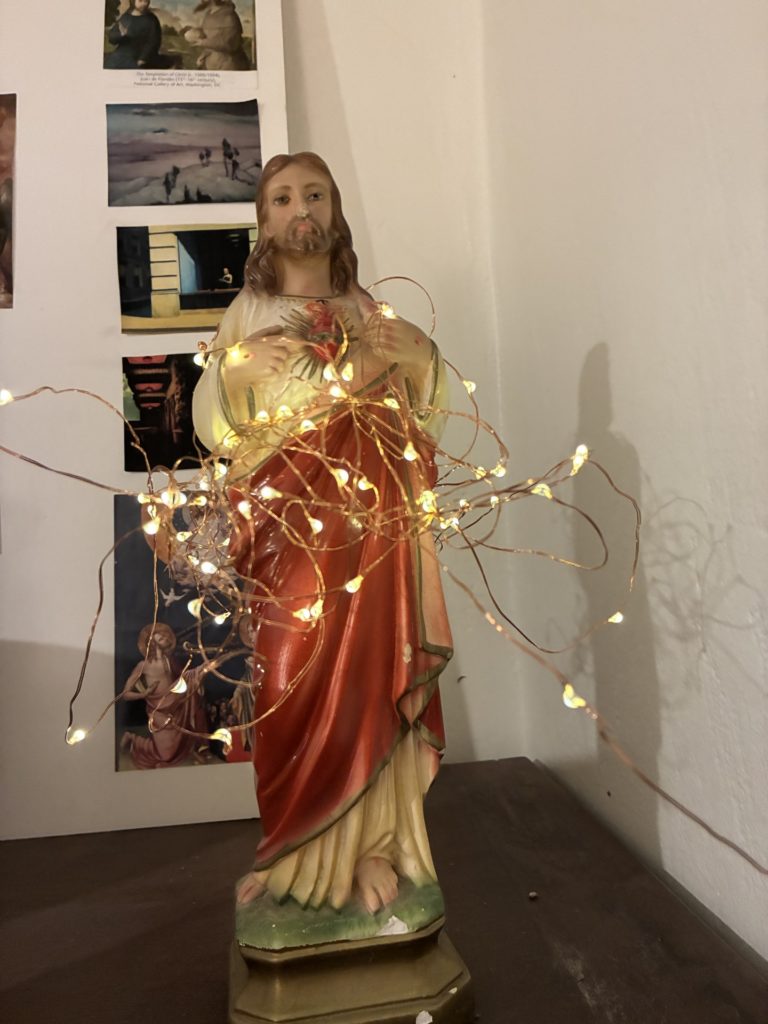
I’ve not had my own Sacred Heart statue formally consecrated, but it is lit day and night and occupies pride of place atop a tall bookcase in my office.
Another tradition I adopted many years ago is the Viaticum prayer. “Viaticum” means “food for the journey,” and in the Catholic context, is the name for the Eucharist administered to a dying person.
There are many such post-Communion prayers. The way I remember it, I found “mine” many years ago in a biography of Servant of God Matt Talbot (patron saint of alcoholics). It runs like this:
“O good Jesus, accept this Holy Communion as my viaticum, as if I were on this day to die. Grant that Thy most adorable Body and Blood may be the last remembrance of my soul; the sacred names of Joseph, Mary, and Jesus my last words; my last affection an act of the purest, the most ardent love of Thee, and a sincere sorrow for my sins; my last consideration to expire in Thy divine arms, adorned with the gifts of Thy holy grace. Amen.”
Let’s face it, you never know when you’re going to get in an accident on the way home from church, or suffer a stroke later that night while kneeling before your Sacred Heart of Jesus statue.
So I derive great consolation, each time I receive the Eucharist, from acknowledging that it might be the last, and asking that it might sustain me on my journey to the next world.
Speaking of which, my fondest wish would be to expire with a priest standing over me, crucifix in hand, murmuring the last rites. However, again — you never know.
Thus, I was thrilled recently to learn of another, perhaps little-known tradition, that anticipates this exact situation.
The Apostolic Pardon is a plenary indulgence that can be granted to a dying person. Usually, this would be administered by a priest at the conclusion of the Anointing of the Sick. But what if a priest isn’t handy to administer the sacraments and impart the pardon as you breathe your last?
The Apostolic Constitution on Indulgences, promulgated by St. Pope Paul VI in 1967, puts it this way. “The Church, like a devoted mother, graciously grants such a person who is properly disposed a plenary indulgence to be gained at the hour of death. The one condition is the practice of praying for this all during life. Use of a crucifix or cross is recommended for the gaining of this indulgence.”
The dying person should have desired this indulgence, in other words, and prayed for it — perhaps by regularly praying the words of the Apostolic Pardon itself. One version runs:
“Through the holy mysteries of our redemption, may Almighty God release you from all punishments in this life and in the life to come. May he open to you the gates of paradise and welcome you to everlasting joy.”
I love that you say the prayer while holding a crucifix.
These practices are completely discretionary, not obligatory. But make no mistake: the treasury of Catholic traditions is no fussy, old-womanish fetish. My Sacred Heart of Jesus statue is an outward, visible sign of a life that is grounded to its smallest moment in the Eucharist, and that is consecrated in its deepest core to Christ.
My prayer cards and medals undergird a deadly serious mission.
“They do not belong to the world any more than I belong to the world,” Jesus said as he delivered his disciples into the hands of the Father before ascending into heaven. “Consecrate them in the truth. Your word is truth. As you sent me into the world, so I sent them into the world. And I consecrate myself for them, so that they also may be consecrated in truth” (John 17: 16–19).