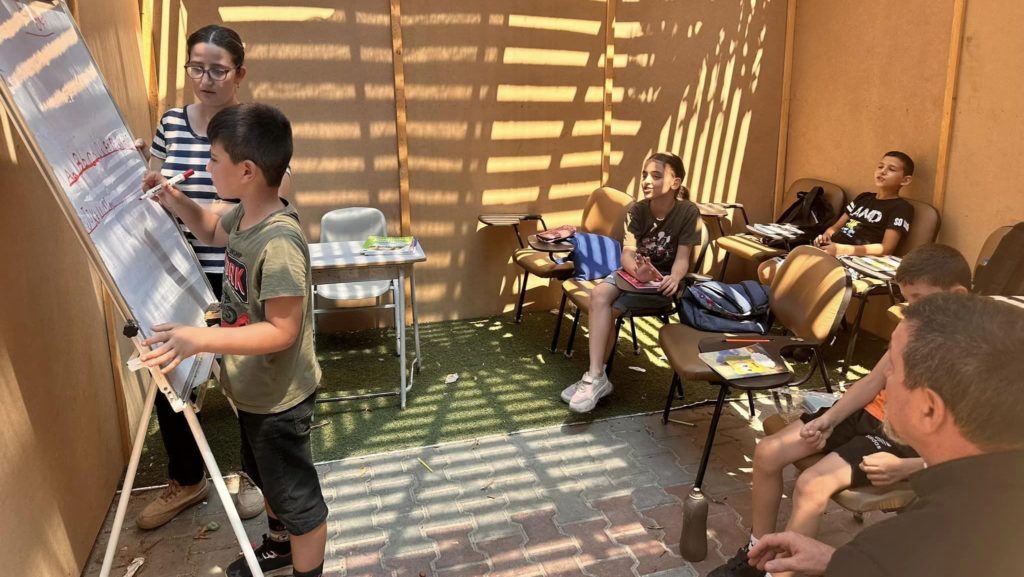
As children worldwide head back to classrooms this fall, students in Gaza are returning to a vastly different reality as the school at Holy Family Parish reopens for the first time since the start of Israel's military campaign.
For Auxiliary Bishop William Shomali, patriarchal vicar for Jerusalem and Palestine, the resumption of classes at the parish compound offers a small but significant step toward normalcy for dozens of children living amid ongoing conflict and destruction.
"Reopening the school is itself a form of care," Bishop Shomali said in an interview with OSV News Aug. 28. "The situation in Gaza remains far from normal -- the conflict is ongoing, and we would not suggest otherwise. But precisely within that reality, giving children a safe place with familiar routines and trusted teachers offers them something dependable to hold onto for a few hours each day."
This September the school at the only Catholic parish in Gaza will welcome approximately 1,000 students at the start of the school year, with 180 enrolled in the patriarchate's kindergarten and the remaining 820 in the primary school, Shomali noted.
Bishop Shomali's focus on the importance of reopening echoed a pastoral letter published Aug. 26 by Cardinal Pierbattista Pizzaballa, the Latin patriarch of Jerusalem, to mark the start of the academic year.
In the letter, Cardinal Pizzaballa noted that "in some parts of the Holy Land, returning to school can no longer be taken for granted."
"There are children whose classrooms no longer stand and communities in which the joy of a new school year is overshadowed by death, displacement and destruction," the cardinal wrote. "Our Christian schools are far more than educational institutions. They are a cornerstone of the Christian presence in the Holy Land. They also welcome many students and families from different religious traditions and educate generations in coexistence, mutual respect and acceptance of the other."
According to an Aug. 24 report by the U.N. Office for the Coordination of Humanitarian Affairs, more than 73,000 people, including 21,283 children, have died in Gaza. The report added that roughly 1.98 million people -- about 94% of the population -- are displaced, while an estimated 637,475 school-age children lack sustained access to formal education.
Since the war began in October 2023, the Holy Family compound has served as a vital sanctuary for displaced families. In 2025, the church compound was struck by Israeli tank fire, leaving three people dead and nine injured, including the parish pastor, Father Gabriel Romanelli.
Bishop Shomali said that while the parish continues to shelter displaced civilians, some families "have been able to return to their homes, even though many of these homes remain damaged and in poor condition."
Despite severe challenges, he added, Father Romanelli and parish staff have gradually repaired the school buildings.
"This process has been carefully organized to ensure that the needs of both students and displaced families are addressed," Bishop Shomali said. "The spaces required for teaching have been made available while continuing to accommodate those families who still have no safe place to return to."
Providing education and sheltering vulnerable families are two responsibilities the Latin Patriarchate views as "inseparable," he added.
Additionally, security remains a primary concern. When asked about safety protocols, Bishop Shomali noted that precautions include student transportation when possible and clear emergency procedures, while acknowledging the grim reality on the ground.
"In the current circumstances, no institution in Gaza can offer absolute guarantees of safety," he said. "Like all Palestinians, we continue to place our trust in God's providence while doing everything humanly possible to protect those entrusted to our care."
Bishop Shomali added that staying home also carries risk, as "many residential areas have been affected by the conflict, and the risks are not limited to schools alone."
Along with academic instruction, the patriarchate is providing psychological support for students and teachers navigating severe trauma, as well as material and moral support for educators.
"We deeply appreciate their commitment to their students and their willingness to continue serving despite the hardships they themselves face," Bishop Shomali said. "Their perseverance is a powerful testimony to the importance of education."
The bishop also acknowledged that hardship extends across the region, noting that Christian families in the West Bank face Israeli settler attacks, nightly military incursions and movement checkpoints that disrupt daily life. Those attacks prompted an appeal from Pope Leo XIV Aug. 16 calling for an end "to the repeated acts of violence against the Palestinian population of the West Bank."
Despite the difficulties and challenges, for Bishop Shomali, the reopening of the school in Gaza serves as a "powerful message of hope, resilience and solidarity."
"Through this school, the Church is telling local Christian families that they are not forgotten and will not be abandoned during what is arguably one of the most difficult periods in their recent history," the bishop told OSV News.
"Education is far more than a social service; it is an act of faith in the future and a concrete commitment to strengthening the Christian presence in the land where Christianity was born," he added. "Every child who enters this school is a reminder that hope is stronger than fear and that the Church remains dedicated to building a future of dignity, opportunity, and peace."