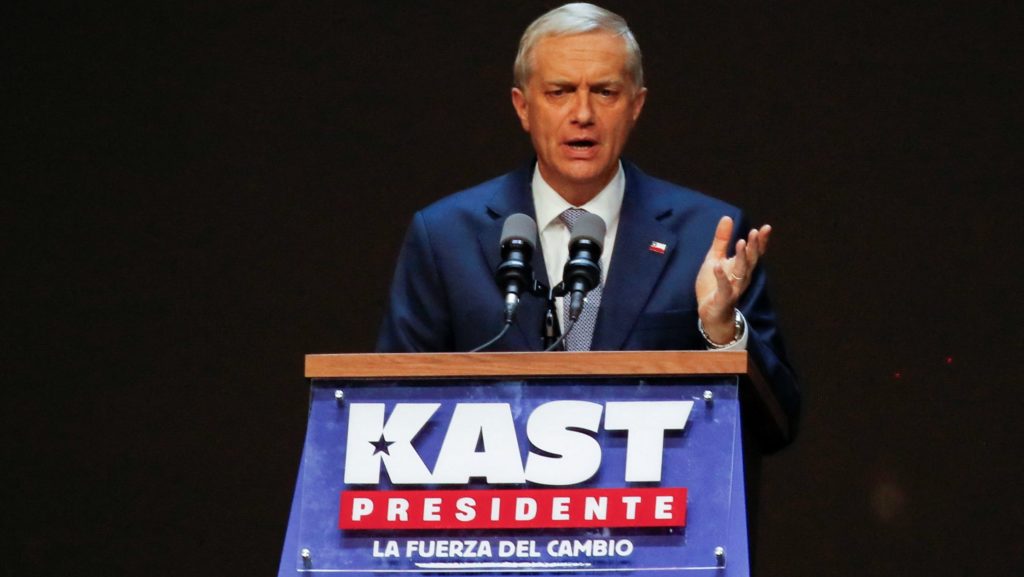
Chile's bishops' congratulated José Antonio Kast for claiming the South American country's election, but called for the president-elect to "promote an environment of dialogue, encounter, and respect, essential for rebuilding social trust" amid deep divisions and rising concerns over crime and migration.
Kast, a married, Mass-attending father of nine, took over 58% of the vote in the Dec. 14 runoff, besting Jeannette Jara, a former cabinet minister, member of Chile's Communist Party and the candidate of a leftist coalition. Kast, 59, called for unity after being elected, scolding supporters for booing Jara and saying, "We may have differences, even harsh ones. We may believe in very different things for our society, but if violence prevails, if harsh shouting prevails, it's very difficult for us to move forward."
The Chilean bishops' conference echoed those sentiments in a Dec. 14 letter to Kast, "We encourage you to promote an environment of dialogue, encounter, and respect, essential for rebuilding social trust."
The letter continued, "We are living through a period marked by accumulated suffering, social and economic crises, and widespread distrust in institutions. However, we also recognize the strength, dignity, and resilience of our people, capable of rebuilding the bonds that sustain life in community. In this context, the presidential election renews the hope of moving toward a more just, fraternal, and compassionate country, where the power of reason always prevails over the force of power."
Kast campaigned heavily on fighting crime, expelling migrants and restoring order in Chile, where the murder rate has more than doubled over the past decade. He also promised to build a wall on Chile's border with Peru and Bolivia.
He ran on a similar platform in 2021, but lost to President Gabriel Boric, a former left-wing student leader. Boric's victory followed widespread protests in 2019 over social inequality in what had been hailed as an economic success story in Latin America.
But disenchantment with the six years since the protests -- including two failed attempts to rewrite the constitution, deteriorating public security and anti-immigrant attitudes -- turned voters toward Kast's conservative platform, according to analysts.
"Kast has gained credibility with voters on these issues owing to his long-standing views on using a hard-line approach to crime and migration," Nicolás Saldias, senior Latin America analyst at the Economist Intelligence Unit, told OSV News.
"The sense of disorder can be traced back to the 2019 protests as it was seen as a before and after moment in modern Chilean political history."
Kast's victory continued a rightward shift in Latin America, where candidates have increasingly won office promising law-and-order, campaigning against migrants. Leaders in countries such as Argentina, Ecuador and El Salvador have allied with U.S. President Donald Trump.
The son of German immigrants to Chile, Kast has not hidden his faith, saying in a 2023 interview, "I'm a Catholic first, and then I'm a politician," according to The Wall Street Journal.
Analysts say Kast focused his campaign on security and immigration rather than moral issues. Church leaders, meanwhile, expressed concern with the state of the country.
"I'm worried about the tone of the country, because it goes far beyond the campaign," Cardinal Fernando Chomali of Santiago said after meeting candidates prior to the first round of voting in November. "I'm worried about the tone on social media, I'm worried about the tone in the streets."
Cardinal Chomali also voiced concerns over Kast's call for migrants to leave the country and expulsions if he won office.
"A mass expulsion would not only be socially traumatic -- from a personal, familial, and social perspective -- but would also generate profound economic damage: reduced productivity, increased costs, loss of formal employment, and upward pressure on prices," Cardinal Chomali said in a column published by Radio Biobío.
"We must also take into account the enormous social assistance that migrants provide to the most vulnerable people in the country: priests, nuns, and healthcare professionals who, through their daily work, support those who suffer the most."
Migrants now account for approximately 10% of Chile's population of 20 million people -- up from 2.1% in 2009 -- with large numbers of Haitians and Venezuelans arriving over the past 15 years.
"A couple of weeks ago, we started receiving worrying stories from people, who are beginning to panic," Father Pablo Walker, chaplain for Jesuit Migration Service in Chile, told OSV News.
In the city of Concepción, "They were asking us, 'Are they going to kick us out like dogs?'" Father Walker said. "Today in Santiago, it's, 'Are the police coming to get us?" They can't get the TV images of what happened in the U.S. out of their heads."
Father Walker described a rising "anti-migrant narrative serving as a channel for … social frustration" as the state failed to integrate newcomers.
Chile's bishops added in their letter to Kast, "We are worried about the growing denigration of migrants and vulnerable people. And we reiterate our commitment to life, human dignity, and protecting the weakest."