VATICAN CITY (CNS) – Pope Leo likened the fragility of the baby Jesus at Christmas with the “defenseless populations,” such as refugees in Gaza and the homeless, in the first Christmas morning Mass celebrated by a pope in 30 years.
"The Word has pitched his fragile tent among us. How, then, can we not think of the tents in Gaza, exposed for weeks to rain, wind and cold; and of those of so many other refugees and displaced persons on every continent; or of the makeshift shelters of thousands of homeless people in our own cities?" he asked in his homily at the Mass Dec. 25 in St. Peter's Basilica.
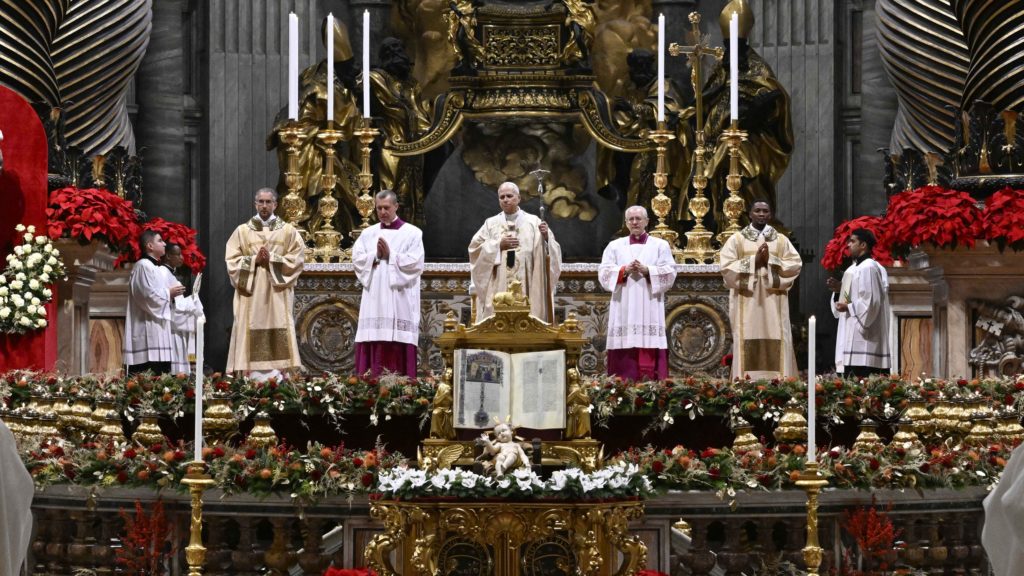
In celebrating the morning liturgy publicly, Pope Leo restored a tradition that had lapsed for 30 years. St. John Paul II did not preside over the liturgy in 1995 because he had the flu, and the morning Mass never returned to the papal calendar.
The night before, the Pontiff had celebrated the traditional Christmas Eve Mass with some six thousand people inside St. Peter's Basilica, in addition to an overflow crowd of thousands more who followed on monitors in St. Peter's Square under cold, pouring rain.
Like his predecessors, Pope Leo went to the central balcony of St. Peter's Basilica at noon to give his solemn blessing "urbi et orbi" (to the city and world). And, returning to a tradition set aside by Pope Francis, who claimed he was bad at languages, Pope Leo wished people a merry Christmas in 10 languages: Italian, French, English, German, Spanish, Portuguese, Polish, Arabic, Chinese and Latin.
"Merry Christmas! May the peace of Christ reign in your hearts and in your families," he said.

In his homily and in his Christmas message before the "urbi et orbi" blessing, Pope Leo insisted that the Christian mission of sharing the good news of salvation in Christ means being serious about what is going on in the world and working to alleviate suffering, promote dialogue and end wars and violence.
Taking on the fragile flesh of a baby, God wanted to identify with every human person, he said in the morning homily.
"Fragile is the flesh of defenseless populations, tried by so many wars, ongoing or concluded, leaving behind rubble and open wounds," he said. "Fragile are the minds and lives of young people forced to take up arms, who on the front lines feel the senselessness of what is asked of them and the falsehoods that fill the pompous speeches of those who send them to their deaths."
"When the fragility of others penetrates our hearts, when their pain shatters our rigid certainties, then peace has already begun," the pope insisted.
The response of Christians to suffering and violence must be firm but tender, he said.
"We do not serve a domineering Word – too many of those already resound everywhere," the pope said, but rather Christians profess and serve a Lord who "inspires goodness, knows its efficacy and does not claim a monopoly over it."
The peace proclaimed by Jesus, he said, will take root "when our monologues are interrupted and, enriched by listening, we fall to our knees before the humanity of the other."
Pope Leo continued his reflection in his "urbi et orbi" message, telling the crowd gathered in the rain in St. Peter's Square that Jesus, "out of love," wanted "to be born of a woman and so share our humanity; out of love, he accepted poverty and rejection, identifying himself with those who are discarded and excluded."

As is customary, the pope used his message to call attention to urgent needs and suffering in places around the globe and to urge people to help relieve that suffering.
"Those who do not love are not saved; they are lost," he said. "And those who do not love their brother or sister whom they see, cannot love God whom they do not see," as the First Letter of John says.
"If all of us, at every level, would stop accusing others and instead acknowledge our own faults, asking God for forgiveness, and if we would truly enter into the suffering of others and stand in solidarity with the weak and the oppressed, then the world would change," Pope Leo said.
Looking around the world, the pope prayed for peace and justice in dozens of countries, including Ukraine, and, as he did the night before and during the Christmas morning Mass, Pope Leo also called attention to the plight of migrants and refugees, asking governments to accept and assist them.
"In becoming man," he said, "Jesus took upon himself our fragility, identifying with each one of us: with those who have nothing left and have lost everything, like the inhabitants of Gaza; with those who are prey to hunger and poverty, like the Yemeni people; with those who are fleeing their homeland to seek a future elsewhere, like the many refugees and migrants who cross the Mediterranean or traverse the American continent."
"On this holy day, let us open our hearts to our brothers and sisters who are in need or in pain," Pope Leo said. "In doing so, we open our hearts to the Child Jesus, who welcomes us with open arms and reveals his divinity to us."
Octavia Thuss and her son Henry Thuss from La Cañada, California, were among the 26,000 people in St. Peter's Square for the pope's blessing. They also had been in the square late the night before, watching the pope's Christmas Mass on a screen in the rain.
Since it was Pope Leo's first Christmas as pope, "It was historic," she said. "It was a really beautiful service."
Spending the Christmas holiday in Rome during the final days of the Jubilee Year added to the experience, since they were among some of the last pilgrims to pass through the Holy Doors at the city's major basilicas.
"It's kind of a no brainer," Henry said, adding that he felt being at the Vatican during Christmas in a Jubilee Year was akin to Muslims making a pilgrimage to Mecca.
Contributing to this story was Josephine Peterson.