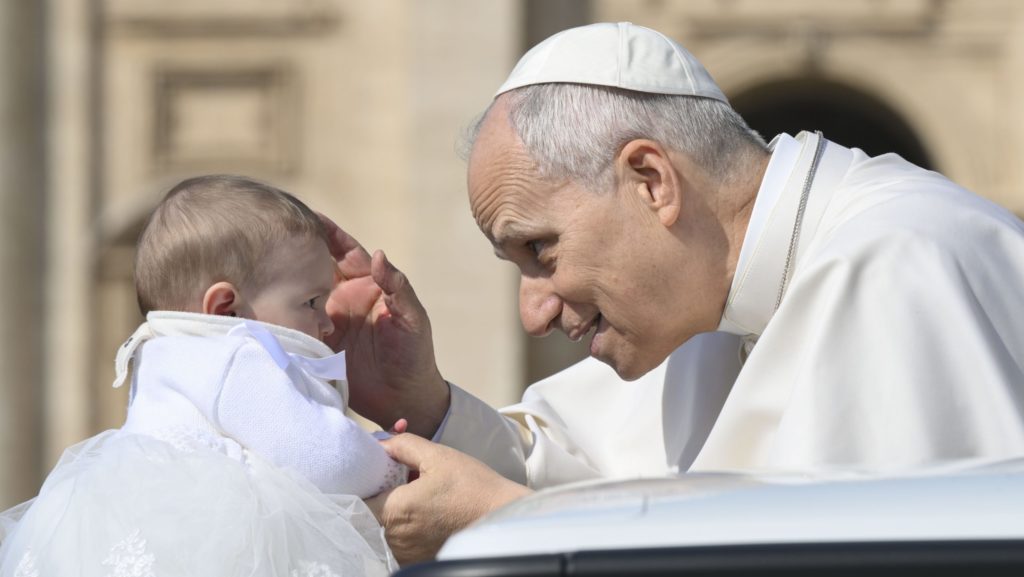
The sanctity of life, from conception to its natural end, must be defended, especially now, in a world marked by "the madness of war," Pope Leo XIV said.
When greeting Polish-speaking visitors during his general audience in St. Peter's Square March 25, Pope Leo highlighted Poland's pro-life celebration during his greetings, saying initiatives such as their "Spiritual Adoption of a Conceived Child" were truly needed.
"In a time marked by the madness of war, it is important to defend life from conception to its natural end," he said.
Poland celebrates the Day of the Sanctity of Life every March 25, the feast of the Annunciation, which falls nine months before the Lord's birth Christmas Day and celebrates Jesus' incarnation in the womb of the Blessed Virgin Mary.
Similar prayer initiatives exist around the world, including in the United States. The late Archbishop Fulton J. Sheen, who is set to be beatified Sept. 24 in St. Louis, also inspired a spiritual adoption program, in which participants pledge to pray daily for nine months for an unborn child whose mother is considering abortion.
Sometimes "spiritual parents" are encouraged to name the unborn child and to pray for him or her daily, and, at the end of nine months, hold a baby shower to collect supplies and money to donate to local pregnancy centers.
Marking the feast of the Annunciation, Pope Leo invited Catholics to follow the example of the Blessed Virgin Mary more closely and to "always be ready to do God's will."
"As we continue our Lenten journey, let us ask the Lord to grant us the grace to imitate Our Blessed Mother in her total 'yes' to the Lord, and so open our hearts to his will for our lives," he told English-speaking pilgrims and visitors.
In his main catechesis, the pope continued his series of reflections on the documents of the Second Vatican Council, specifically, the Dogmatic Constitution on the Church, "Lumen Gentium."
Pope Leo explained that the hierarchical structure of the Church is not a "human construct" for fulfilling some kind of organizational function, but is "a divine institution whose purpose is to perpetuate the mission given by Christ to the apostles until the end of time."
The Catholic Church, he said, is "founded on the apostles, whom Christ appointed as the living pillars of his mystical body, and possesses a hierarchical structure that works in the service of the unity, mission and sanctification of all her members."
Since the apostles are called to faithfully preserve Christ's "salvific teaching, they hand on their ministry to men who, until Christ’s return, continue to sanctify, guide and instruct the Church 'through their successors in pastoral office,'" he said.
While all the faithful make up "the one priesthood of Christ," he said, those ordained ministers who have received the Sacrament of Holy Orders, that is, bishops, priests and deacons, do have a unique ministry.
Endowed with "sacred power" for service in the Church, the bishops, "first and foremost, and through them the priests and deacons, have received tasks ('munera' in Latin), which lead them to the service of 'all those who belong to the People of God,'so that, 'working toward a common goal freely and in an orderly way, [they] may arrive at salvation,'" the pope said, citing the council document.
This apostolic mission is "collegial and communal," reflecting the Lord's desire for "shepherds of His people" who serve with love, he said. That is why St. Paul VI presented the hierarchy as being "born of the charity of Christ, to fulfil, spread and ensure the intact and fruitful transmission of the wealth of faith, examples, precepts and charisms bequeathed by Christ to His Church."
"Dear sisters and dear brothers, let us pray to the Lord that He may send to His Church ministers who are ardent with evangelical charity, dedicated to the good of all the baptized, and courageous missionaries in every part of the world," Pope Leo said.