With the jubilee year now officially ended, the pope's travel schedule is also expected to ramp up, with one trip especially dear to the pontiff just confirmed: a June visit to Madrid, Barcelona and the Canary Islands.
Cardinal José Cobo of Madrid confirmed that the delegation of Spanish bishops had a meeting in the Secretariat of State in the morning of Jan. 9, just after the consistory, to discuss a papal trip to Spain with "a first draft" of the plan "prepared for the Holy Father to review."
"This came directly from the pope ... this was his personal initiative," Cardinal Cobo said of the idea behind the trip.
"Spain has long been in need and has continually requested a papal visit. So I think that the opening of this door now is a cause for hope and joy for everyone, both for the civil authorities and, of course, for the Church in Spain," Cardinal Cobo told the media in Rome Jan. 9.
The first apostolic trip to Turkey and Lebanon was inherited by Pope Leo from Pope Francis' calendar. Pope Francis was invited to Spain several times but never went, leaving the traditionally Catholic country -- struggling with dropping Church attendance -- without a papal visit for 14 years.
While there has been no official confirmation of a trip by the Vatican, OSV News learned from sources close to the Spanish bishops that the organizing committee in Madrid is hard at work planning to welcome the pope. The tentative plan is that the pope will arrive in Spain on June 6, after which he will meet with young people during a vigil that same evening.
The last time a pope visited Spain was in 2011 when Pope Benedict XVI traveled to Madrid for World Youth Day.
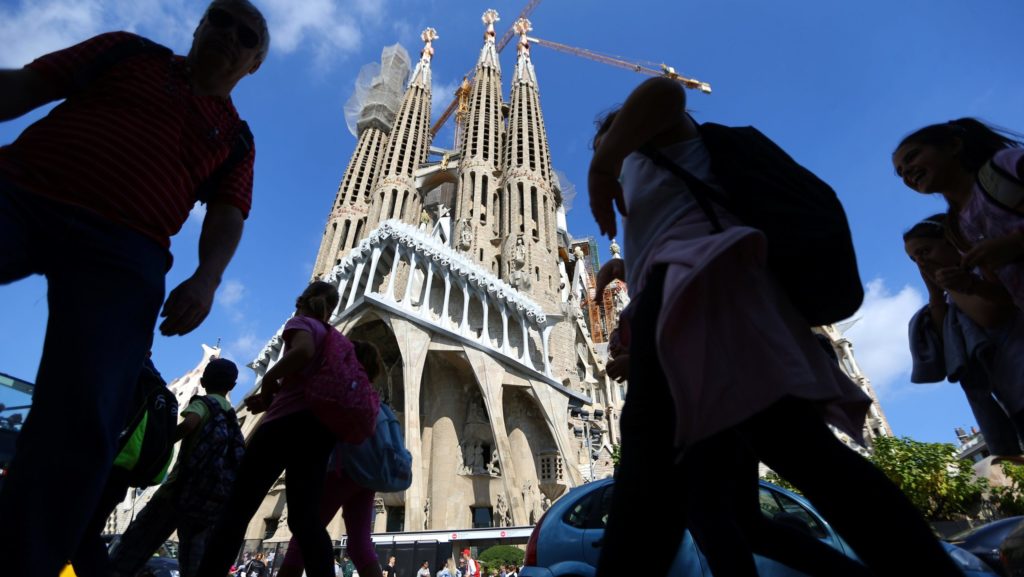
OSV News confirmed that Cardinal Juan José Omella Omella of Barcelona, a member of the close circle of papal advisers, or the Council of Cardinals, begun by Pope Francis convinced Pope Leo to attend the celebrations of the centenary of the death of Antoni Gaudí -- the legendary architect of one of the world's most iconic churches, the Basilica of the Holy Family in Barcelona, known in Spanish as Sagrada Familia.
When Pope Benedict visited Sagrada Familia in 2010 for its dedication, he said, "Gaudí, by opening his spirit to God, was capable of creating in this city a space of beauty, faith and hope which leads man to an encounter with him who is truth and beauty itself."
A visit to Sagrada Familia would be a "central point" of the trip, Cardinal Cobo confirmed Jan. 9.
For Eva Fernández, Vatican correspondent for COPE, the radio network of the Spanish bishops' conference, who spoke to OSV News Jan. 7, Barcelona would be a "logical stop," not only for the completion of the main building of the Sagrada Familia, but the possible recognition of a miracle attributed to Gaudí, that could lead to a beatification ceremony that would coincide with a papal visit.
It is also possible that the Archdiocese of Madrid would take advantage of the presence of the pontiff for a beatification of a group of seminarians martyred in 1938. During the rule of the Spanish Republic (1931-1939), 13 bishops, more than 6,800 priests, and many religious men and women were killed for their faith in one of the bloodiest systematic persecutions the Church suffered in the 20th century. More than 2,000 of those who died have been already beatified, while many are still waiting.
In Madrid, Cardinal Cobo -- one of the youngest in the college of cardinals -- is organizing an intense agenda, including national-scope events like a Saturday night vigil with young people, World Youth Day style, most likely to be held in the just-renovated Bernabeu stadium. Pope Leo will follow other Americans who have performed in the stadium, including the NFL's Washington Commanders and the Miami Dolphins who played there in November, and Taylor Swift, who filled it up with more than 65,000 spectators last May.
A Sunday morning Mass for families in the central avenue of Paseo de la Castellana, where both Pope John Paul II and Pope Benedict presided over large Masses, is also being planned, OSV News has learned.
The Church in Spain is strong, with its magnificent history and traditional Catholicism, and with Holy Week processions not seen anywhere else in the world. The number of people attending Mass, however, has been going down in recent years. Over 47% of those who consider themselves Catholics almost never attend any religious service as of June 2025, according to statistics.
In 2011, slightly over 70% of the Spanish population identified as Catholic; according to Statista, that number now stands at 56.1%.
The Church in Spain has been struggling in recent years with the clergy sexual abuse crisis, with cases being reported one-by-one in the media, especially the newspaper El Pais. The country's bishops waited so long to commission their own report on abuse that the state -- run by socialist government of Pedro Sanchez -- did one on its own. On Jan. 8, an agreement between the Catholic Church and the Spanish government seeking to provide reparations to victims of clergy sexual abuse was signed.
Because the Catholic Church clashes with the Spanish government on many different issues, from abortion to euthanasia, the meeting with state authorities could be a sensitive issue for Pope Leo. No issues whatsoever await him as regards meeting the Royal Family, however, as King Felipe and Queen Letizia are both practicing Catholics.
Regarding the significance of a trip to Spain, Fernández told OSV News that a papal visit to the country has been "highly anticipated," and should Pope Leo visit this year, he "will be very well received."
"This year is especially important because Spain is going through some years of political turbulence. Obviously, the visit of a conciliatory spiritual leader -- like Leo XIV, who also placed such emphasis on unity from the start of his pontificate -- can help a great deal in recomposing the current political map of great polarization in Spanish society," she said.
Pope Leo's trip to Spain is to end with a visit to the Canary Islands, sources confirmed. The archipelago, which is geographically in Africa, is the destination each year of thousands of Sub-Saharan migrants looking for a better future. They arrive in poor and fragile boats called "callucos," and many die in transit.
Pope Francis intended to visit the Canary Islands, Cardinal Cobo said, stressing that now is "also a very important moment to give voice to migrants ... throughout Spain and all the major entry points, and to the situation of migration that is sometimes made invisible." Pope Leo "is also addressing the major concerns that Francis raised," the cardinal said.