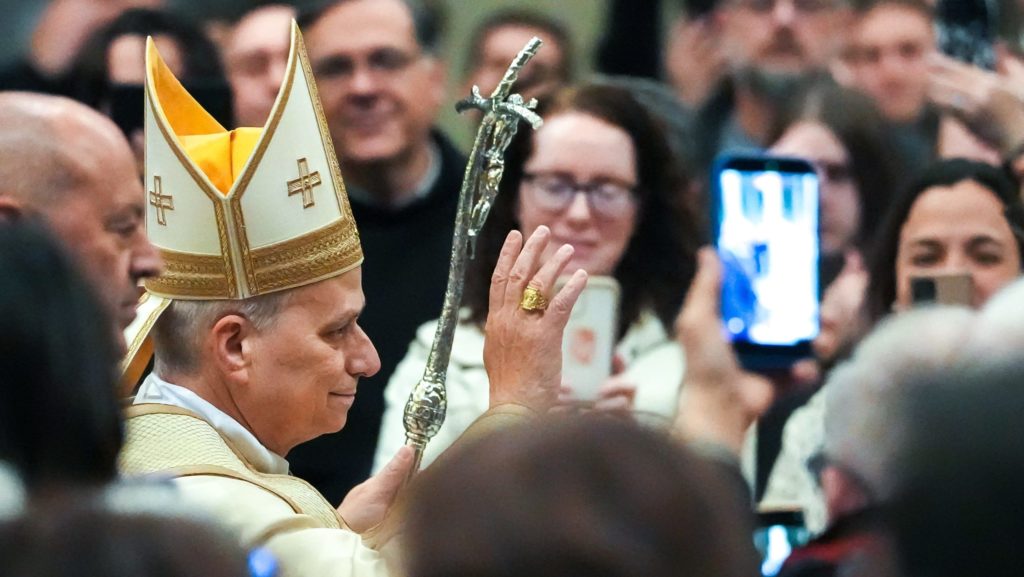
Humanity must not allow technology, especially AI, to obscure, exploit or suppress human voices, needs, knowledge, talents, creativity and critical thinking abilities, Pope Leo XIV said.
Algorithms designed to maximize engagement on social media can lock people into "bubbles" of easy consensus and rage, weakening people's ability to listen and think critically, and increasing polarization, the pope wrote in his message for the World Day of Communications.
"Added to this is a naively uncritical reliance on artificial intelligence as an omniscient 'friend,' a dispenser of all information, an archive of all memory, an 'oracle' of all advice," which can also further erode the ability to understand what things really mean and to think analytically and creatively, he wrote.
The pope's message was released Jan. 24, the feast of St. Francis de Sales, patron saint of journalists. The Vatican and most dioceses will celebrate the World Day of Communications May 17, the Sunday before Pentecost.
The theme for the church's 60th celebration of World Day of Communications is "Preserving human voices and faces," which the Dicastery for Communication announced Sept. 29.
The theme underlines the pope's focus on the need to respect the human person and each person's God-given uniqueness and diversity.
The challenge, he wrote, "is not technological, but anthropological. Protecting faces and voices ultimately means protecting ourselves."
Humanity can embrace the opportunities offered by digital technology and artificial intelligence "with courage, determination and discernment," he wrote, without hiding or ignoring the critical issues, problems and risks they pose.
The main concern is not what "machines" or technology can or will be able to do, Pope Leo wrote, "but what we can and will be able to do, growing in humanity and knowledge, with the wise use of such powerful tools at our service."
The heart of the problem, he wrote, is the human temptation to passively accept the fruits of knowledge without being an integral part of the technological process, without doing the needed research and without being held accountable and responsible regarding their use.
"Giving up the creative process and surrendering our mental capacities and imagination to machines means burying the talents we have received to grow as people in relation to God and others," he wrote. "It means hiding our face and silencing our voice."
Without proper safeguards, he wrote, "digital technology risks radically altering some of the fundamental pillars of human civilization" since current technology is able to simulate "human voices and faces, wisdom and knowledge, awareness and responsibility, empathy and friendship."
"There has long been ample evidence that algorithms designed to maximize engagement on social media -- which is profitable for platforms -- reward knee-jerk emotions and penalize more time-consuming human expressions such as the effort to understand and reflect," the pope wrote.
"By closing groups of people into bubbles of easy consensus and easy indignation, these algorithms weaken the ability to listen and think critically and increase social polarization," he wrote, adding his warning about any naive and uncritical reliance on AI for information, remembering the past, "friendship" and advice.
"Although AI can provide support and assistance in managing communication tasks, shirking the effort to think for ourselves and settling for an artificial statistical compilation risks eroding our cognitive, emotional and communication skills in the long run," he wrote.
Pope Leo flagged the danger of letting AI systems take control of producing text, music and video, and allowing "masterpieces of human genius in the fields of music, art and literature" to become "mere training grounds for machines."
"Much of the human creative industry is thus at risk of being dismantled and replaced with the label 'Powered by AI,' transforming people into mere passive consumers of unthought thoughts, anonymous products, without authorship, without love," he wrote.
Pope Leo also highlighted the increased presence of "bots" and "virtual influencers" on people's social media feeds, and their ability to influence public debate and people's choices.
Another danger, he added, was "anthropomorphizing" Large Language Models, which can imitate human emotions and appear "affectionate," potentially deceiving or influencing vulnerable people and exploiting the human need for relationships.
If people replace real human relationships with AI-trained systems, where "everything is made in our image and likeness," he wrote, people can build a "world of mirrors" and be robbed of the opportunity "to encounter others, who are always different from us, and with whom we can and must learn to engage."
AI and its propensity to "hallucinate" as well as its ability to fabricate "reality" make it increasingly difficult to distinguish fact and fiction, thus posing a great risk to journalism, he wrote.
"A failure to verify sources, together with the crisis in on-the-ground journalism, which involves the continuous gathering and verification of information wherever events occur, can create even more fertile ground for disinformation, causing a growing sense of mistrust, confusion and insecurity," the pope wrote.
And finally, he warned about the danger of having a "handful of companies" be in control of so much data and be able to "subtly influence behavior and even rewrite human history -- including the history of the Church -- often without us even realizing it."
What needs to be done, he wrote, is "not stop digital innovation, but to guide it, to be aware of its ambivalent nature" and to "raise our voices in defense of human beings, so that these tools can truly be integrated as our allies."
This alliance must be based on responsibility, cooperation and education, he wrote,
"Media and communication companies cannot allow algorithms designed to win the battle for a few extra seconds of attention at any cost to prevail over their professional values, which are aimed at seeking the truth," he wrote. "Public trust is earned through accuracy and transparency, not by chasing after any kind of engagement."
"Content generated or manipulated by AI must be clearly labeled and distinguished from content created by humans," the pope wrote. Authorship, ownership and copyright must be protected.
"Information is a public good. A constructive and meaningful public service is not based on opacity, but on transparency of sources, inclusion of stakeholders and high standards of quality," he said in his message.
The pope called for increased media, information and AI literacy on all levels. "As Catholics, we can and must make our contribution so that people -- especially young people -- acquire critical thinking skills and grow in freedom of spirit."
More should be done, too, he added, in protecting people's face, image and voice from being used in "the creation of harmful content and behaviors such as digital fraud, cyberbullying and deepfakes that violate people's privacy and intimacy without their consent."
"We need faces and voices to represent people again," he wrote. "We need to cherish the gift of communication as the deepest truth of humanity, to which all technological innovation should be oriented."