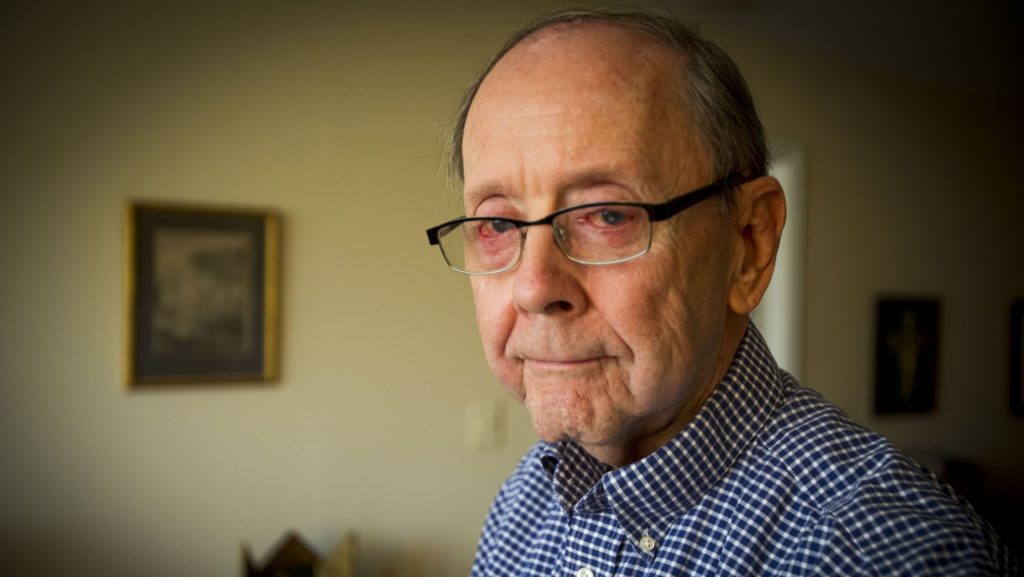
Russell Shaw, a veteran Catholic journalist who led communications for the U.S. bishops and Knights of Columbus and authored numerous articles and books, died Jan. 6 at the age of 90 in Silver Spring, Maryland.
Friends and colleagues recalled the Washington native as a man of deep intelligence, keen insight and personal discipline whose prolific writing and communications work helped to shape the Catholic Church in the U.S. for more than a half-century.
"It was Russell Shaw who gave us the words to understand what was going on in the Second Vatican Council, in the events of the late 60s, in the pontificate of Pope John Paul II, which seemed to come out of the clear blue sky, it was so different from what had gone before," Mike Aquilina, a Catholic writer mentored by Shaw, told OSV News. "I don't think anyone can count the number of articles he wrote in his life, and we don't realize how much of what's in our head, of what we consider memory of those years, was mediated by Russell Shaw."
After decades working in church communications beginning in the 1960s, Shaw returned in the late 1990s to his first career, journalism. He wrote on a broad range of topics from Catholic education and civic responsibility to the sacraments and suffering. He was especially known for championing the role of the laity, a sharp criticism of clericalism and an advocate for transparency among the bishops. However, he was always charitable and respectful in writing and conversation about those with whose ideas he disagreed, Aquilina said.
Kathryn Jean Lopez, senior fellow at the National Review Institute and religion editor at National Review magazine, described Shaw as a "giant of the Church" who was also humble and understated.
"Russell Shaw was an example of someone who knew the warts and all, but he lived his life to be in constructive service, in humble service, in wise service," Lopez, Shaw's friend and a fellow Catholic writer, told OSV News. "It was always about serving the Lord in all he did."
In his writing, Shaw provided "a blueprint for what it means for the laity to rise to the occasion of what John Paul II called the new evangelization" while also living that role exemplarily, Lopez said. "He was a witness of married life, of fatherhood and how you live the faith in the world," she said.
Greg Erlandson, a longtime Catholic journalist and former president and editor in chief of Catholic News Service, called Shaw "a writer's writer" who was always finishing a book or starting a new one. He admired Shaw for his charitable approach to critique and for defying Catholic ideological boxes, and for the way he distinguished between optimism and hope.
"He was not necessarily an optimist," Erlandson said, but "his faith was (that) Christ was not going to desert his Church, even if Russ sometimes took a rather bleak view of how it was doing. There still was that faith that animated him. That should be sort of a call to all of us."
David Scott, vice chancellor for communications for the Archdiocese of Los Angeles, worked closely with Shaw in the 1990s when Scott was the editor of OSV Newsweekly. "His writing was clear, intelligent, fair," Scott said. "You would shake your head at how much he could get across in 1,200 words, and you never had to change a thing."
Scott also said Shaw was "an old word we don't use anymore: a gentleman."
"Everything with Russ seemed to come from a place of calm and prayer," he added. "Over the years, he taught me the meaning of a lot of things that matter, and he did that through conversation and example: how to be a good husband and dad, a good son and friend."
Shaw's many published works include "Nothing to Hide: Secrecy, Communication, and Communion in the Catholic Church" (Ignatius Press, 2008), "American Church: The Remarkable Rise, Meteoric Fall, and Uncertain Future of Catholicism in America" (Ignatius Press, 2013), and "The Life of Jesus Christ: Understanding the Story of the Gospels" (OSV, 2021).
His most recent book, "Turning Points: How Thirteen Remarkable Men and Women Heard God's Call and Responded to It," was published by Ignatius Press in 2025. He had been working on a book drawing parallels between Flannery O'Connor, St. John Henry Newman and Blaise Pascal before his health failed last year.
Shaw was born May 19, 1935, in Washington to U.S. Army Col. Charles Burnham Shaw and Mary Russell Shaw. He graduated from Gonzaga High School in Washington and then attended Georgetown University, earning a Bachelor of Arts summa cum laude in 1956 and Master of Arts in English literature in 1960.
After college, Shaw worked for a year as a reporter for The Catholic Standard, newspaper of the Archdiocese of Washington, before joining NCWC News Service, an arm of the organization of U.S. bishops then known as the National Catholic Welfare Conference, and a precursor to Catholic News Service. During his nine years there, he worked on the national news desk and covered the U.S. Supreme Court.
In 1966, Shaw became director of publications and information for the National Catholic Educational Association in Washington. Three years later, he became the director of the National Catholic Office for Information for the National Conference of Catholic Bishops/U.S. Catholic Conference, which succeeded the National Catholic Welfare Conference after the Second Vatican Council.
He served the two organizations (which would unite as the U.S. Conference of Catholic Bishops in 2001) from 1969 to 1987, becoming the associate secretary for communication and then the secretary for public affairs. He directed the organizations' media relations, provided counsel on public relations and did extensive ghostwriting, being the principal writer of three pastoral letters from the U.S. bishops.
He was the press secretary for the U.S. delegations to Synods of Bishops held in Rome between 1971 and 1987, and for American cardinals during the two conclaves of 1978. He also served as the national coordinator of media relations for St. John Paul II's pastoral visits to the U.S. in 1979 and 1987.
Beginning in 1987, Shaw spent a decade as director of information for the Knights of Columbus, an international Catholic fraternal benefit society based in New Haven, Connecticut. He then dedicated his time to writing. He was the author of thousands of articles, columns and reviews, and more than 20 books, many focused on contemporary Catholicism.
He edited Our Sunday Visitor's Encyclopedia of Catholic Doctrine, published in 1997. He also contributed to the Encyclopedia Americana, the New Catholic Encyclopedia and the Catholic Social Sciences Encyclopedia.
Shaw was a contributing editor of Our Sunday Visitor's national weekly newspaper and the American correspondent for Palabra, a monthly newsmagazine based in Madrid. He wrote a syndicated biweekly column appearing on the Catholic Exchange website and in several Catholic newspapers, as well as a monthly column for Inside Catholic. He was editor of the documentary publication "The Pope Speaks" from 1998 to 2005.
Shaw was also an adjunct professor of communications at the Pontifical University of the Holy Cross in Rome and a consultor for the Pontifical Council for Social Communications. He served on several boards and was awarded an honorary doctorate from The Catholic University of America in 2019. He was also a member of Opus Dei, the Equestrian Order of the Holy Sepulchre of Jerusalem, the Knights of Columbus and other groups.
Shaw was also a devoted husband and father. He married Carmen Carbon in 1958 and the couple raised five children in Washington, where they were members of Our Lady of Victory Catholic Church. Carmen Shaw died in June 2022. The couple had 10 grandchildren and two great-grandchildren.
Their youngest daughter, Elizabeth Shaw, described her father as "the same person out of the house or in the house." He was gentle, mild, humble, very thoughtful, literary-minded and, when she was a child, "always did a great job at Christmas," she told OSV News.
Reflecting on his writing, she said, "I do dwell a lot on his attention to ... the twin themes of personal vocation and the sanctification of work ... the idea being that it's not through huge public acts of charity but through our daily lives -- and for those of us working in secular professions, through that work -- that we live Christian charity, we bring the Gospel to world."
Despite living at the center of politics and religion, Russell Shaw also "faithfully resisted polemics," she said.
"He did not want to get into the fray in that kind of way, and he instead focused on expounding the truth in the spirit of Christian charity," Elizabeth Shaw said. "That's all he wanted to do."