In the last few years since the COVID-19 pandemic, many observers have pointed to a few surprising moments and trends as evidence of an American Christian revival.
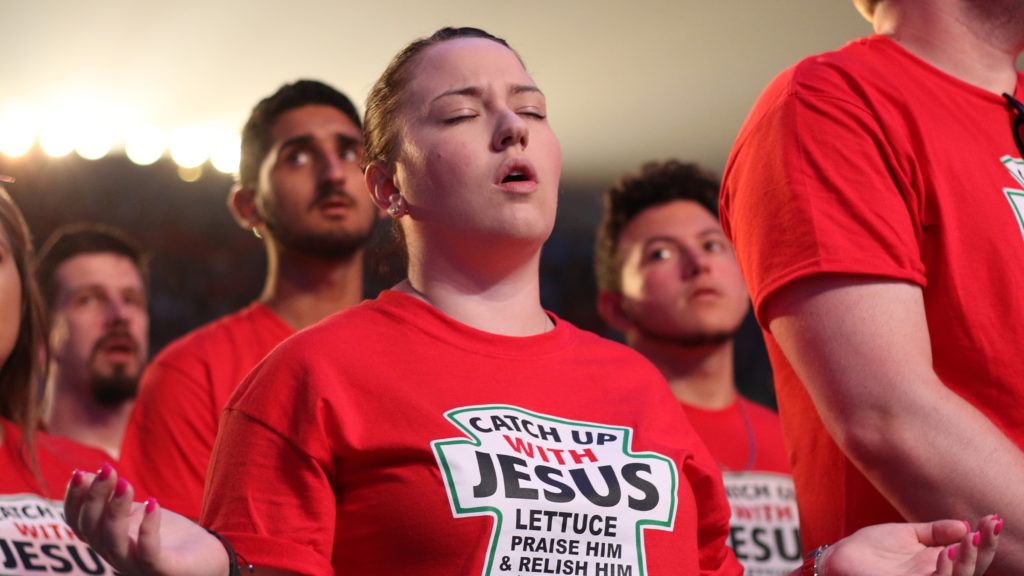
For example, there was the weekslong continuous prayer service at Asbury University in Kentucky in 2023, which drew thousands of college students from around the U.S. — and the world — to participate.
In 2025, The Free Press hosted a live debate, “Does the West Need a Religious Revival?” as its first event of the year. The Washington Post and The Wall Street Journal both examined the intensifying religious commitments of college students, particularly Gen Z Catholics.
Celebrity and influencer conversions to Christianity, including actors Shia LaBeouf, Russell Brand, and podcaster Tammy Petersen, the wife of psychologist and author Jordan Petersen, have made headlines.
The Orthodox Church became a destination for young men looking for spiritual discipline, so much so that an Antiochian Orthodox priest commented, “In the whole history of the Orthodox Church in America, this has never been seen. This is new ground for everyone.”
Charlie Kirk’s memorial service, which drew thousands of in-person attendees and millions of online viewers, felt less political than religious in nature with keynote speakers like Secretary of State Marco Rubio delivering biblical exegesis with passionate conviction.
There was also the election of an American pope, which caused some to wonder if a resulting “Leo Effect” might boost Catholic practice in the U.S.
But do these things mean we are actually approaching a religious revival in the U.S.? Catholic sociologist Christian Smith has a demoralizing but direct answer: No.
A few weeks ago, Smith made headlines for announcing his resignation from Notre Dame University — where he’d taught for nearly two decades — over concerns that the university has all but abandoned its Catholic identity.
But in a book titled “Why Religion Went Obsolete: The Demise of Traditional Faith in America” (Oxford University Press, $38.50), released last year, Smith offered a sweeping postmortem on the reasons younger generations left religious practice and why only a marginal number are returning, even if their stories are moving.
“Some may hope that a post-Gen Z generation will in time revive traditional religion. But, at present, nothing on the sociological horizon indicates this is likely. Quite the opposite. Nothing in the 2010s or early 2020s fundamentally reversed any of the big forces of change let loose in the 1990s and 2000s. At some point the decline of religion will have to plateau, if for no other reason than that fewer religious people will be left to leave. But leveling off is not revival.”
Smith believes religious leaders need to stop focusing on “the inadequacies of their programs and communications” as well as “their struggles to retool for greater appeal and relevance.” They first need to understand the larger sociological “tectonic plates shifts” that affected post-Boomer generations in the early 1990s and 2000s.
They should also identify where younger Americans are searching for meaning instead. According to Smith, secularization has not won out in the end. Neither campaigns from public atheists trying to persuade people to choose between science and religion, nor the materialism and consumerism that saturates daily life have satisfied young people’s longings.
But neither has traditional religious practice.
Young adults are still seeking spiritual realities but winding up in dangerous places, including occulture and psychedelic overuse — what many characterize as “re-enchantment.” The imperative to reach them has never been more pressing.
Meanwhile, for American Catholics under 45, the Church no longer serves as a moral authority or source of community. And the intra-ecclesial wars dominating so much of Catholic media, from liturgy to papal politics, never even hit their radar.
The success of digital efforts like The Bible in a Year podcast and the Hallow app have been noteworthy, but there is no available data showing they are moving a statistically relevant number of people from digital to sacramental engagement.
Catholic thinkers have spent years speculating about what drove millennials away from religious practice.
Many have laid the blame on the sexual abuse crisis and cover-up; others on the sweeping cultural acceptance of gay marriage and “LGBT culture;” still others the watering down of objective truth claims.
Smith’s surveys reveal that for a modest number of millennials, these factors made practice personally impossible.
But the top reasons people cited for leaving their childhood religion were: “Religion is not about institutions but a personal matter;” “just drifted away/apathy”; and “life obligations got in the way.”
Widespread cultural changes — all of which are harder to address with apologetics or parish/chancery policy — tipped the scale.
One of those cited by Smith as a leading factor is college education. Millennials became the most educated generation in American history, with nearly 40% of Americans having an undergraduate degree in 2020. While education does not conflict with religious practice per se, for this cohort, studies show it “undermined [their] personal religiosity.”
Postmodern ideas, including critiques of authoritative sources, rejections of metanarratives, and the belief that all knowledge is relative have come to dominate syllabi.
These perspectives, along with the emergence of what philosophers call “expressive individualism,” led to a generational conviction that one’s identity and purpose come from discovering expressing an inner self and protecting it from all external forces.
Millennials also began to distrust institutions of all kinds. The widespread breakdown of marriage, through divorce and a third sexual revolution, led them to forego or delay marital commitment altogether. And the longer one delays marriage and childbearing, the less likely one is to practice religious faith as an adult.
Distrust of the government became a signature marker for those coming of age in the wake of the 9/11 attacks, as the justification for War on Terror and the tactics used to fight it exposed manifold, coordinated lies.
The 2008 financial crisis hit millennials just as they were graduating college, leaving them unemployed and in massive debt. Then economic fallout from the COVID pandemic stole their hope for equal or better financial prospects than their Boomer parents.
The Church, rife with scandal in the early 2000s, was no exception. Catholics saw hypocrisy on full display and decided that one did not need religion to be a moral person.
Smith notes that the digital revolution was not designed to disrupt religious practice. But it did give a generation raised by the internet a sense of community without commitment, constant consumer messaging, decreased attention spans, and the expectation to be productive outside of traditional work hours.
The Church cannot reverse these trends. Smith equates them to particulate matter in the atmosphere — millennials, Gen Z, and Gen Alpha have been raised or will be raised with these as givens. From a purely sociological perspective, what’s done is done.
But he does end with a poetic, if less practical note: “To borrow from a biblical parable, perhaps a season has come for traditional religion’s remaining seeds to fall into the ground and appear to die so that some much more fruitful life might be born.”
The last few years have provided hopeful signs that American Christianity still has a heartbeat. A remnant remains, still attracted by traditional practices and houses of worship. Commissioning them seems to be the first and only step to take in the current religious terrain. They can ask the same question of their co-workers, neighbors, and family members that Jesus did to those who are hungry and searching: “What are you looking for?”