In 1989, the National Infertility and Family Building Association (known as RESOLVE) launched an initiative with the stated goal to “empower you and change the conversation around infertility.” This year the week runs April 19-25.
The annual campaign, now known as National Infertility Awareness Week, is aimed at educating the public, reducing the stigma of infertility, and removing barriers those with infertility face in their journey toward parenthood.
Sounds positive, right? The only glitch is that “removing barriers” is code for “access to IVF (in vitro fertilization).” This should give Catholics pause, as the Church does not see it as a morally licit means of becoming a parent.
Today, many people, including doctors and government officials, propose IVF as the best solution to infertility and the falling birthrate. In reality, only 22% of cycles started result in live births on average. While it now accounts for 10% of all annual births, IVF has done nothing to touch the plummeting rate in the U.S.
Neither the media, medical establishment, nor the academy want to look at the underlying factors causing infertility. Thankfully, that is the focus of NaPro Technology and Restorative Reproductive Medicine (RRM), something increasingly gaining traction in Catholic circles. When they do reference this kind of medicine, groups like RESOLVE characterize it as restrictive and misleading.
So, where is a faithful Catholic carrying the cross of infertility to turn?
For those of us experiencing infertility but also looking to follow the Church’s moral teaching, there are some resources that offer accompaniment and guidance.
The website of the United States Conference of Catholic Bishops (USCCB) is a great place to start. I also recommend Springs in the Desert, a beautiful ministry supporting those with infertility through blog posts, a podcast, online and in-person small groups, and retreats. This year, in partnership with Ascension Press, they’ve launched a series of reflections and a novena on their app, coinciding with NIAW.
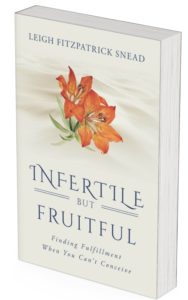
However, in recent years, I felt called to lend my voice and share my experience, all of which came together in my book, “Infertile but Fruitful: Finding Fulfillment When You Can't Conceive” (Sophia Institute Press, $18.95).
I toyed with the idea of trying to appeal to a secular audience and sneaking in bits of Catholic wisdom here and there about marriage, sex, and procreation. But upon reflection, I decided to write the book about my own experience as a Catholic with infertility navigating a secular medical landscape and finally getting the care she deserved. (Note: it was the “care,” not the “baby,” I deserved.)
But a big part of writing this book was my desire to address Catholics who find themselves faced with the prospect of IVF. After all, every standard OBGYN practice offers it as a solution — and at an especially vulnerable time for a woman or a couple.
I felt that it’s important that they know that they are seen, and that those who encounter them have a better understanding of what they face.
It’s important to understand why so many in the pews are using IVF. Some are quick to point to poor religious formation. Others accuse them of being “culturally Catholic.” But these judgments are neither charitable nor necessarily true.
Instead, it is necessary to understand the temptation of IVF.
First, the temptation is strongest in private. Infertility and its accompanying pain are often experienced in secrecy and shame. Many well-intentioned people attempt to armchair diagnose causes of infertility, then make judgments about why someone is or isn’t conceiving or miscarrying. As a result, an infertile couple has few people with whom they can freely dialogue about their pain.
You wish this wasn’t happening to you. Then, the temptation: go through with it, and it will be over quickly. No one will ever have to know, you tell yourself, and even you will forget. What’s one more thing done in a doctor’s office, especially when it might cure you of this wretched condition once and for all?
Second, temptation is nurtured by desperation and exhaustion. Women and men carrying the cross of infertility feel like they are literally starving for a child. They’re exhausted. Their prayers often amount to little more than “Why me?” But then Big Fertility tempts them to ask, “Why not me?” They dangle in front of you the thing that you most desire, something that God says is good.
Third, temptation takes over if we are ignorant of what the Catholic Church teaches to help, rather than limit, human beings. We may know the formal rules, the nos. But unless we understand the beautiful yeses, and are moved by the beauty in the Church’s teachings about what it means to be a parent and who a child is, we are not fully armed for the battle.
The Church teaches that life is a gift from God that is ideally transmitted through the loving conjugal embrace of husband and wife. The child emerges as the fruit of that love, a new human being equal to us in dignity. She is begotten, not made, someone we welcome and love unconditionally.
IVF by contrast, involves the imposition of rational mastery and technology — a process of reproduction, not procreation. This is clearest with all of the adjunct technologies that accompany IVF, such as sex-selection screening and polygenic risk scores for intelligence, height, eye color, and the like. The child of IVF is increasingly a made-to-order consumer product.
And, of course, as practiced, IVF often involves the intentional destruction of human life at the embryonic stage of development. People of goodwill — not just Catholics — can recognize this as a grave injustice against the weakest and most vulnerable.
So, how do we help our brothers and sisters fighting this temptation?

First, by making it clear that we love them and will accompany them in their suffering. They don’t have to suffer in private or in shame. Second, we can address their suffering and fatigue. We can simply talk to them and empathize with them. We can model the unconditional and self-emptying love of Jesus.
We can look to and share examples of fruitfulness without fertility — the Church has produced many saints who set the world on fire in a myriad of ways.
For those of us who formed our families through adoption, we can share our stories. That might not be a path for everyone, but it will be for some.
And finally, we can share the beauty of our Church’s teaching with them, not by preaching, but as a friend shares something beautiful with another. This is how we can change hearts and minds about what it means to welcome children and what a truly fruitful life can look like.
Wouldn’t that be an authentic way to empower people and change the conversation around infertility?