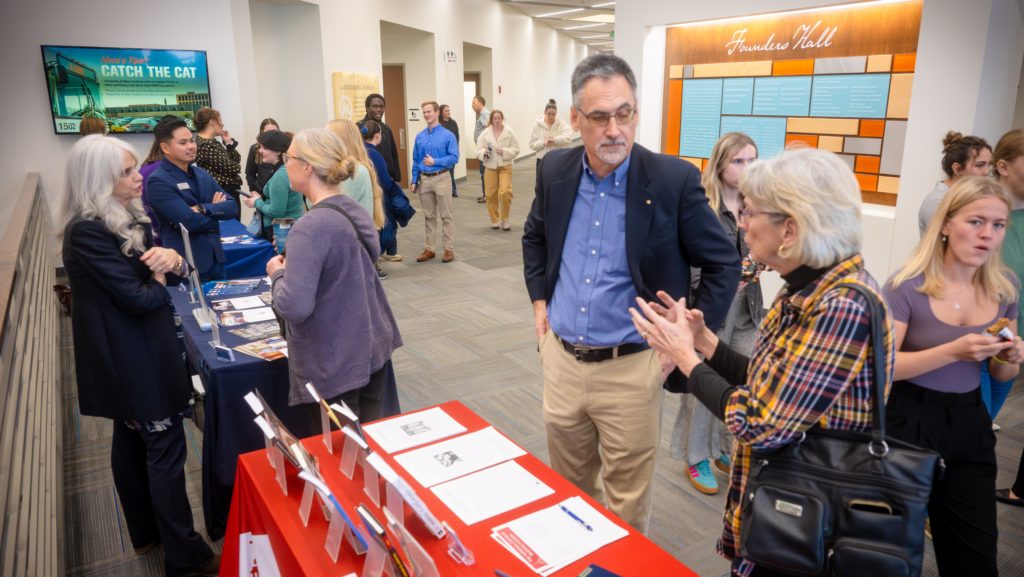
More than 550 people attended a medical professionals conference at the University of Mary in Bismarck, North Dakota, that focused on human dignity and explored the theme, "Mission-Driven Healthcare in a Profit-Driven World."
"We are all called to remember that health care is not simply a business; it is a vocation," Mary Dockter, dean of the university's St. Gianna School of Health Sciences, said Dec. 5 as she opened the first full day of the Dec. 4-6 conference. "It is a mission that is grounded in the dignity of every human person."
Hosted by the Benedictine university's St. Gianna School of Health Sciences, the fourth annual St. Gianna Medical Professionals Conference sought to respond to health care needs by preparing attendees "to uphold the dignity of the human person through compassionate, courageous, ethical, and joyful care."
On Dec. 5, speakers explored the meaning of health care, the integration of Catholic social teaching, the modern challenges of artificial intelligence and genetic technologies, the necessity of self-care and more.
At the same time, they spoke about the beauty of serving Christ by serving others.
"We understand that any patient who walks into our waiting room -- or every time I open an exam room door to walk in to see somebody -- that I am to see that person made in the image and likeness of God," Dominican Sister Mary Diana Dreger, a keynote speaker, told the story of how she once defined Catholic health care during a meeting. "My encounter with that person is actually an encounter with Christ."
Sister Mary Diana , a physician who serves the sisters in her community, the Dominican Sisters of St. Cecilia Congregation in Nashville, Tennessee, with St. Martin Medical Care, spoke about "Health Care for the Poor: Upholding Human Dignity." She recognized the inherent dignity of every human person, whether they are the patient or the medical professional caring for the patient.
Several speakers highlighted the dignity not only of patients but also of those who care for them. James Link, a licensed psychologist and associate professor of psychology and Catholic Studies Endowed Chair at the University of Mary, and Dr. Louise Murphy, president of the Catholic Medical Association's Bismarck Guild and medical director and board member of the Women's Care Center in Bismarck, discussed "Healing the Healers: Faith-Inspired Self-Care to Prevent Burnout in Medical Professionals."
In his opening address, Msgr. James P. Shea, president of the University of Mary, also spoke about protecting the rights of health care workers.
"Health care workers have rights too, rights of conscience, rights to be able to serve the dignity of the human person in freedom according to your own dignity," he said.
A total of 645 U.S. Catholic hospitals assist with nearly 90 million patients every year, and 1 in 6 patients nationwide receives care in a Catholic hospital, according to numbers from 2014 listed by the U.S. Conference of Catholic Bishops. The Catholic health care network extends further with more than 400 health care centers and other places of care.
The expertise of good health care professionals is needed with AI on the rise, according to Dr. Dominique J. Monlezun, the world's first triple doctorate-trained physician-data scientist and AI ethicist. He spoke about the need for medical professionals to contribute their wisdom to the discussion around responsible AI.
"Most AI experts worry that AI will not be ethical over the next decade," Monlezun said. "It's only going to be for profit, not for the capabilities for most of us. And even most health care systems in the United States, the most mature health care AI ecosystem on the planet, about 90% of health care systems lack any mature AI governance system."
Monlezun is a board-certified hospitalist physician and assistant professor for Mayo Clinic and professor of bioethics and AI ethics for three United Nations-affiliated universities, serves as executive director for the Center for Responsible AI and Global Health and is the principal investigator and senior data scientist-biostatistician for over 100 research studies.
His keynote addressed, "Responsible AI's Health Transformation: Human-Centered Economics and the Common Good."
"Ultimately, what's the human-centered global platform for responsible health AI?" he asked. "I propose to you it's the person, the platform that could also bring the divine and the secular together."
As a board-certified and licensed genetic counselor with MyCatholicDoctor, Caroline Aragón, stressed that a person is more than their genetic results during her keynote, "In the Creator's Image: Upholding Human Dignity through Genetic Technologies."
"There are ways that we can use genetic testing information to really uphold the dignity of each person and steward that information in a way that improves lives," she said during her keynote that focused on prenatal genetic testing and diagnoses.
Dr. Ashley K. Fernandes, clinical professor of pediatrics at Nationwide Children's Hospital in Columbus, Ohio, and associate director of the Center for Bioethics at the Ohio State University College of Medicine in Columbus, spoke about the tension between medicine and business during his keynote, "Hard Days but Never Bad Days: Finding Moral Meaning in the Business of Health Care."
Fernandes, who is also an instructor of bioethics at the University of Mary, drew from his own experience. He said he has less than eight minutes to spend with each patient, many of whom are children from the poorest neighborhoods in his city and many of whom are people who speak a different language. At the same time, he said, no system in the world can stop a practitioner from loving and caring for patients in the moments they have together.
"How I combat moral distress or burnout is by thinking to myself that, at the end of the day, there's something absolutely good that I have done for one person," he said, adding later, "It's always a good day when you're called to do what God has called you to do."