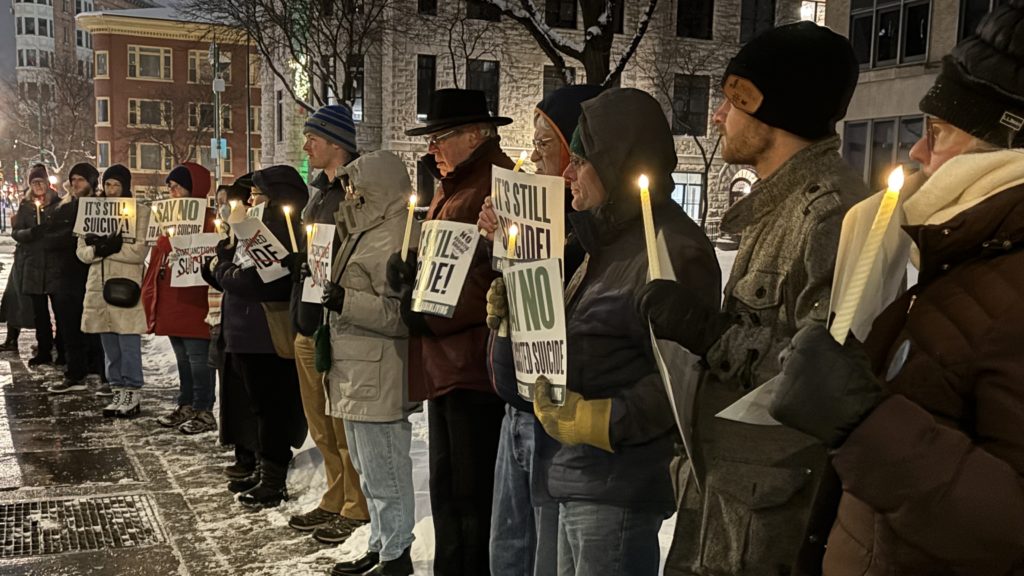
Looking at the numbers, the push to legalize assisted suicide in the United States appears to have serious momentum on its side. Since Oregon became the first state to allow adults to choose to end their own lives (in certain cases) in 1997, nine other states, including California and the District of Columbia, have followed.
Other states are proposing similar legislation. Religious and cultural opposition to the practice is in decline. Sooner or later, one might figure, assisted suicide will become common and legal.
But is this outcome inevitable? Matt Vallière doesn’t think so.
As executive director of the Patients Rights Action Fund (PRAF), considered the country’s leading organization opposed to assisted suicide, Valliere has spearheaded attempts to block assisted suicide laws in several states, including Colorado and California. Today, the organization announced a lawsuit against Delaware, challenging its constitutionality and warning it will allow assisted suicide for people with “non-terminal conditions” like spinal cord injuries and anorexia.
Vallière believes there’s a good reason to hope that assisted suicide could be declared unconstitutional by the U.S. Supreme Court.
“The courts are a great equalizer,” Vallière told Angelus. “And if justice is meted out, we have a real chance of overturning assisted suicide in places like California and across the country.”
Vallière sees signs that the momentum may be shifting. Grotesque news reports involving assisted suicide are emerging in places like Canada and Europe.
In the States, coalitions including Catholic bishops and secular political figures are doing more to spread awareness and build opposition. Recently, two anonymous donors committed to match donations to PRAF and its sister organization, The Institute for Patients’ Rights, up to $1 million to support its litigation efforts nationwide.
The cause is also personal for Vallière, who has relatives with disabilities and whose father and sister worked for people with developmental disabilities while he was growing up. Before joining PRAF, Vallière owned multiple construction companies. When a friend who started PRAF asked him for help, Vallière understood that his business experience could make a difference.
“People are being devalued to death,” said Vallière. “They’re almost always people with disabilities, or they are older adults, or both. These areas are near and dear to me.”
As PRAF announced its new lawsuit in Delaware, Vallière spoke with Angelus about what’s changing in the fight against assisted suicide and why he thinks the issue faces a genuine “tipping point” in the U.S.
Where do you see the movement to ban assisted suicide in the U.S. at right now?
We’re at a major tipping point. Things could go one way or the other. In the next five to 10 years, you’ll either see assisted suicide be legalized in a critical mass of states, or you’ll see our efforts in the courts to overturn these laws be successful. It’s not going to be this eternal struggle where some of the states are “Yes,” and some of the states are “No.”
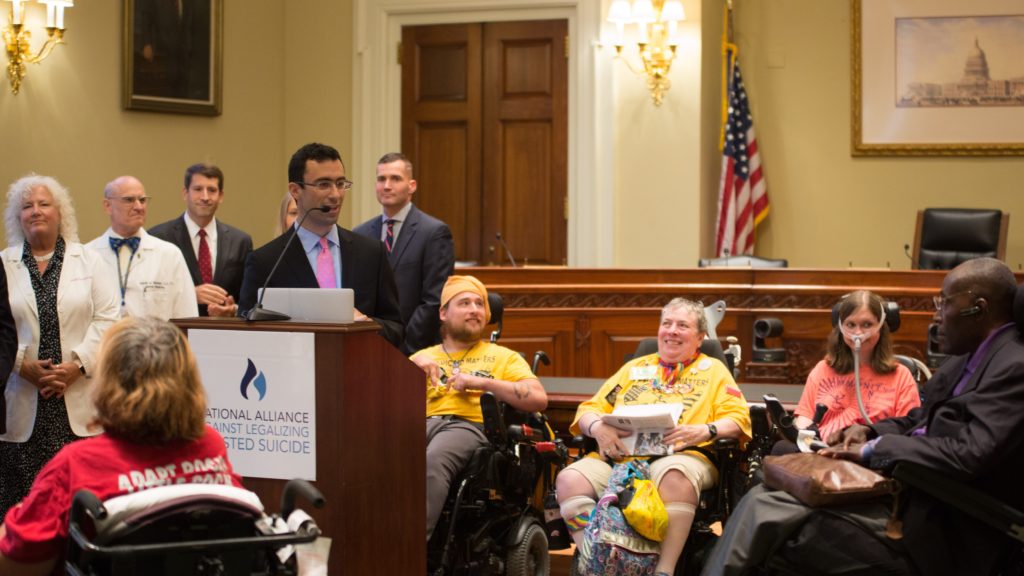
These lawsuits are about showing the public that the legalization of assisted suicide laws flies in the face of equal human dignity and in the face of the human rights that are established both in the Constitution and by federal antidiscrimination law, like the Americans with Disabilities Act.
Interestingly, the states legalizing assisted suicide lately have not done so by large margins. Delaware’s legislature recently legalized it by a single vote. When California legalized, it was also by a slim margin.
We’re in a situation where the singular vote of one assemblyperson can change the course of human history. Because once it’s legalized, people become used to the idea.
We’ve filed lawsuits in Delaware, Colorado, and California. What’s clear is that the courts are a great equalizer, and if justice is meted out, we have a real chance of overturning assisted suicide in places like California and across the country.
If those three lawsuits you mentioned succeed in overturning those assisted suicide laws, what are the next steps?
We aim to have a lawsuit in every circuit court in which there’s a legal jurisdiction, with the hope of getting this to the Supreme Court, which can make a final decision about whether or not assisted suicide really can stand or cannot stand in the face of federal anti-discrimination law and the Constitution.
Once the court makes a determination like that, it is — as far as I can tell — it’s impossible to pass an assisted suicide law that would get around it without being discriminatory in nature.
What are you seeing in terms of public opinion on assisted suicide?
If you look only at the first main question in polling, it shows that a small majority of Americans are in support of legalizing assisted suicide or euthanasia. But diving deeper into polling also shows that when people understand the implications of these laws or experience them, that support drops off.
I think the reason why support has gone down is in part due to our reframing of this issue away from this false idea that assisted suicide laws add to autonomy and prevent suffering at the end of life. It’s about showing them for what they really are, which is a discriminatory framework and a eugenic result that only people with disabilities get, while everyone else gets suicide prevention.
Look at Canada, just north of us. This is not a faraway place like Europe. In Canada, they’re killing people because they’re poor or because they have disabilities. Any physical disability qualifies you for lethal drugs. This is unconscionable, and we as Americans have to ask ourselves some hard questions.
We’ve seen news of assisted suicide being offered in cases of autism and anorexia. Are you seeing signs of social resistance or outrage that give you hope?
Yes, there are signs that at least give little glimmers of hope.
Gallup polling shows that support for assisted suicide and euthanasia are both down 3% from recent high water marks. You’re seeing major progressive newspapers like the Chicago Tribune coming out in opposition to the assisted suicide bill that was put before the Illinois legislature, and now encouraging Governor Pritzker to veto the bill, which was passed by a singular vote at 3 a.m. This is in a deep blue, progressive state!
Similarly, in New York, an assisted suicide bill passed by a very slim margin. Brand-name Democrat governors are wringing their hands, having serious and deep conflict over whether or not to sign such a thing. That to me is hope.
Why? Because if this was just a foregone conclusion, there wouldn’t be any handwringing, there wouldn't be any conflict. There wouldn’t be close votes.
There are also some areas of society where people are really asking themselves hard questions. There are stories like Jane Allen’s, a 28-year-old who found herself coming out of a morphine induced stupor in an inpatient hospice setting with lethal drugs at her disposal and a DNR (Do Not Resuscitate order) on file. If that’s not patient abandonment, I’m not sure what is.
People were shocked that this person was prescribed assisted suicide. They’re shocked that the doctor effectively said, “Your case is hopeless.” And they should be. Is that enough shock for these governors to veto these bills? We’ll see.
Also, this issue doesn’t cut down the traditional lines of party or worldview. The fact that we have a growing and diverse coalition opposing these laws is also a great hope to me that we have a real chance at total victory on assisted suicide.
Some people compare the assisted suicide issue with abortion. Three years ago, the Supreme Court’s Dobbs decision gave pro-life advocates what they’d worked towards for years. But for them, changing hearts and minds on abortion remains a big challenge.
Similarly, even if state-assisted suicide laws get overturned, aren’t you still dealing with a similar problem?
Although the issues are very different, legally speaking, we’ve actually been in a “Dobbs moment” for almost 30 years.
Back in the late 1990s, proponents of assisted suicide tried to make a case that would have established a right in the Constitution to assisted suicide, a move they hoped would produce a similar outcome to what Roe v. Wade did for abortion. They lost 9-0 in a case called Washington v. Glucksberg. That was a Dobbs-like loss for proponents of assisted suicide laws.
Our organization takes no position on issues like abortion. The two issues vary dramatically and people have different positions on them.
There are 10 states and the District of Columbia that have legalized assisted suicide. But it’s been a very slow uptake on assisted suicide because not all of the same factors are at play.
We’re not asking the Supreme Court to overturn a previous ruling. We are trying to prove that the assisted suicide laws in fact violate anti-discrimination laws and the Constitution, so that through a decision, it can declare assisted suicide laws null and void. If it were successful, it would effectively abolish assisted suicide in this country for our grandchildren’s lifetimes.
Now states could try to legalize a different form of assisted suicide that would somehow get around the ruling. But in the end, the only way around our hoped-for ruling is that you have assisted suicide for everybody; otherwise, it must be for nobody.
I don’t think that our society is ready to give lethal drugs to an 18-year-old with a messy breakup. We’re just not there. But there are a lot of other battles to fight on the human dignity front. There are a lot of policies in both medical practice and in public policy that devalue people to death.