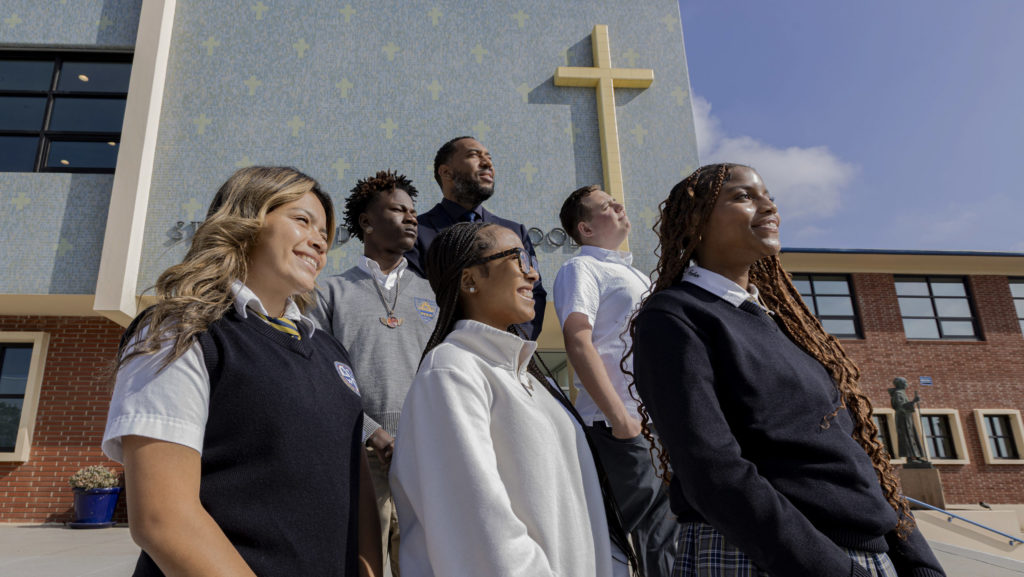
Pardon the dust these days that the ocean breeze kicks up around the St. Bernard College Preparatory in Playa del Rey.
There’s heavy machinery grading dirt around the campus, with progress viewable in all directions from the school’s second-story classrooms. There is also the whisking away of persistent dusty rumors that the school is once again on the brink of closure.
As an ambitious $20 million upgrade to the 14-acre campus moves forward, there’s also been a flurry of activity since May 2024 next door on the 31-acre development called Lulu’s Place, a new athletic and education complex that will be used as a training facility for the 2028 Olympics.
“It feels as if we’re building the plane as it’s flying,” said St. Bernard Principal Austin Jackson with a laugh, surveying activity from the school’s main lobby.
It’s an extreme makeover that no one would have predicted just a few years ago.
“If the stars don’t align, none of this happens,” said LA Catholic Schools Superintendent Paul Escala during a recent visit to St. Bernard, located on prime real estate on the edge of Los Angeles International Airport’s (LAX) northern runway.
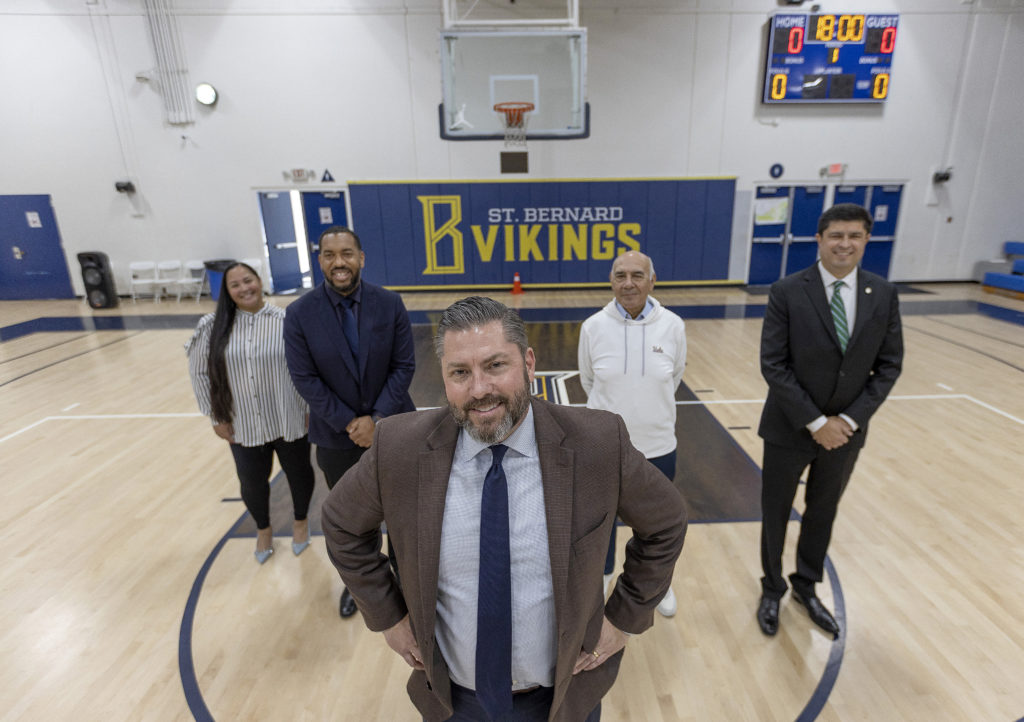
When Escala arrived on the job in 2019, St. Bernard’s was on the brink of closure, and finding a way to keep it open quickly became a priority.
St. Bernard High School, as it was called when it officially opened in 1958, had a peak enrollment of about 1,250 during its glory days from the late 1960s through the early 1980s. In 2019, it was 182.
Escala set about forming a plan. Plans for a hybrid community project — the development of Lulu’s Place and the remodeling of St. Bernard’s — began to take shape, with a green light coming in the spring of 2021. That was when he hired Casey Yeazel, whom he’d worked with at St. John Bosco High School in Bellflower and at a charter school system in the California Central Valley, to lead the school as president.
When the school officially rebranded as a college preparatory campus in 2024, there were 143 students. Today, there are 200.
“The St. Bernard history has been complicated,” Yeazel said. “There was a lot of good intentions, but never a catalytic moment. Now we see how this can be an ecosystem for youth of Los Angeles on the Westside.”
Lulu’s Place, described as the largest-ever philanthropic investment in youth sports in Los Angeles, is funded by a foundation named after Carol “Lulu” Kimmelman, a former USC women’s tennis player and longtime Los Angeles Unified School District teacher. The key tenants incorporated with St. Bernard are a STEM lab courtesy of Tiger Woods’ TGR Foundation, a national training center supported by the U.S. Tennis Association, and health facilities sponsored by Cedars‑Sinai/Providence health systems.
The property is leased from both the Los Angeles World Airports and from Archdiocese of Los Angeles-owned land, allowing the Lulu’s Place project to help finance a new all-weather athletic field for the school.
Combined, the two projects represent an $175 million investment in the future.
Escala credits Archbishop José H. Gomez for supporting St. Bernard’s cause from the beginning, even before the plan for Lulu’s Place emerged.
“He has always sought solutions for a turnaround.”
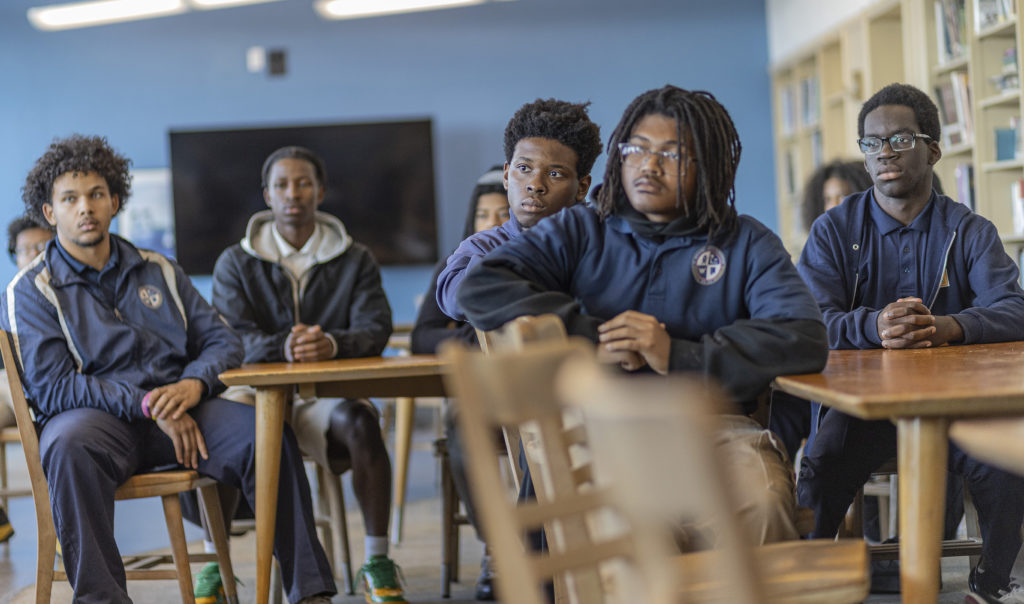
Some 80% of St. Bernard’s student body identifies as African American, a majority from the nearby cities of Inglewood and Hawthorne. The high school has had success attracting students from Catholic schools in nearby Westchester — St. Anastasia, St. Jerome, and Visitation — but a need for expansion into South Bay and Westside neighborhoods is key to its future.
Today, the school boasts several selling points.
Currently, the school has a 12-to-1 student-to-teacher ratio. Tuition has settled into the $13,500 range, well below the state national average of $22,000. Some 80% of the students receive tuition assistance thanks in large part to the Catholic Education Foundation of Los Angeles and the Doheny Foundation.
Philanthropic investment in the school has already been taking place through grants by the Catholic Education Foundation, Shea Family Charities, Dan Murphy Foundation, Seaver Funds, Rose Hills Foundation, and the Ahmanson Foundation.
Yeazel’s incremental plans expect to have it up to 500 students by 2030.
Kim Muno, St. Bernard’s new director of Impact and External Engagement, says she wishes the school had made a stronger case for her son and daughter to stay closer to home after graduating from American Martyrs School in Manhattan Beach in the 2010s. Instead, they excelled in academics and sports at Notre Dame High School in Sherman Oaks, where Muno worked in admissions for 15 years.
“St. Bernard wasn’t the school we knew it could be then,” Muno said.
When Yeazel asked Muno about joining the new St. Bernard administration, “it was an easy yes.
“The investment the archdiocese is making makes me believe it’s a place South Bay families can come back to, which is what it was for so many years.”
When upwards of 100 families come to St. Bernard for an open house these days, they learn that 98% of the Class of 2024 and 2025 combined were accepted to a four-year college. A recent valedictorian went to Johns Hopkins University to study medicine. The school has an admissions partnership with nearby Loyola Marymount University. A new program for male leadership development has been launched. They even have a new girls golf team.
Students who are paying attention are also learning about its history.
Michael Simpson, who finishes his senior year at St. Bernard this summer and has been accepted to LMU’s screenwriters program, has taken film and theater arts courses since his freshman year. It led to him launching a documentary project on the school’s history.
“I had no idea about how close we were to shutting down and what an impact it had on the community until I did this project,” Simpson said.
Johnny Bernoudy had only attended public schools in South LA before he was drawn to St. Bernard’s two years ago when the football program came back in 2024. Apart from being a running back and linebacker, he’s also excelled in the school’s drumline. Now, Bernoudy hopes to attend West LA College, whose units-building program is built into the St. Bernard curriculum.
“I feel they really care about my education and getting me into college,” Bernoudy said. “I feel it’s made an impact on bringing out my personality.”
Zerimar Ramirez, a senior who has played on the St. Bernard girls soccer and basketball teams, was one of Bernoudy’s football teammates — she was the team’s placekicker. Ramirez could have easily gone to LA’s Fremont High School across the street from her home, but said she gravitated to St. Bernard because her uncle, a 2017 alum, said he appreciated the attention he received there.
“With a smaller campus, there’s no real delineation between a freshman and senior, so there’s not all that tension,” Ramirez said.
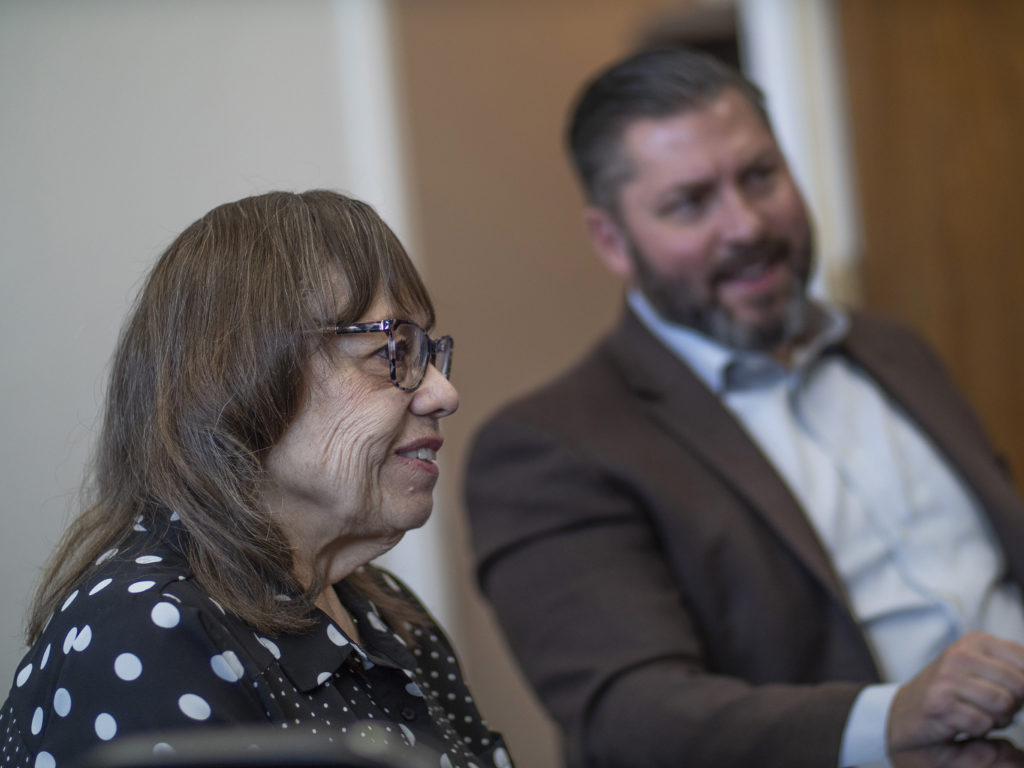
Rosalie Roberts was thinking about retirement when she was shown the new St. Bernard High/Lulu’s Place plans a few years ago.
Caught up in the latest version of St. Bernard administration musical chairs, Roberts was handed the title of “interim principal” in 2020. The job was only supposed to last three months, but because of COVID-19, it stretched to two years.
“My first response was, yeah, sure, I can give you renderings upon renderings upon renderings of what this place can look like. I’ve heard these stories all before, then I get excited, then I get let down,” said Roberts, a college counselor when she arrived at St. Bernard’s campus 31 years ago, the same year her son, Ernest, graduated.
“We’ve had good times and bad times, but I never lost faith in what this school was and what it could be,” said Roberts, back as an assistant principal. A product of LA’s Bishop Conaty High School and the sister of the late Father Allan Roberts, she said seeing the fruits of the academic transformation is a sign that patience pays off.
“That’s the internal part,” she said. “Now, to see all that’s going around here with the facilities — it’s true, it’s really happening. Kids who I taught when I started are bringing their kids here and they have faith in what is happening.”
Debra Duncan (Class of 1971) had worked with the Dan Murphy Foundation in the past to obtain funding for the school. Now, St. Bernard’s school board chair recalled how it “was so disheartening when we would seem to get something going and then it didn’t happen.”
“When people tell me they’ve heard this (revival) story before, I tell them this is not only different, but just drive by the campus and see what’s happening. It’s a big deal.”
Erin Thompkins, a St. Bernard Class of 2001 grad, has been the school’s head of admissions for the last two years — long enough to see her daughter, Kiyomi, graduate from there and accept a journalism scholarship to Pepperdine University.
Thompkins’ father graduated from the all-boys Mount Carmel High School. Her mother is a product of all-girls St. Michael High School — two archdiocesan schools that eventually closed. Thompkins said she is determined not to see her alma mater have the same fate.
“Casey has told us: You guys are the ones who will take this school back to what it once was,” Thompkins said. “We are forward-thinking and hopeful for the future after so many years of growing pains. This construction makes it real. We’re not closing and the proof is all around us.”

Escala and Yeazel hope St. Bernard will become a model for other archdiocesan schools when it comes to collaborating with the local community — and getting alumni involved.
Ryan Gales (Class of 1996), the CEO of JGM Architecture Design and Construction Management, is helping with the actual blueprints. Bernard McCrumby and Shannon Howell (both Class of 2000) have returned to lead the respective boys and girls basketball teams.
Mike Flores (Class of 1969) was compelled to drive from his Newport Beach home recently to have Yeazel show him around.
“Buildings don’t necessarily make a school — people make the school,” said Flores, the starting UCLA quarterback in 1971 who got into college coaching for 15 years and now has his own executive leadership training business. “Casey says he’s been moved by the Holy Spirit to be there for these students, and that has a powerful impact on me. You can tell everyone there, it’s for the kids.”
It’s more than just nostalgia that brings alums back, Flores agreed.
At one point in his tour, Flores watched Escala hold up his cellphone to record video of the progress made toward what was once 92nd Street but was now part of the new tennis facility.
Flores shook hands again with Escala and admitted, “I’m impressed.”
Escala replied: “Wait until we’re done.”