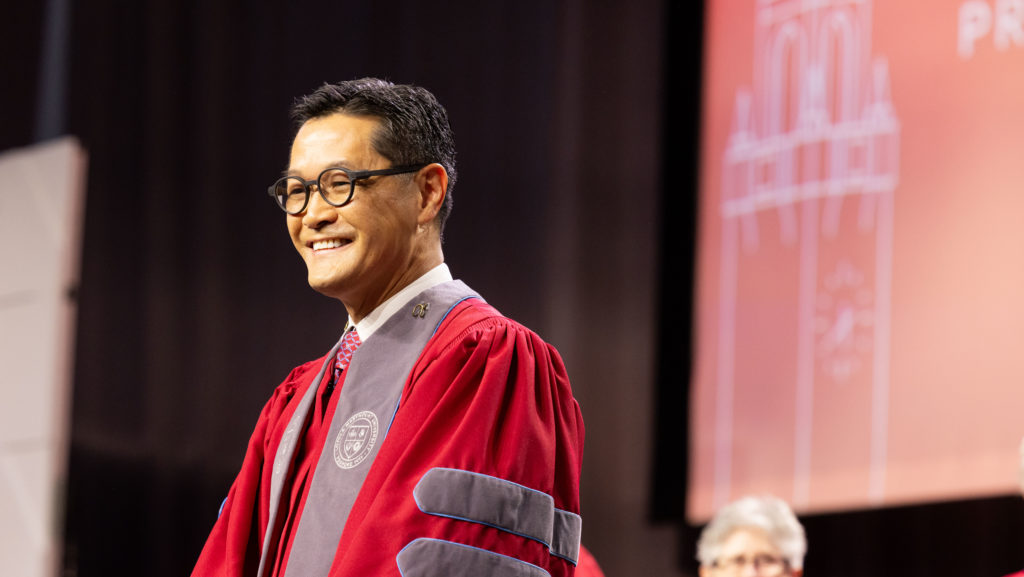
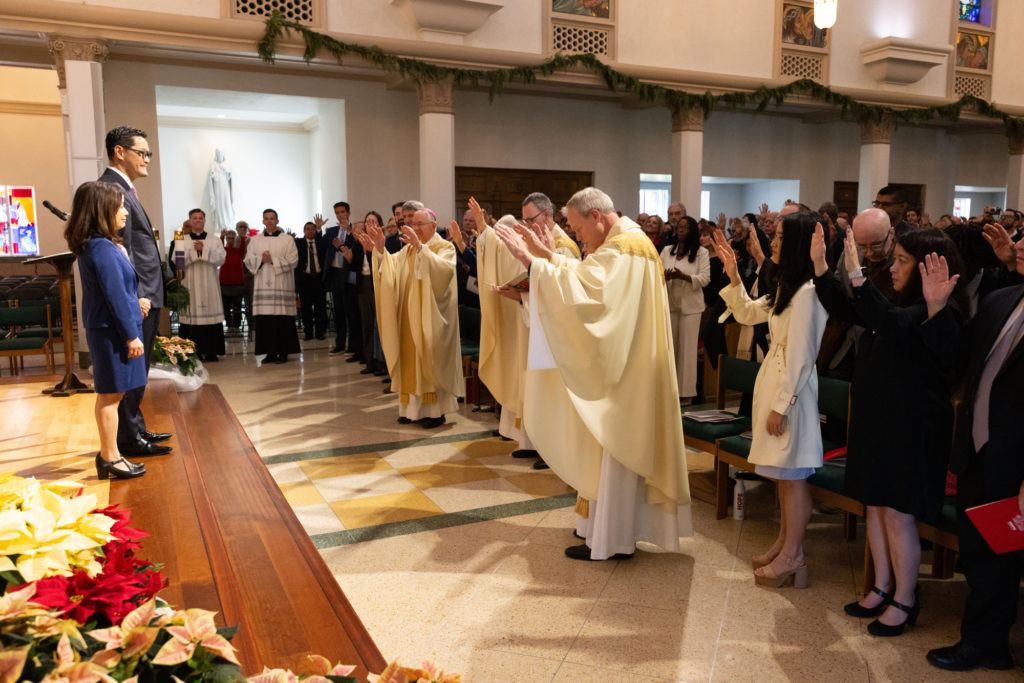
Archbishop José H. Gomez encouraged Loyola Marymount University to live out its Gospel mission as the “salt of the earth” and “light of the new world” at a special Mass officially welcoming new President Thomas Poon.
The Dec. 9 missioning Mass inside a packed Sacred Heart Chapel on LMU’s Westchester campus marked the start of a full day of events to mark Poon’s inauguration as the university’s 17th president. The Loyola Marymount Board of Trustees named Poon as president earlier this year in April, and he officially took over on June 1, replacing Timothy Law Snyder, who had served for a decade.
“Why salt and light? Because neither one exists for its own sake,” Archbishop Gomez said in his homily. “Jesus is telling us today that our lives are not our own. We are not here for our own sake. We are here for the sake of others.
“This is why a truly Catholic education is so important, and the mission of Catholic universities and colleges is so important.”
As part of LMU being a Catholic university, Archbishop Gomez stressed the strong interlacing of academics with accompanying students to a renewed relationship with Christ.
“We cannot love someone whom we do not know. So education and evangelization can never be separated,” Archbishop Gomez said. “Pope Leo says that education is about ‘drawing new maps of hope.’ I think it’s a beautiful image, drawing new maps of hope. It’s about helping our young people to navigate and find the pathway to the living God who comes to reveal himself to us in Jesus. It’s a beautiful mission.”
Poon had previously served as LMU’s executive vice president and provost. A tenured professor of chemistry, he has been hailed for expanding the university’s profile in research, promoting a more diverse faculty, and increasing students’ access to LMU.
About 1,200 attended the event, which included the Mass, a celebratory lunch, an inauguration ceremony, and a Spirit of the Season reception.
The theme of the day was “Hope, Made Here,” and the topic was invoked several times throughout the day, from a prayer blessing during the Mass, to a video shown during the inauguration ceremony, to Poon’s speech itself.
“Colleges and universities are navigating demographic shifts, technological transformation, political polarization, and questions about the value of a college degree,” Poon said during a ceremony inside Gersten Pavilion. “The world around us is changing at a breathtaking pace, and yet the need for institutions like ours has never been greater. Honoring our legacy begins with hope. Hope isn't passive. It is, as the Jesuits say, contemplatives in action. Hope rolls up its sleeves and asks, ‘What’s the work we need to do to make things happen?’ ”
Later in his speech, Poon outlined three “hopes” he believed would be accomplished at LMU.
The first was to make a Loyola Marymount education attainable “for every talented student called to our mission.” The second was to “build bridges” to nearby communities, including the Archdiocese of Los Angeles, LAX, and other important sectors such as aerospace, biotech, sports, and more. The third hope was to mold student leaders using “Ignatian excellence,” using LMU’s namesake, St. Ignatius of Loyola, as a model.
“LMU’s next chapter is not for any one leader to write alone,” Poon said. “I ask each of you to claim a share of that work, boldly, generously, and with the confidence that our moment demands, because this next chapter will be written by all of us. Each of you holds the pen. Each of you is part of the story, and together we will write the next chapter of Loyola Marymount University, one filled with purpose, possibility, and hope made here.”