Years before Los Angeles County became a sprawling metropolis, the village of Artesia was part of the general farm area later known as “Dairy Valley.” Immigrants, especially from Portugal, settled there and worked on dairy farms. For decades, Holy Family Church was their spiritual home.
Nowadays, the parish serves a much more diverse congregation that includes immigrants from the Philippines and Mexico. But when pastor Father John Cordero, MMHC, began thinking of a way to pay tribute to his parish’s rich history, his imagination traveled back to Portugal.
“In Portugal, there are plenty of churches where the entire facade is covered in tiles,” explained Father Luis Proença, SJ, a native of Portugal who has served at Holy Family for more than 30 years. “Inside and outside, everything is decorated — usually in blue and white.”
More than a year ago, Cordero approached Proença with an idea: what if we bring a tile panel from Portugal?
From there, what started as a tribute to the parish’s history grew into something bigger: a vision for renewing the church facade with traditional tilework.
Proença, who teaches at Loyola Marymount University’s School of Film and Television, reached out to colleague José García Moreno, who serves as director of the Academy of Catholic Thought and Imagination at LMU.
Moreno’s work includes the large-scale installation “Anima Mundi: The Soul of the World” at the university’s chapel. Familiar with his work, Proença shared images of the artist’s installations with Cordero, along with photos of the chapel.
“Father John was inspired by what he saw,” Proença recalled. From there, he introduced the two men and the project got underway.
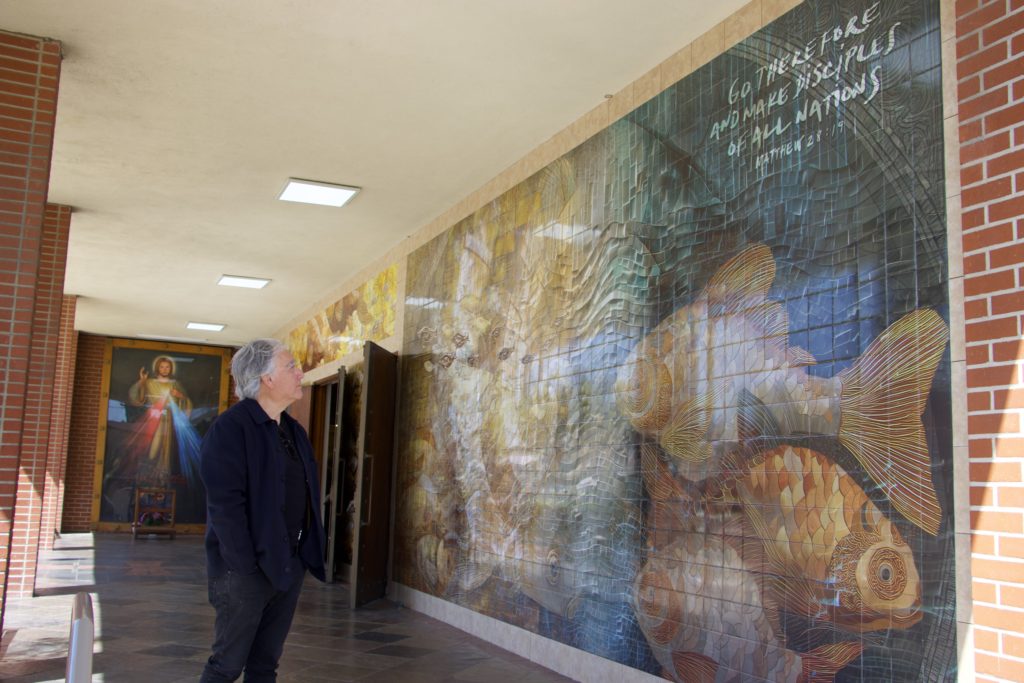
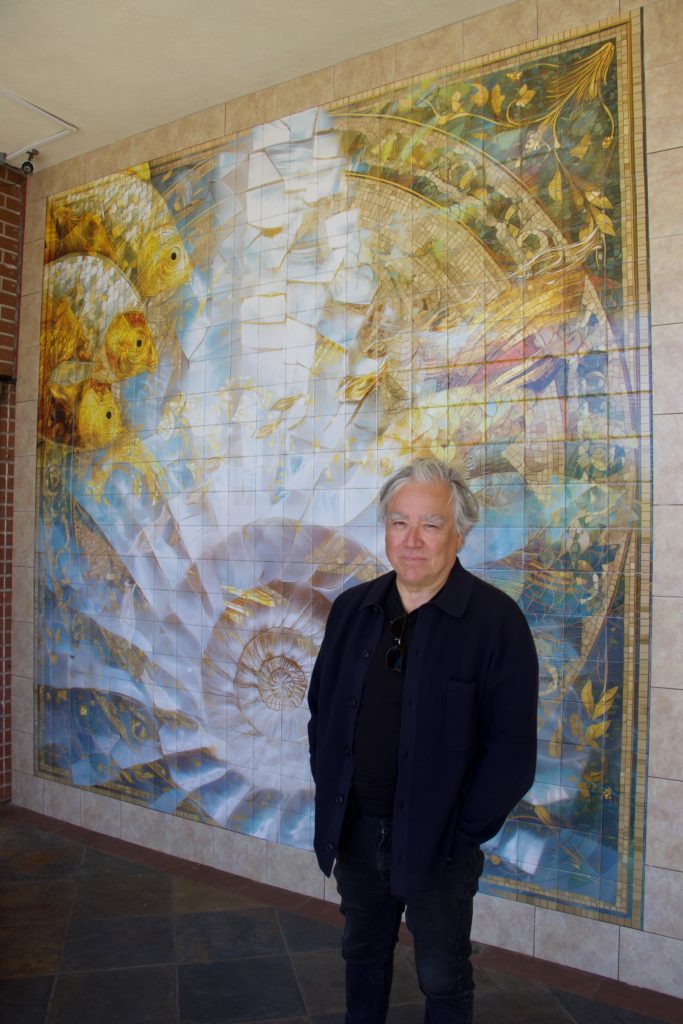
For Proença, the mural reflects the spiritual identity of the parish itself. He describes the spiral woven through the design as “a creation that doesn’t close on itself,” but instead as “all revolving, all creation, and all renewal.” It represents the diversity of their parish.
The intertwined fish moving through the spiral symbolize the interconnectedness of the community. “We all come from different backgrounds, different roots,” Proença said.
To him, the spiral expresses “the spiritual creation that the Holy Spirit brings us together as one community.” The medium’s lasting quality strengthens that concept. The facade panels were designed to endure. “Three hundred years from now, people can still look and see those panels,” Proença said.
In a Facebook post, Father John Cordero wrote that the mural’s theme follows the Gospel call to “make disciples of all nations” (Matthew 28:19). “This is particularly meaningful for our multicultural parish made up of immigrants from different peoples of the world,” he noted.
Blending the imagery of the apostles’ mission to be “fishers of men,” Cordero explained the mural, in which fish from around the world are brought together in the Eucharist, which appears on the far-left side of the wall. The mural was made of printed tiles designed to resemble traditional mosaics and extend across the entire vestibule wall.
Frank Faria, a Portuguese parishioner since the 1960s who was ordained a permanent deacon two years ago, sees the mural as a fitting way to tell the parish’s story.
“We have three deacons,” he said, jokingly referring to them as “the three P’s — the Filipino, the Panamanian, and the Portuguese.”
For Faria, Cordero’s intention was clear. “Father John’s wish was to make it a tribute to the Portuguese community,” honoring the families who helped establish Holy Family nearly a century ago and who “have always been a part of the church.”
The use of traditional Portuguese tiles reinforces that connection. Cordero specifically wanted tiles the same size as those used in Portugal, tying the church visually and culturally to its origins.
At the same time, Moreno’s work is rooted in searching for new ways of creating.
“I’m constantly trying new things, but they all come from the same roots of experimentation — who I am, and how technology helps me become a vessel for it,” said Moreno.
That sense of experimentation carried into the making of the mural itself. He compares the process to “building up a Lego,” working with massive digital files that had to be broken apart and reassembled piece by piece.
Even with those technical challenges, his intention remained simple: “How can I make beautiful things that can help people contemplate, in their own way, their own spirituality?” Moreno said.
For Faria, the style also feels familiar beyond the church itself, noting that “many of our Portuguese neighbors have little mosaic tile images on their actual houses.”
Since it was first unveiled just after Easter, Cordero has come across some visitors becoming visibly moved by the mural.
“When you hear that, you realize you’re impacting someone profoundly, but also that it [the art] doesn’t belong to you anymore,” said Moreno.