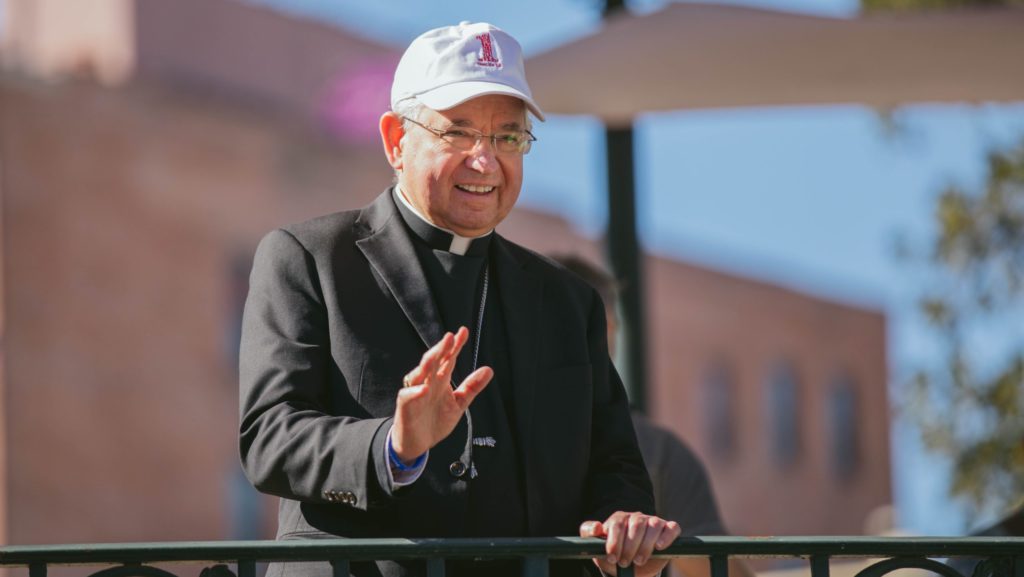
Anyone who’s spent time around Archbishop José H. Gomez will tell you that leading the nation’s biggest Catholic community is not a dream job.
It entails managing a calendar of endless appointments: parish anniversaries, school visits, confirmations, board meetings, working breakfasts, and check-ins with priests and staff.
Then there are all the people to greet, phone calls to make, homilies and talks to prepare, decisions to make, and words to choose for every interaction.
But since he began his tenure in 2011, there’s been a clear sense that Archbishop Gomez sees the job as being about something else.
After Archbishop Gomez ordained Robert Barron as a bishop in 2015, he asked his new boss what he expected from him as the Santa Barbara Pastoral Region’s new auxiliary bishop.
“I want you to be present to the people, to teach them doctrine, and to give them hope,” the archbishop replied, words that Barron wrote on a piece of paper that he left next to his computer for the next six years in Southern California.
According to Barron and other close collaborators, those words define how Archbishop Gomez sees his work here in Los Angeles. It’s not a job, it’s a mission.
And that may explain why after 15 years, he hasn’t slowed down.
“He doesn’t let the office consume him,” said Auxiliary Bishop Brian Nunes, who while still a priest lived and worked with Archbishop Gomez for eight of those years. “He’s very down to earth.”
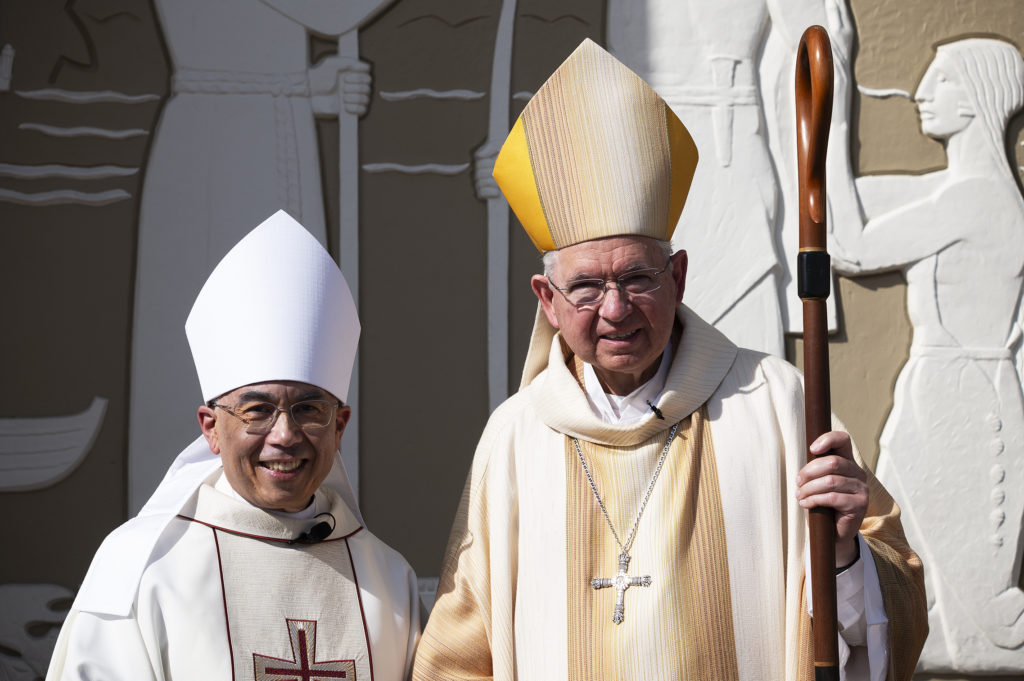
A few months after he succeeded Cardinal Roger Mahony as archbishop in March 2011, Archbishop Gomez articulated that sense of mission in a pastoral letter titled “Witness to the New World of Faith,” which spelled out his five pastoral priorities for the archdiocese: promoting education in the faith, vocations to the priesthood and religious life, a stronger sense of Catholic identity and cultural diversity, the sanctity of life, and the beauty of marriage and family.
Fifteen years later, Archbishop Gomez says he’s encouraged by the faith of ordinary people he meets around the archdiocese, in particular the young people answering the call to the priesthood and religious life, and those who turn out for events like NCYC, Youth Day at the Religious Education Congress, and Catholic school gatherings.
“For me, as a bishop, to see so many young people participating in the life of the Church is just amazing,” said the archbishop in an interview with Angelus.
One thing that surprised him at first about the archdiocese was its sheer size, especially the long drives to visit parishes in Santa Barbara County.
“Everywhere I go, there are people from all over the world here,” said Archbishop Gomez. “It’s the universal Church at its best.”
Since he first arrived in LA as coadjutor bishop in 2010, Archbishop Gomez said he felt very welcomed not only by Cardinal Mahony, the auxiliary bishops, priests, and deacons, but by the ordinary Catholics he met everywhere. All these years later, he said, he’s still learning from them.
“These 15 years have been an extraordinary blessing for me,” he said. “What else can I say?”
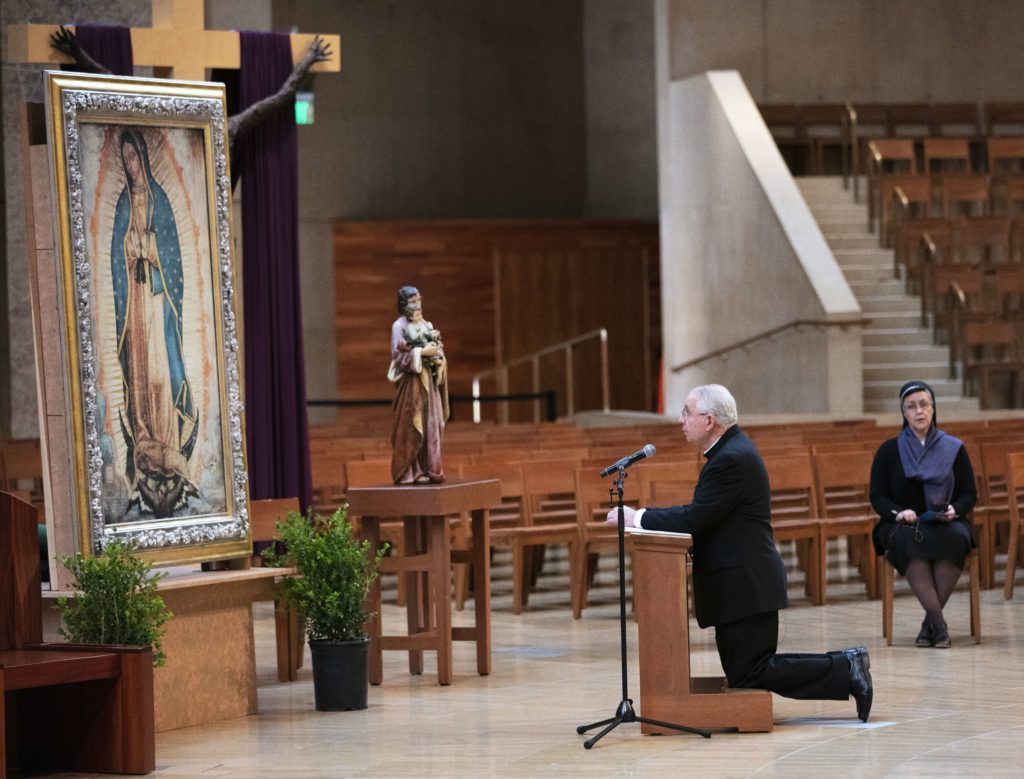
Ordained to the priesthood in 2008, Nunes recalled that he was still a “baby priest” when Archbishop Gomez arrived. During his first years in LA, they didn’t talk very often.
That’s why Nunes was surprised when one day he was called to interview to be the archbishop’s next priest secretary. During the meeting, Nunes had an excuse ready for why he wasn’t qualified for the job.
“Archbishop, I’m not tall enough to put the miter on your head,” Nunes told him with a laugh.
“That’s OK, don’t worry about that. I like to do that myself,” the archbishop replied.
As the interview went on, the archbishop asked Nunes only a few questions. He wanted to know about his family, his Spanish skills, and whether he could sing.
“He just really wanted to get to know me,” said Nunes. “That really said a lot to me about how he sees the importance of relationships.”
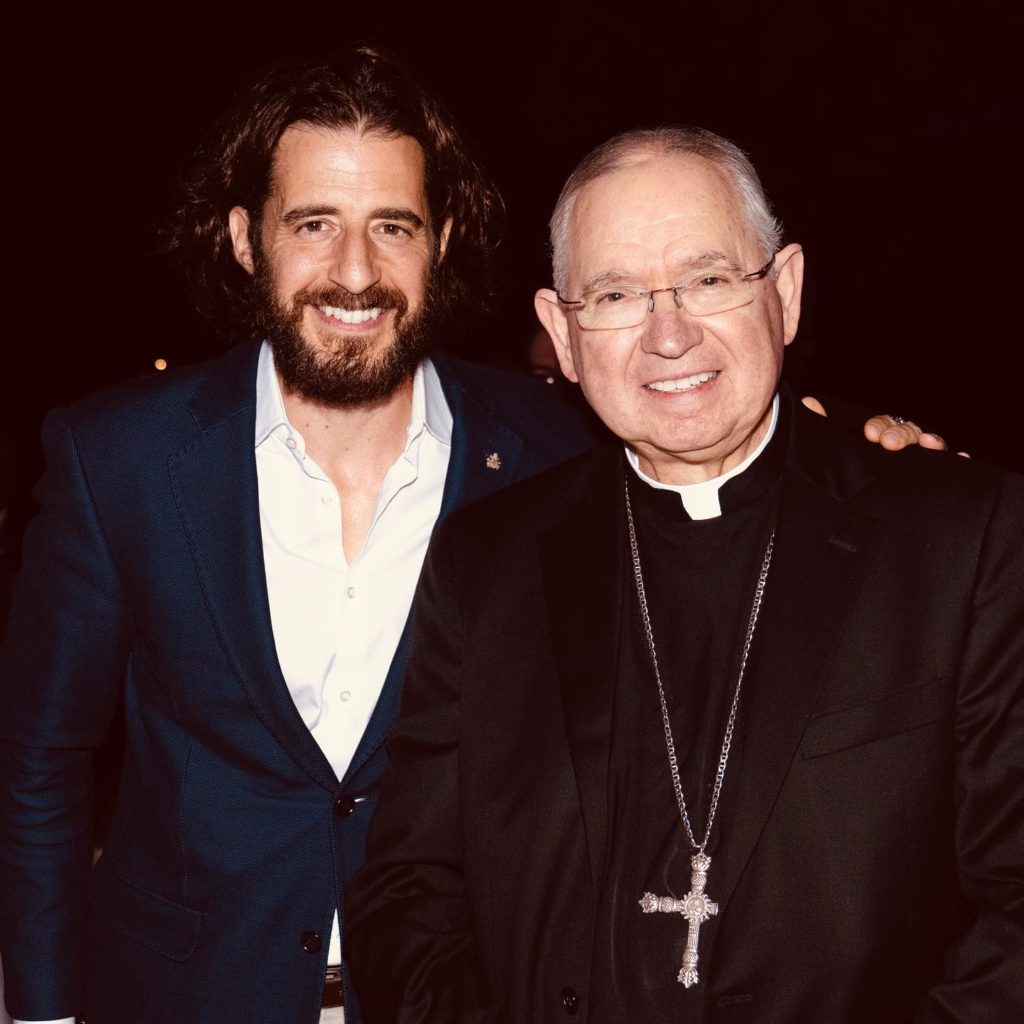
When Archbishop Gomez first came to LA from his previous posting in San Antonio, some of those relationships blossomed in surprising ways.
Leticia “Letty” Ibarra remembers how she and her husband, Arturo, were set to host a big welcome dinner with guests at their Pasadena home. But after getting held up doing business at the Cathedral of Our Lady of the Angels, Archbishop Gomez never made it.
The following weekend, the Ibarras went to a Mass and breakfast to finally meet him.
“I was in line with my husband, so I greeted him, and I spoke Spanish,” said Ibarra. “I don't know why.”
Walking away, Archbishop Gomez suddenly called out, “Wait, Letty!”
Remembering that he never made it to that welcoming dinner, he said, “I want to go to your house.”
“It was a big honor for me that he told me that without knowing me,” Ibarra said. “Since then we’ve had a very nice, beautiful friendship.”
The Ibarras would go on to help Archbishop Gomez create a Catholic Association of Latino Leaders (CALL) chapter in Los Angeles after founding it in 2007. Both husband and wife have served on the board. The Ibarras were surprised by how much effort he made to attend their meetings and even celebrate Mass for the members.
“He was very accessible to us. He gave us his time. He made time, as busy as he is, to attend the meetings, to celebrate the Mass for us, for the members. It was special.”
Born in Monterrey, Mexico, Archbishop Gomez has ministered to Latinos for decades. Ibarra believes that’s been a key advantage during his time in Los Angeles.
“He understands the Hispanic community, he understands [immigrants], he understands how we live, why we do things,” said Ibarra. “Because a lot of them are traditions … that gives a lot of safety for the Hispanic community.”
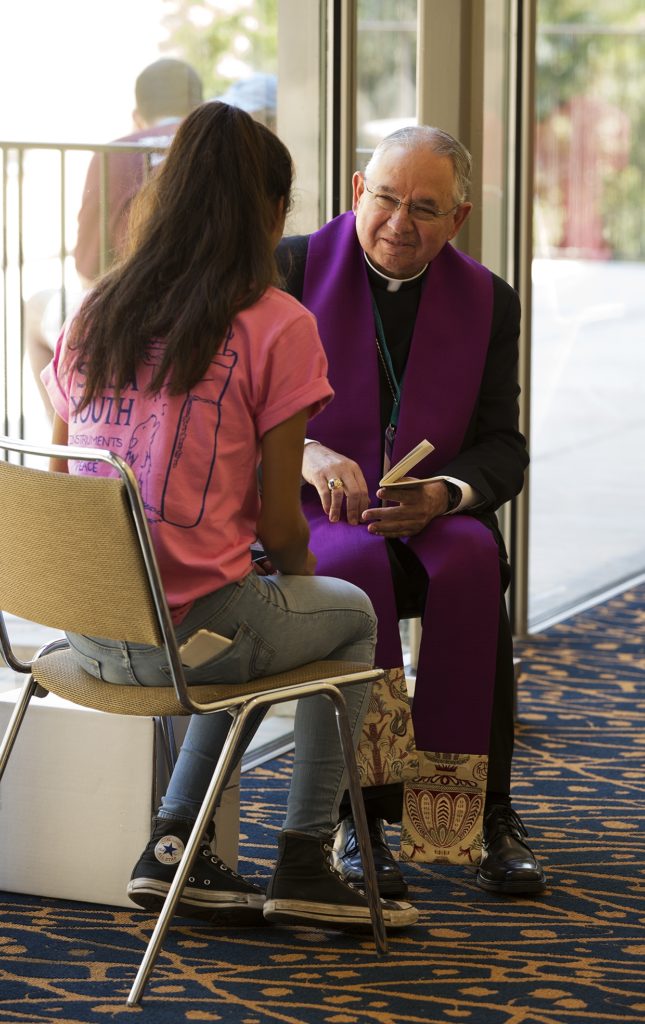
Another demographic championed by Archbishop Gomez since his days as an auxiliary bishop in Denver has been young people.
“He sees that we need more stuff done with the youth,” said Kenny Lund, who has served with the archbishop on several boards and committees, including the regional advisory council of NET Ministries, a youth missionary organization.
Six years ago, the archbishop encouraged Lund when he led an effort to purchase, renovate, and rebrand the site of Camp Mariastella in Wrightwood as Saint Edward Retreat Center.
“He really helped us get that off the ground and rebuild that place,” said Lund, a parishioner of Assumption of the Blessed Virgin Mary Church in Pasadena. “With his help, we’ve gone from eight retreats a year to 65.”
People like Lund will also tell you that while Archbishop Gomez sees his mission primarily as that of an apostle, that doesn’t mean he doesn’t take the other aspects of his job seriously.
“You can see that the archdiocese has done very well under his leadership, but he also knows how to delegate that leadership to others,” said Lund, also the executive vice president of Allen Lund Company, a transportation brokerage company founded by his father that today has 41 offices across the U.S. with 800 employees.
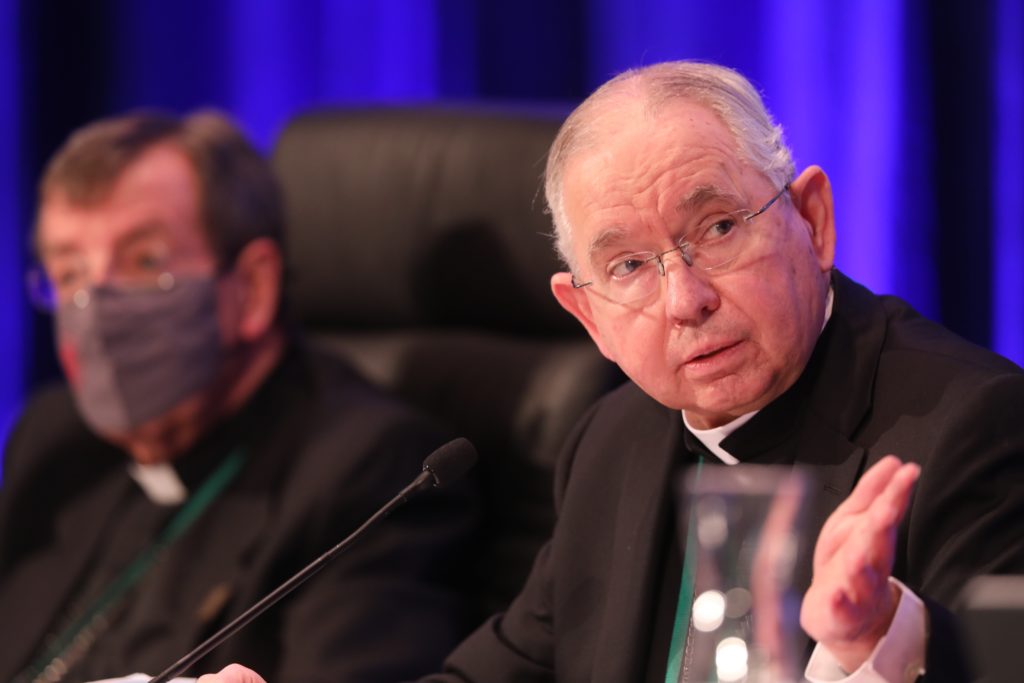
Lund’s background has given him an appreciation for how difficult it is to “run” a sprawling operation like the LA Archdiocese.
“You can only be successful in that large of an organization if you’re comfortable in delegating and empowering people to get that vision accomplished.”
Lund said he’s seen how Archbishop Gomez has had to “learn a lot” and even change as a leader during his years in LA. What’s less obvious, he said, is how one person can do so much “without getting too upset or without being overwhelmed.”
After their years together, Nunes sees a few clues.
“It’s his faith, his prayer, his devotion to the Blessed Mother,” said Nunes. “That’s not a revelation to anybody who’s been around him at all.”
That sense of personal discipline, Nunes believes, includes not only prayer and daily Mass, but also a good diet and regular exercise.
“He’s very careful. He knows he’s in it for the long haul.”
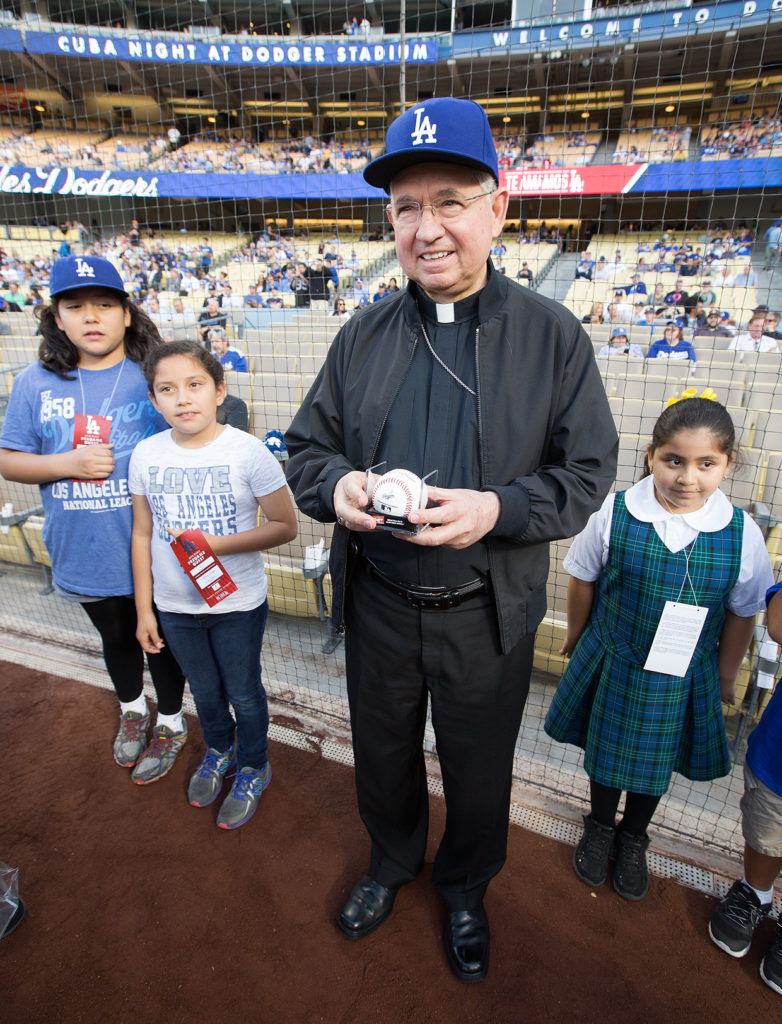
According to Nunes and Barron, a major test came when Archbishop Gomez was elected president of the U.S. Conference of Catholic Bishops in November 2019. As the metropolitan archbishop, he already had his fair share of administrative duties beyond Los Angeles. Then, a few months later, the COVID-19 pandemic struck. The responsibilities seemed too much for one man.
“[During that time], he was one of the most respected churchmen in the country — and yet his manner was always humble, unassuming, and kind,” said Barron, who now leads the Diocese of Winona-Rochester in Minnesota. “I never once saw him put on airs or demand special notice, just the contrary. He’s a man of tremendous simplicity, humility, and graciousness.”
Now stationed in the archdiocese’s San Gabriel Pastoral Region, Nunes considers himself lucky to know the lighter side of Archbishop Gomez that few get to see: an avid sports fan who will channel flip from one sports game to another during quiet evenings, and a diehard Green Bay Packers fan.
“[Packers games] are the only time I’ve ever heard him root for a non-LA team,” confessed Nunes.
Upon taking up the role of priest secretary, Nunes made another surprising discovery.
“Part of my job as secretary was to be his driver, and that would free him up to do emails, phone calls, whatever else he needs to do [during trips],” recalled Nunes.
But as often as possible, especially on long rides, the archbishop would inform Nunes: I want to drive.
“He’s not a big stickler for things needing to be a certain way. He was happy to drive, and it was nice to be able to relate to him on that level, as road trip buddies.”
As for his more public side, Mass-goers at the cathedral — where Archbishop Gomez lives and celebrates Mass regularly — said they appreciate how he makes visitors and regulars alike feel welcome.
“He has this aura, like a real father to the community,” said 83-year-old Hedy Rosario, speaking to Angelus after 10 a.m. Sunday Mass at the cathedral on March 1, the day he succeeded Cardinal Mahony back in 2011.
Other Mass-goers said they appreciated the archbishop’s accessibility to greet people after Mass at the cathedral. More than one said they were inspired by his advocacy for immigrants and his way of connecting with Spanish-speaking faithful. Pauline Bennett said she was impressed by how he’s handled the problem of priest sex abuse from his early days in LA.
“It was such a clear moral issue to him,” said Bennett. “I remember thinking that it was good to have the leadership of the Church saying clearly to the people of Los Angeles without making excuses for it, that this was a great wrong and a great harm.”
But after accompanying Archbishop Gomez to countless public events — especially liturgies like confirmation Masses and parish anniversaries — Nunes said he came to understand something about him that wasn’t obvious at first: “He takes very seriously his role as bishop.”
“For so many people that he meets, he understands that may be their one time ever meeting a bishop and for that person, he’s very aware that he represents the Church to them,” said Nunes.
“So he’s very sensitive and careful about what he says and how he acts because he wants people who, if they’re encountering the Church, or even somebody who represents God, that they have a good impression.”
Associate Editor Mike Cisneros and contributing writer Kimmy Chacón contributed to this story.